
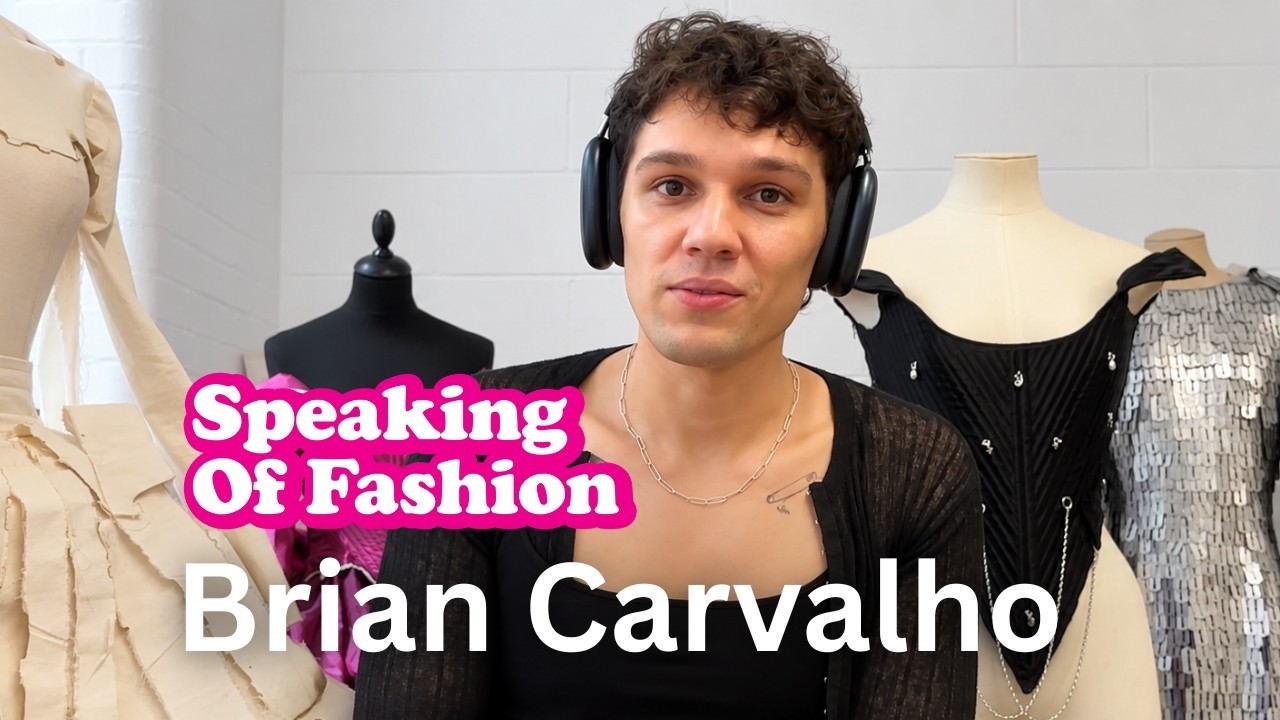
Brian Carvalho opens up about becoming a self-taught designer, meeting John Galliano, navigating London’s fashion industry as a working-class creative, and reclaiming the corset through queer identity, rebellion, and a commitment to making fashion that means something.
Brownfashiongal: So, first things first, the thing that caught my eye about your work was your meeting with John Galliano. As a Galliano fan myself, I was obsessed with your photo with him. You mentioned that he was a big influence and one of the reasons you decided to pursue fashion. I’d love to start from there and learn more about how you actually got into fashion. Were you always interested in it, or was it something you discovered later in life?
Brian Carvalho: No, of course. I studied fine art at Westminster and graduated in 2019. Obviously, I can’t remember if it was the same month or the following month, but lockdown happened here in London. So I had just graduated and then I couldn’t go to work, I couldn’t go out, I couldn’t do anything. During lockdown, I decided to teach myself how to sew. Fashion was always something that I was interested in, but I never really had the opportunity to pursue it or do it.
So I kind of took advantage of the fact that I now didn’t have the excuse of not having enough time or resources. I bought a cheap little sewing machine and started cutting up bedsheets, curtains, all that kind of stuff. In terms of Galliano, I actually met him at Vogue World when they did it here in London. That was forever ago now. At the time, I was very much conflicted because I had gone back to work. I went back to being a sales associate. I had been sewing during lockdown, then lockdown lifted and I stopped, and I kind of went back to normal life. I was at this weird point where I was like, “Do I do it? Do I not do it? I don’t know what to do with my life.” It was fun, but I didn’t really know what I was doing and I hadn’t really studied that.
And he was super supportive. He was very much like, “You should do this. You’re clearly really talented.” He kept commenting on the course that I was running at the time. And that, for me, was huge because John Galliano was like a god to me. So to have him notice me, let alone encourage me and speak to me, felt like I now didn’t have a choice. If I didn’t do it, it felt disrespectful to him. Someone that I really respected and almost idolised was telling me, “You have to do this. This is clearly your thing.” I think I quit my job the next day or two days later because it just didn’t feel like real life anymore. Going back to work and folding socks and T-shirts, I was like, “I spoke to John Galliano yesterday. He told me to pursue a career in fashion. What am I doing?”
Brownfashiongal: Yeah, I get that. As a Galliano fan myself, I think I would just make that my life’s destiny to make what he said happen in real life. One thing I’ve noticed, we’ve been interviewing a lot of independent and upcoming designers on this podcast, and one thing I’ve noticed is that a lot of them, in fact almost all of the people I’ve spoken to, don’t come from a fashion school or a traditional fashion background. It’s so interesting because you guys are the ones who are going to be leading the industry in the next decade or so. It’s interesting that so many designers coming up now, even when we have such a big array of fashion schools and such a developed fashion education system, haven’t studied fashion. Do you think fashion schools are becoming irrelevant, or do you think there’s just not as much dependency on them?
Brian Carvalho: I think that, obviously, coming from someone who didn’t study fashion, I went through a phase where I really respected people who studied fashion. I always felt like they had an edge above me just because they had that education. But the longer I work in this industry and the more I meet people and collaborate with people, I realise that a lot of fashion schools have a one-way system of teaching you. Sometimes that works for certain people because they like your aesthetic or they like the way you work and process things. But for a lot of people, they can’t really create and produce in that lane.
When you don’t study fashion, you’re coming at it from a blank-canvas perspective. Even for me, the way I started fashion was by making things out of wire and canvas. I was using materials that I was used to in fine art because I didn’t know how to use fabric. I didn’t know how to manipulate fabric with sewing machines and things like that. So I think it creates this space of play and exploration that maybe fashion doesn’t necessarily give you.
I’ve had a lot of interns and a lot of people work with me, and I keep hearing, “There’s a right and a wrong way. You don’t do this and you don’t do that. You can only do it this way.” It’s funny because when I’m training an intern or showing people how I produce my work, they’re always like, “I was told I wasn’t allowed to do that,” or “We were told that’s not the way to do it.” Whereas I’m like, “Well, it still achieves the end result. It still gets me what I want. I don’t really mind how I get there,” because I wasn’t indoctrinated into that specific training.
Brownfashiongal: So is that a factor for you when you’re hiring for your team or building your team? Does it matter where they come from in terms of education, or do you feel that some roles require a degree?
Brian Carvalho: Yes and no. To be honest, again, I didn’t study fashion, so I don’t necessarily have that prejudice of, “If you studied fashion, you know…” For me, it’s more about the attitude of the person. I’ve taken on interns who had very minimal sewing skills or were just starting out and wanted experience. For me, it’s more about the hunger in that person. Are you willing to work hard? Are you eager to learn and make the most of the situation? Or are you going to be a student who, because you went to a prestigious university, is going to drag your feet and not want to do certain things or produce work? For me, it’s more about the person’s character and the hunger they have for the industry and to create.
Brownfashiongal: When we talk about hunger and fashion, fashion is, if not the most romanticised industry, one of the most glamorised industries in the world. The industry runs on people because they don’t get paid enough and they don’t have good working conditions, whether it’s a stylist or a designer, especially in factories and things like that. You mentioned being a working-class designer in London. What exactly do you mean by that? How does it feel to be a designer in London who’s juggling so many different things? How does your day look?
Brian Carvalho: I think it’s kind of funny because I feel like the term “working class” gets thrown around a lot. When I initially started to publicly talk about it, it wasn’t a badge of honour. It was just like, “I am struggling. It is much harder for me. I have to face a lot more challenges and difficulties than most.” Annoyingly, or sadly, there are designers who have money and resources or come from a prestigious background, and you see them say, “I’m a working-class designer.” I think the meaning has kind of been misconstrued.
But in my case, I’ve come from a background where my mother is a cleaner, my father isn’t in the country, and they don’t support me. They don’t pay for me, cover my bills, my rent or my food. Genuinely, I’m left on my own. If I don’t make money one week or I don’t earn a certain amount in a month, that’s my rent, my food and my bills. To me, that’s what it means to be working class. You have to work for your own money and earn your own living.
Fashion has this perception of glamour, wealth and beauty, and a lot of people think, “I don’t have to pay this designer because it’s fashion and they’ll be happy with a cover, or they’ll be happy to dress Lady Gaga, or they’ll be happy to end up on this carpet.” They don’t consider that person spent hours, days or weeks on a garment, and they need to be paid for that. They need to earn their living because otherwise those brands can’t keep existing and creating.
You can have an order one month, but then the next month you need it again, and again, and again. It pains me sometimes when I see designers say, “I’m a working-class designer,” and I know they come from a privileged background and don’t have to face those financial burdens. For me, it got to a point where so many people wanted things for free. So many people were like, “Well, it’s a cover of a magazine,” or “It’s such-and-such celebrity. We’ll tag you.” And I was like, “You tagging me doesn’t pay my rent. I can’t print that out and give it to my landlord and say, ‘Here you go, I’m on the cover of Vogue.’” So I got to a point where I was like, “I’m not going to do it. If you’re not paying me, you’re not getting the clothes.” It’s that simple.
Brownfashiongal: That’s such a good point because almost every celebrity look we see, especially from young designers, is running on conversations and collaborations and hoping for a tag. I don’t feel like enough people talk about how detrimental that can be to emerging designers. There have been so many cases where a celebrity has borrowed a dress and then given it back in horrible condition, or never given it back. Who do you think is responsible here? Is it the celebrity, the team or the stylist?
Brian Carvalho: I think everyone plays their part. The designer has a responsibility to say, “This is the boundary,” and not cross it. I’ve done things for free myself and now I’m like, “I shouldn’t have done that.” It’s exciting when someone says, “You’re going to end up on this album cover,” or “Such-and-such publication wants your stuff.” But I think the first step is that the designer has to set their own boundaries. What am I willing to accept? What am I willing to cope with? How do I protect myself?
If you’re going to give something away for free, have them sign a loaning form. Make them responsible for your garment so that if it comes back destroyed, they’re paying for the repairs or buying that garment outright. You decide that. And second to that, it’s the stylist, the publicist, the manager and the artist themselves. We like to believe that people like Zendaya or Lady Gaga have no idea where the clothes come from, but they have a say at the end of the day. When the garment is in front of them, they have a say: “Where did this come from? Who made this?” I think it’s up to everyone to challenge that and for everyone to uphold that respect.
A stylist can take a hundred dresses from a hundred different designers, but that’s now your responsibility to take care of those hundred dresses. Treat them with respect, make sure they’re clean and return them on time. If you’re not paying someone, a late return or a damaged item is money that that designer might not be making or might be losing.
Brownfashiongal: You’ve dressed quite a few celebrities. I was looking at your portfolio — Miley Cyrus, for example, and you’ve been featured in a lot of Vogue publications. Apart from the hassle of it all, do you think that has brought you anything meaningful in terms of revenue, customers or clients? Apart from exposure, is there something meaningful that you get out of these collaborations?
Brian Carvalho: It’s interesting because when they first started happening, for me, because I never studied fashion, I always had this feeling that I was outside looking in. So when I got my Vogue cover, when I did Lady Gaga’s album, I was like, “Wow, fashion is accepting me. I’m a part of fashion now.” Granted, yes, it’s an achievement. I’m proud to have it and grateful to have it. But again, doing the cover of Vogue didn’t make me money.
Dressing Lady Gaga and ending up on all of her merch didn’t make me money. I was fortunate enough that one person bought the dress that ended up on Vogue and one person bought the dress that Lady Gaga wore, but it didn’t create revenue. I still had to continuously post and promote. I’ve had requests for almost every Vogue you can think of — Vogue Korea, Vogue Japan, British Vogue, American Vogue — and I just say no now. I’m like, “No. If you’re not going to pay me, if you’re not going to cover the fees, if you’re not going to pay a rental fee or whatever, I don’t really care to be in every Vogue.” Again, I don’t want to go to my landlord and say, “I’m on five different Vogues and this is super prestigious.”
Brownfashiongal: I think that’s completely fair, and I wish more people would speak up.
Brian Carvalho: I think fashion has created this kind of scene where you can’t really talk about stuff. I think we’re all innately built with that fear from the ’80s and ’90s where you can’t call people out and you should just put your head down and accept the abuse, and your time will come and your day will come.
I understand respect and I understand boundaries in terms of people who have been in the game for a while. But if you’ve come to me and requested something from me, you’re on my turf. If you want a dress, if you want a corset, if you want whatever, I set the rules on how you get that.
Brownfashiongal: I think that’s exactly the way it should be. It’s so important for young designers to talk about their experiences because if you take a younger designer or a student who just might not know all these things, that’s how people exploit young talent in the industry. It’s really tragic.
Brian Carvalho: For sure. There are designers and stylists that will intentionally only loan from emerging or student designers because they know you’re inexperienced. They know you’re desperate for exposure. So they can say, “Give me your whole collection. I’m not going to pay you,” because you’re excited and you want it to be seen. You want your work to have that moment.
Brownfashiongal: And then the stylist of the celebrity gets credit for promoting and uplifting young designers, which isn’t the intent. They’re just trying to save money and hassle. It’s such a vicious cycle.
[The interview briefly pauses due to technical issues before continuing.]
Brownfashiongal: So, I think let’s start with a new question. You’re based in London, and London is the global hub and pioneer for emerging designers. It’s the place where you want to go if you want to seem like a cool, new, upcoming designer. How much of that is actually true? How supportive or unsupportive has London been? And would you want to set up your base somewhere like Paris or Milan, perhaps?
Brian Carvalho: London is fun in the sense that you still have that punk, messy, throw-it-together energy, which is always fun, especially for people like me who haven’t studied fashion. There are no rules. You do what you want and how you want, you can charge what you want, behave how you want, and really come into yourself, which is nice.
I think we’re less — I don’t know — we’re just more willing to come across as rude or difficult if it means standing our ground. Whereas I have a feeling in America and Paris and places like that, there’s more decorum, more of a way to present yourself.
All of that said, London is difficult in the sense that there isn’t loads of money here. We’re all collectively struggling. A lot of my clients, and a lot of the moments where I make the most money, are clients in New York, Paris, Dubai or LA. For months and months, everything we’re doing is for someone in LA, someone in New York or someone in Paris, and I’m like, “No one in London is booking us.” I think it’s because they don’t have the budgets. They don’t have the same safety nets and options that maybe other countries can offer.
Obviously, the British Fashion Council is doing what they can to help emerging designers. But even that I find extremely selective because, at the end of the day, the British Fashion Council is a business. They’re going to pick designers that already make money. They’re going to pick designers that don’t necessarily need the support. A lot of the time, those designers aren’t working class. Those designers have money, backing and support.
It’s interesting when, like you said, similar to the thing with the stylists, they get rewarded for using a young designer. But actually, the reason they’re doing that is to make themselves look better. They’re not actually helping that young designer. They’re using the cachet and demographic that that designer has for their own benefit. They’re not actually putting money into that designer and supporting them.
Brownfashiongal: When you hear about it, it’s interesting because I wasn’t there around the ’90s, but you hear about these heiresses and socialites who used to pioneer young designers. John Galliano and McQueen were supported by people who actually believed in their art, which I feel is so rare now. Over the last few years, I’ve noticed that a lot of celebrities who weren’t into fashion at all are trying so hard to become “fashion girls” because fashion is culture now and it’s becoming more prominent. The way emerging designers are being used to present celebrities in a cool new way is something that I find very sad. You’re using something that people actually love and do, using it for capitalistic or commercial gains. Designers have no other option but to take the cheque because everyone is running a business. It’s such a cycle.
Another thing you mentioned is how designers who have more connections get referred. That’s not just a fashion problem, it’s a global problem. But fashion is definitely one of the most elitist industries. There’s gatekeeping, and there are so many factors that a person is judged on before they’re welcomed into the industry. Have you ever faced something along those lines?
Brian Carvalho: My God, yes. Again, it sounds silly, but because of where the brand is, we’ve been doing this for four or five years now. I’ve met a lot of the designers in London. I’ve either met them physically, connected through socials, been invited to their shows or had them invited to mine. London is like a tiny little egg of a place where eventually, if you’re in the same industry, you’re going to bump into each other one way or another.
Because I never studied fashion and never had those kinds of people around me, when I started my brand I was like, “My God, I would love to have a designer friend. I would love to have a fashion friend. When I’m having a problem with a stylist, I can ask them for advice, or when I’m in a situation where I don’t know what to do, maybe they can help me.” I wanted to create this sense of community within fashion, connecting young designers and all that kind of stuff.
But every time I would try to make friends with a designer who was my age, they would be distant, make excuses, and then I would hear that they were saying things about the brand. Again, because they studied fashion, there’s a right and wrong way. They were taught this innate competitiveness.
I believe there’s more than enough money and opportunity. You can be a successful designer, another designer can be successful, I can do really well, and no one has to step on each other’s toes. We’re all doing our thing and we’re all successful. Whereas, especially with CSM and UAL students, it’s like, “Only I can do well. Only I can be successful. If you’re making money, that means I’m not making money. Only I can make money.”
I’ve had quite a few situations where I’ve wanted to connect with a designer or reached out to them about certain things and they’re super gatekeepy and standoffish. Even silly things where I’ve been like, “Do you want to go to a gallery? Do you want to have a coffee?” And they’re kind of like, “No,” because of this and this and this and that. Eventually, I gave up.
A lot of my friends are actually photographers, makeup artists, stylists — everything but a designer. I don’t actually think I have a fashion designer friend who is really, really close to me. Of course, there are people I’m cordial with and I admire a lot of people’s work. I’m the first to be like, “Your work is amazing. I love what you did.” But again, they always look at me like I’m a competitor. They look at me like I’m enemy number one. I think they’ve been trained to believe that and trained to think in that way.
Brownfashiongal: That’s especially concerning for an industry that’s famously built on connections. Now, with the digital and social media angle, people have more means to present themselves to the world. Earlier, you needed connections. Now, with performance marketing, you can almost create an illusion of success. I think that’s why there’s even more competition.
Brian Carvalho: For sure. I think the evil underbelly of fashion is that a lot of the time people only give you the time of day or want to connect with you if they see you’re on the up, if they feel like you can introduce them to someone or get them someplace.
At the start, when I was getting ignored by a lot of people, once I got my Vogue cover, they were the first ones to message me, congratulate me and want me around. Fashion is beautiful and transformative, and the art of creating is so magical. The art of dressing — you become something new, you create this new identity for yourself — is so beautiful. But the industry is the part that I don’t like. If I could make dresses for random women in the woods, I would, honestly.
Brownfashiongal: I completely get that. The industry is no easy place to be, and more than anything it takes a toll on your mental and emotional energy. It’s emotional labour dealing with so many people and seeing what they feel like. Sometimes you wonder, is it worth it or not?
I want to talk a little bit more about your work. You’re definitely inspired by a lot of 18th-century costuming and outfits. Corsets are obviously a huge part of what you do. How do you stop your final garment from looking like a costume? When we talk about a gown, especially one that is inspired by that era, it’s very easy for it to look like a movie, cinema or opera costume. How do you prevent that from happening? How do you give that modern edge?
Brian Carvalho: For me, it’s kind of what you just said at the end. I take inspiration from the 1800s or whenever, and I look at the silhouettes, the fabrics and the textures, and I think, “How would I wear that today?” If I use the same shape and the same fabric, how would I make that into something I could wear out tomorrow? How would I make something for myself?
I always take something I really love from a point in time and make it relevant for today. Whether that’s changing the cut, changing the neckline or maybe changing the fabric. Maybe the fabric is what makes it dated, so you update the silhouette a little bit.
Again, I come from a fine art background, so a lot of the time I’m using unconventional materials. Sometimes I’ll make a dress out of razor blades, or make a dress out of something and burn it. Maybe I’ll make something out of canvas and tea-stain the whole thing.
I definitely think that paying respect to the times before us is important because it teaches you a lot. When I’ve made things that are extremely accurate, granted, they’re not things I would have released and they’re not things I would wear now, but they’ve been extremely informative. They’ve taught me how to play with shape and structure and make it more modern and interesting.
Brownfashiongal: You mentioned the razor-blade dress, and I was meaning to ask you about that because, as I was looking through your collection, that was one look that immediately stood out to me. It’s definitely my favourite, if I may say so. I’d love to know your thought process behind it. How did you actually manage the construction? How did it get on the runway? Tell me all about that.
Brian Carvalho: This is so bad, though. It makes me sound so bad. The razor-blade dress was kind of born at a point of anger. This was at a point where, again, I had done the Vogue cover already and we were doing celebrity after celebrity, and I was still having people wanting everything for free. I was still having designers treat me like I was a second-class citizen.
I was having all these things where people were being gatekeepy, mean and unfair. I was like, “You all want my stuff. You’re all watching my Instagram. You’re all like, ‘Opportunity, opportunity, opportunity,’ but none of you want to pay me, none of you want to respect me, none of you want to actually support me.”
I was really frustrated. I was like, “Do you know what? I’m going to make a dress that you’re all going to want, but you’re not allowed to wear. I’m going to make it impossible for you to wear it.”
Before studying fine art, I studied science and I was meant to be a radiographer. Granted, I never did it, but I have that kind of human-body, science-y brain. A lot of the time I think, “I could use this or I could use that.” I’ve had random ideas in the past where I wanted to use medical equipment to make stuff. Finally, I was just like, “I’m going to make a dress out of razor blades.”
That way, nobody can wear it because it’s not going to be safe and they’re going to hurt themselves. They’re all going to want it and they can’t have it, and that’s going to be my punishment for all the treatment I’ve had.
Brownfashiongal: I absolutely love that. That’s not the answer I was expecting, but I think that’s why I love it. It comes from such a place of honesty, and that’s what we need more of. It’s easy to make a pretty gown, but to make something that is a piece of art is what a designer is supposed to do. I love that you’re so honest about it. Thank God you didn’t give me a generic answer.
Brian Carvalho: The thing is, I know that I’m very unconventional by nature. Again, I did fine art, where they were very much like, “Be yourself, be unapologetic. The uglier the better.” Even if it’s not pretty, if it’s not nice, say it, do it.
Sometimes in fashion that doesn’t work. Sometimes it gets me in trouble and people are like, “You shouldn’t do that,” or “That’s not allowed.” But I would rather be myself and get the opportunities that are offered to me than bite my tongue and pretend to be someone I’m not just because I want more progress in my career.
Brownfashiongal: If we think about some of the greatest designers we’ve had, most of them didn’t do what people wanted them to do, whether it was McQueen, Galliano or Rick Owens. Who are your ultimate favourite designers? Who inspires you the most?
Brian Carvalho: The very first designer that made me look at fashion as, “That’s a job and that’s something I could do,” was McQueen. Before then, I liked fashion and I liked dressing up and styling and that kind of stuff, but I never considered it. I have immigrant parents, so the option was basically doctor or lawyer. I obviously opted for doctor, but I never considered fashion a real option or something I could genuinely do.
When I went to the Savage Beauty exhibition, there was a room where they covered the whole room from floor to ceiling with these little cupboards, and they showed all his headpieces, all his dresses. It was a room where you just saw all of his work at once. I remember standing in that room and being like, “I want this to be my life. I want to make stuff like this.”
I learned about him, I learned about Galliano, I learned about Westwood. Of course, there have been many other incredible designers, but for me, those three encapsulate the energy of hunger and rebellion and creating for creating’s sake.
Now, with social media and the business of fashion, people make things that they think you want or things that they want to sell. They don’t make things just to make things. When I made the razor-blade dress, I was like, “That’s not going to sell. No one’s going to buy it. I’m going to spend thousands and thousands of pounds on this dress. Nobody’s going to buy it.” But it’s my most popular piece.
Brownfashiongal: It’s definitely the most memorable. It’s quite editorial, too. It has so much potential. This brings me to another question. You have quite a varied aesthetic in terms of execution, but I think in terms of the thought process and bigger-picture vision, it all comes together beautifully. Within this vision, where do you envision your woman? Who is the woman wearing your clothes? What are her traits and qualities?
Brian Carvalho: For me, the BDC woman is an unapologetic woman. She’s not necessarily incredibly poised, demure or soft, but she’s someone who knows who she is and is unapologetic about that. She’s not going to make excuses for her behaviour, how she carries herself or how she dresses.
I’ve been really fortunate to meet incredible people and incredible women and have the honour to make customs for them. There’s something that gives me a nice warmth when I’m making a custom for a woman and she’s really throwaway and cocky and arrogant. She says what she says and wants what she wants and doesn’t care. If she looks a mess, she looks a mess, but she doesn’t care.
I love that rough-and-ready view of life because I think we spend so much time wanting to be perfect, wanting to be pretty and wanting all these things. Fashion can be that. But to me, something isn’t truly beautiful unless there’s a fault. Unless there’s something slightly wrong or slightly off. That’s what makes you think.
It’s easy to make a perfect corset. It’s easy to make a perfect dress. But that’s not thought-provoking. I find it more interesting if it’s like, “Wait, why is the hem completely ripped to shreds?” or “Why is there a hole there?” or “What does it mean that it’s made of that material?” I think that provokes more change and thought.
That’s part of the reason why I started with the raw edging. I learned how to make corsets sealed, closed and pretty, and I just felt they lacked character. They lacked emotion. Maybe it’s my fine-art background, maybe it’s just me as a person, but I’ve always found it more interesting when something is tainted or damaged versus when something is pristine.
Brownfashiongal: You talked about needing to feel something when you design something. It can’t just be a pretty item. Is that something you would also want your wearer or customer to feel? If I’m at your studio looking for a dress and you put me in something, what would you want your girl or customer to feel?
Brian Carvalho: Obviously, every time I make a piece — and it’s more predominant when we do collections — if once it’s made I’m looking at it and I don’t feel something, we scrap it. We’ll take it apart and use the fabric for something else.
Fashion can be so surface-level, shallow and business-driven, but I look at fashion in a very old-school way, like a pen-and-paper type of way. For me, it’s about the emotions, the movement and creating shapes. I don’t care what people feel when they see my work, as long as they feel something. If they feel disgust, then they feel disgust. But I want people to look at my work and have an emotional reaction rather than just, “That’s nice. That’s pretty.”
A lot of the time, clients will come in and say, “Your work is this and that and we love it.” We’ll lace them into something or dress them in something, and you’ll immediately see their whole character change and their whole demeanour change. Those are the moments that make me go, “This is why I do this.” It makes me feel like I’m doing something right and we’re not just producing and polluting the world with more clothes.
Brownfashiongal: I also wanted to understand something you mentioned about trying to put your queer identity through your work. How has that experience been for you? How do you do that in terms of your work and collections? Sometimes these things don’t come across that easily for everyone. How do you make sure your identity comes across in your work? And how has your experience as a queer designer been in the industry?
Brian Carvalho: It’s funny because London is accepting compared to other places, but my upbringing and my family weren’t like that at all. My mum is Brazilian and I have a hundred and one relatives on that side. My dad is Italian and they’re a little bit easier and more open. But for the most part, they weren’t hugely accepting or comfortable.
It was fun to find a way to slowly and subtly involve myself in womenswear and create that kind of shape and that kind of life. I got to a point where I was using these 18th-century shapes and silhouettes and looking at how women were restricted, how they had to face challenges and how they couldn’t do certain things. Then I was comparing that to how I couldn’t do certain things. I couldn’t wear what I wanted to wear, I couldn’t have the friends I wanted to have.
I would look at queer history and female history and find where they would link. They didn’t always, but I would find the moments where they made sense with each other. I think that’s why my very first piece was a corset, because it restricts you but at the same time it’s also empowering. It gives you a shape and straightens your back, and you have no choice but to stand tall in a corset.
Even the corsets that we make stay visible. From a historical standpoint, there were corsets that you wore underneath your garments, so you never saw them. The fact that we then made that thing visible — something that you would never see, something that was hidden — I was now making it shown and bringing it to the forefront.
I’ve also had the absolute pleasure of working with a lot of trans people and drag queens from the community. I’ve been very fortunate for the people I’ve been able to work with and who have supported the brand over the years. A lot of the very first people who wore my stuff were drag queens. They were the first to be like, “I want this, I want that. Can you make me this? Can you make me that?” It was kind of a nice, warm place to start.
Brownfashiongal: I think this would be my last question. You mentioned a little bit about corsets and the myths around them, how they were restrictive. Corsets are still seen in many parts of the world, and many people who may not be as fashion-forward don’t like corsets or have a very negative connotation with them. I’d love for you to elaborate on how you feel about that.
Brian Carvalho: Obviously, it’s kind of tricky because I make them, but I agree with how they’ve been used. Maybe I don’t agree with how it’s moved, but I agree with the sentiment of the way they were used and the way they were made. They were intentionally restrictive and it was kind of to put the woman in her place.
But I wanted to reclaim that energy. Granted, I’m not a woman and there’s no way I would ever understand that, but I have a lot of friends, I have a lot of queer friends, and I sympathise in that sense.
Again, it was more about making the connection that they were physically restricted and financially restricted, and me as a queer person face my own obstacles and restrictions in the same way. It was about taking a garment that is supercharged in that negative way and using it as a form of empowerment, liberation and expression.
That wasn’t its purpose originally. The purpose wasn’t to empower the person wearing it. It was to make them aesthetic for the audience. I like the idea of putting women’s corsets on men and that kind of gender play and exploration in shape, structure and style.
Now, a lot of people will say our corsets are really comfortable. They’ll say, “I thought I was going to be in a lot of pain, but I can wear it all day with no issue.” And that’s kind of the point. It’s not meant to hold you back. It’s meant to give you a new lease of life.
Brownfashiongal: I love the evolution of the corset because, with all the perceptions around it, especially in the last year or so when it’s really taken off, it’s definitely becoming more mainstream. Not necessarily the actual corset, but variations and more easy-going versions of the corset. I love the evolution of how something that was so restrictive and almost patriarchal has now become the new “it” thing. It’s a beautiful little journey to think about. And men call it the hottest thing, if I might say so.
I think that’s pretty much it from my side. I’ve really loved learning about you and your brand. Speaking to you was absolutely beautiful.


