
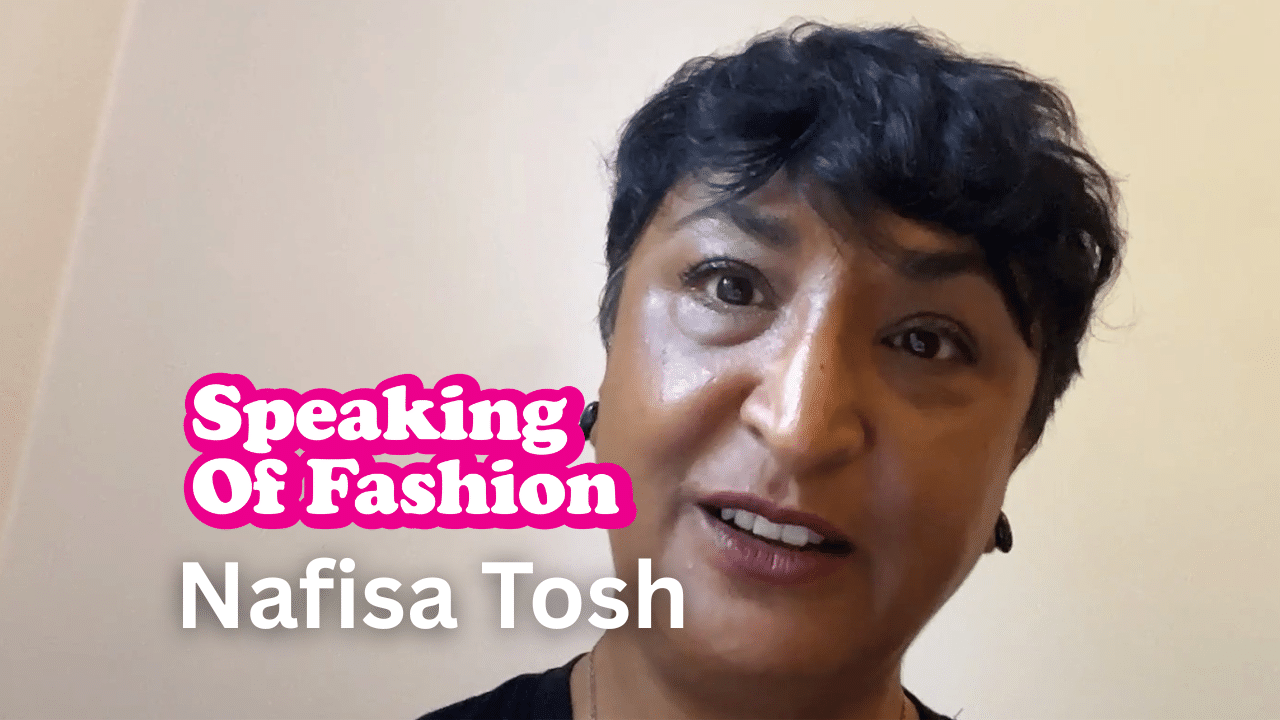
From watching her tailor father turn cloth into “real magic” to pleating a whole roll of silk for Lee McQueen, Nafisa Tosh has spent decades making the clothes behind fashion’s biggest moments. The London designer, maker and tailor talks about her family’s story, Christopher Kane’s neon collection, Chanel’s artistry, teaching at Central Saint Martins, why stylists get too much credit, and why couture belongs to Paris.
Brownfashiongal: Hi, Nafisa. Welcome to Speaking of Fashion. I think we have a lot to speak about, especially because you are one of the key people imperative to the process that goes behind making a garment, be it on the runway or on the red carpet. What I would really love for you to do initially is tell me a little bit about yourself. How did you get into fashion? Did you study fashion? What was your journey like? I know you come from the UK, but there’s so much that goes on, especially coming from a South Asian descent. I would love to know how you got into fashion and how easy or difficult it was for you to choose this as a career.
Nafisa Tosh: Well, first of all, thank you for having me. It’s a pleasure to be interviewed by you, Shreya, and I’m delighted to do this with you. A few people know from previous things that I’ve done that my father was a tailor. He came from Gujarat to London in 1960, and he went for a trial on Savile Row, but he wasn’t allowed to work above stairs, because there used to be this upstairs-downstairs thing. So he went to work for this really lovely Jewish tailor. All I know about him is his name, Solly, and he gave my father a chance, with my uncle. They lived in a predominantly Asian area, Ilford, but they worked in Stamford Hill, which is still a traditional Jewish area in London.
After a couple of years, Solly said to my father and my uncle, “You guys need to leave.” And they were like, “What have we done wrong? If we’ve made a mistake, we will rectify it.” And he laughed and said, “No, you were too good when you came here two years ago. You now need to leave and do your own thing.” This amazing man helped my father financially and gave him a bank loan. My father said, “We can’t afford to pay the interest back.” And he said, “Look, every Friday, after you’ve done your Friday prayers at the mosque, you will meet me outside my synagogue and you will pay me five English pounds.” They had a gentleman’s agreement. They just shook on it. That’s how things were. Everybody worked together and supported each other. One of Solly’s cousins taught my father the machinery, another one gave them studio space, and Solly gave my father the bank loan and the overflow of work, plus work from his other cousins who had Jewish tailoring businesses. So my family were hugely indebted to the amazing Jewish community.
That was the first big step: my father having his own factory. Unfortunately, a few years down the line, there was a fire that destroyed all the work and the factory, and my uncle got seriously injured. Like all families, they argued about money, and then my father moved around the UK. We lived in sixteen different places before we settled in Manchester, where my parents bought their house. Manchester and Bolton have this wonderful connection with cotton. The history of cotton, India and Manchester goes far back.
But I was that girl. I was obsessed with how he could take soft, floppy fabric, like a piece of wool, and turn it into something that was engineered. I saw my father as an engineer of fabric and cloth. I remember one client coming to the back room where my dad did all his sewing, and my dad fitted this jacket. This guy had lopsided shoulders and a little bit of a paunch, but when he put the jacket on, it evened out his shoulders. It made him look beautiful, taller, slimmer and more elegant. And I thought, wow, this is magic. This is real magic, because that is true structural engineering.
This morning I was just thinking about how, a couple of years ago, I worked with Crystal Cox, who styles Tom Holland, and I think it was one of the first things I did with Prada for Tom Holland. A couple of years later he saw me and said, “Nafisa, that suit you tailored for me, that green suit?” I said, “Yes.” And he said, “Every time I put that suit on, it makes me feel invincible.” And I thought, I wish my dad was alive to hear that. Because that’s what I do. I want to make the client, the person, the talent look and feel amazing, so that when they’re on the red carpet, they don’t need to worry about whether their jacket is wrinkled or whether the sleeves are right. We all know about the circle of shame that started a few years ago with celebrity gossip magazines, and how harmful it can be to somebody who’s not always on the red carpet. So that’s where I see myself.
Brownfashiongal: You started your journey in the industry in the eighties, which was a very different time from what we see today. There was no social media, the fashion week structure was very different, and the industry itself was much smaller and much more centralized. I think it was much more unattainable for a person to be a part of it. So how did you start your career? I would love to know about your initial years. Where did you start, where did you work, and how was that experience for you?
Nafisa Tosh: When I was at school, we had a thing called work experience, which I’m sure happens all over the world. I think I was fourteen or fifteen, and I told my dad and my school teachers, and they were like, “Well, there’s no fashion industry in Bolton.” So they sent me to a denim factory. On the first day, I was creating a mood board and silhouettes and all that, and the person who owned the company said, “Right, okay, we don’t do any of that here. We just copy things: jeans, jean jackets and shirts.” Then they put me on the factory floor doing piecework, and I thought, well, this is definitely something I don’t want to do. So for me, my journey started with a process of elimination. I knew I didn’t want to work in a factory. Not that there’s anything wrong with it, but it just wasn’t for me.
In my head I had French Vogue, and my best friend’s mum, who’s Burmese. They still live in Bolton. She would buy Vogue twice a year, because it was such a luxury for South Asians, and I would pore over all the details and the credits. Because I only had one issue, I would memorize absolutely everything. I read every single article and the adverts in the back: who did the hair, the makeup, et cetera. Styling wasn’t a thing, and there wasn’t a fashion industry as such. It was the rag trade. There were no fashion weeks back then. Designers just showed in showrooms.
So I thought, right, how do I get into this industry? I got into shop work, retail work, so that every step I took took me a little bit closer to the world of fashion, because there was no way I could equate me in Bolton with Vogue magazine. I didn’t see a path. There wasn’t a journey back then, in the mid-eighties. So it was a slow process, but that’s really where it started: with what I didn’t want to do.
When my sister, who’s two years younger than me, went to art college, my parents then allowed both of us to go to art college, and from there I did an HND where my uncle lived. Back then, South Asians went into the traditional accountancy, science or medicine. Fashion was just the rag trade, and my parents were like, “You’re not going to work in a factory.” When I found the course that I wanted to do, there was only one course, and thank God it was near where my uncle was. So there was safety. They could keep an eye on me so I wouldn’t become awara, you know what I mean? Go boy crazy. That was the fear, that I would run away with some taxi driver. And I was like, please. Obviously I was interested in boys, but I wanted my career. I wanted to be in fashion far more than to run around with a stupid boy. That could come much, much later. I wanted my fashion education.
I got my HND at what is now the University of Huddersfield, and by the way, I only ever went to two parties: the one before college started and the one after college finished. I was just concentrating on fashion, design, pattern cutting and sewing. I wanted to know every single aspect, because I thought, if I have my own label one day, I’m not going to be able to afford to employ lots of people. So I have to know exactly what it is to create a garment, to design it, what good design is, and what makes this fabric work but that fabric not work for my design. So I was teaching myself and pushing myself further and further. I was competitive, not with my classmates, but with myself. Okay, you got a B-plus on that last project, so on the next one you have to get an A, and then an A-plus.
I had no support other than my friends and classmates, and we were competitive with each other. I remember two of my friends, Serena and Sharon, whose final-year collections were slightly similar. At that time, because we didn’t have social media, your research and development was so integral to your designs that these two girls ripped up their research and development and started again, because one or two pieces were slightly similar. That’s the integrity we had then. We wanted to be unique. We didn’t want to look like everybody else, and our designs couldn’t be like somebody else’s. So that’s the foundation of where I was.
After I graduated, I would do any job that came along. I went to work for a tailor’s in Manchester. I worked for two or three, and each time I learned how to use a new piece of machinery or a different way to finish a pocket. At that time I was really lucky, because there were so many mature people with decades of experience, and I knew nothing. I knew what my father had taught me and what I’d learned at college, but I didn’t know how the industry worked. So when I met somebody who’d been in the industry for a few decades, I’d sit down with them and say, “What is the best way to do this? Can you show me?” And they would love to impart their knowledge: “Sit down with me, darling, I’ll show you how to do this zip or this pocket.”
I was making notes. I always kept a notebook and a diary, but I also remembered things, and then we’d practice. I’d go back to them and say, “Right, is it like this?” I’m sure I was super bloody annoying, but they felt so flattered to have that knowledge tapped into, and I was super flattered that they wanted to share it with me. Because I thought, if I get all the technical bits right, if I know how to put in the perfect concealed zip, how to do a jetted pocket or a welt pocket, the best way to put a lining in, all the different ways to do a collar, then once I know the basics, I can start experimenting. You can’t experiment if you don’t have the foundations of a rock-solid base.
Brownfashiongal: That’s amazing. You mentioned how you were deeply inspired by Vogue, and I also read in your past profiles that Vogue has had a significant influence on you since you discovered it as a little girl. I think magazines held so much more power and relevance back in the day. I would love to know your take on the media. How relevant do you think magazines are today?
Nafisa Tosh: For me, paper copies will always be relevant. Nothing beats it, even if you can’t afford Vogue, and I couldn’t. I came from a working-class background. A copy of Vogue in the eighties was about five pounds. That was a good day’s wage for my mum, who was a stay-at-home housewife and a home sewer. So it was such an incredible luxury. I remember picking up the September issue, which back then was about two inches thick, and it was so inspirational. I still pick up fashion magazines. I sit down on a Sunday and read the first fifty pages, and I pore over all the details. I still get really excited by picking up a magazine.
God bless my mum, she didn’t understand the significance. When I moved out, she threw away all the Vogue magazines that I’d been collecting from 1986, when I could first buy my own, to 1993, when I moved out.
Brownfashiongal: Oh my God.
Nafisa Tosh: I know. I can’t think about it.
Brownfashiongal: That’s a classic Indian mother thing, I feel.
Nafisa Tosh: “It’s just a magazine. It’s just paper.” And I was like, “Mum, you have a massive house full of stuff, like five blenders in case you run out of one blender, and you threw away the magazines, the one thing…” It was my religion. Fashion was my religion. Those books were my Bibles.
Brownfashiongal: Oh my God, moms do that. My mom did something very similar with my old sketching notebooks, and I was just like, oh my God, what the hell? It’s really traumatizing.
Nafisa Tosh: But you know what, I thought, okay, they’re just magazines, and I have been able to buy some of them back. But the articles in those Vogue magazines are still relevant today, because I pick them up when I have a moment. The people who wrote for those magazines are still relevant. We still reference those photo shoots today. I see it in the mood boards, like the ones for yesterday and the ones for last week: the fifties, sixties, seventies, eighties and nineties being referenced again. The creativity, the people that came together. It wasn’t an industry the way it is now, with so many different tiers.
Back then it was just a phone call: “Hey, I want to do a shoot, I’ve got this idea.” You would sketch things the old-fashioned way, do cutouts from magazines for reference points, and collect things like feathers or a glove that you found. That’s how it came together. The creativity was in your mind.
When I was teaching at Central Saint Martins earlier this year, in January, February and March, on the first day the students opened up their laptops and said, “This is my mood board.” I said, “No, close the laptop and talk to me.” Because fashion is about communication. Talk to me, sell me your ideas for this collection. A lot of the students struggled, and I said, “If you cannot talk to me, you’ve failed.” Because if you go into the industry with a collection, you have to talk to buyers, fashion editors and journalists. If you cannot communicate verbally and tell me what your collection is about, you’ve failed as a designer. It was very hard on them. But my students, my God, they turned their collections around. I was really proud of them, like they were my children, my babies.
Brownfashiongal: You mentioned that the research process back in the day was much more intensive. It came from within, and it had to be unique. Do you still think that is the case today? If you look at the larger industry, with mass production, social media and so much trend forecasting, there are some very specific trends, and things look very homogenized. So do you think the research process today is as creativity-driven as it was back in the day, or has it mellowed down?
Nafisa Tosh: I think it’s become watered down. I call it the golden age of fashion. I worked with this amazing photographer, Robert Vanessa, and his wife, and we’ve discussed it. We said we were so lucky to be there at the beginning, in the golden age of fashion, from the eighties until, I feel, digital came in, and that changed everything. It is amazing to be connected with the world, but I feel that it has hampered creativity, and creativity has reduced somewhat.
But then you look at somebody like Tim Walker. He still uses old-fashioned notebooks, watercolors and sketching, and he collects bits like feathers, bits of fabric, maybe an old hat. I went to one of his exhibitions, and he still creates in what I call the classic way of creativity. You can still do that. What I disliked when I was teaching at CSM was students just downloading an image. That is not creativity. What do you take from that image? Work into it. Show me more. So yes, creativity has changed. I feel it has become watered down, but only if you allow it to. You have to push yourself: okay, I’ve downloaded an image, what can I do with that, as a creative, as an emerging designer?
Look at the work of people like Steve O Smith. His work is quite graphic. It’s really bold, and he’s doing something different. So you have got amazing new designers. He uses what was a squiggle, a swirl, and he’s developed that and keeps developing it further and further. So it’s a concept, but look at how he’s pushed it. I did some work with him about two or three years ago, when Celeste was wearing one of his jackets and I had to help with the tailoring on that jacket. I think it was maybe his second or third collection.
I still love to work with young designers and support them, because the industry is hard. The creativity is there, but you have to dig for it. You have to push yourself. It was like that in the eighties, the nineties and the noughties too. You could be as creative as you wanted, or you could be as lazy as you wanted. It’s up to the individual. How do you want to push yourself? Because you can. There’s proof of that out there.
Brownfashiongal: That’s beautiful, and I love that, because there are so many amazing designers today. Even the big brands, I think, after the great designer reset, have been doing some really interesting work.
Nafisa Tosh: I haven’t had a chance to look at all the collections, but obviously Chanel and Prada are two of my biggest clients, and I’ve seen how Matthieu has taken Chanel back to the artistry in his clothes. When you see his work up close and see the work that has gone into it, the atelier, it is absolutely exquisite. I remember seeing what looked like a pair of jeans, and it wasn’t until I got right up close, which I guess a lot of people won’t, that I saw the work. It was exquisite. It was sand-washed, peach-skin silk, a very heavy silk that had been treated, washed and stitched to look like a pair of jeans. Bhavitha wore that outfit, and everybody was saying she was just wearing a shirt and jeans. And I was like, you don’t understand the artistry. People were saying they did her wrong, but you could only see the beauty of it when you got up close. And she chose the outfit herself, apparently.
Brownfashiongal: I think the hate around that outfit was insane. It was just a social media witch hunt. There were accusations of racism and God knows what. It was so pointless, and she looked beautiful. It’s so iconic to reference yourself. No one gets to do that. The social media brigade is always picking up the weirdest things to fight about.
Nafisa Tosh: Absolutely. And it’s keyboard warriors. These people are faceless and anonymous. If you’re going to say that, put yourself out there and back it up, but otherwise be quiet. Because Matthieu, I met him last year. His assistant, Mary Valentine, is a friend of mine. We go back about sixteen or seventeen years. She worked at Louis Vuitton, where we worked together with Marie-Amélie Sauvé, so we did a lot of Vuitton shoots, and she introduced me to Matthieu when he had his portrait done by David Bailey in London. So it was amazing. And he loves women. Look at the women he has: that beautiful American mixed-race model, Stephanie, opening his shows, Bhavitha, all these beautiful women of age, experience and substance. People are saying he doesn’t like women. No, he really does. He loves women. His whole team are women.
Brownfashiongal: I think that comes across in his work if you really look at it and analyze the inspirations. If someone wants to understand why his work is appreciated the way it is, they just need to read about it or look at it. It’s pretty much out there.
Nafisa Tosh: Agreed.
Brownfashiongal: You also mentioned that you are teaching at CSM, and you studied fashion as well. What do you think is the difference between when you were a student and how students are today? Of course there’s social media, the internet and a lot of technological advancement, but at the core, in their motivations, their purpose, or why they want to be a designer, do you sense some sort of difference between the two generations?
Nafisa Tosh: Well, I was quite brutal on my first day with my students. I was there on Tuesdays and Thursdays, and on the first day I said, “I don’t want to look at your printouts. Shut your laptop. Talk to me.” It was a bit of a shock, because that’s how they used to do presentations. I said, “I’m going to teach you the way I was taught.” They’d had a few weeks to do their preparation and research, and I was like, “Where are your fabrics? Where are your samples? Where is your stitching? What kind of stitching? Why are you doing this stitching?” The inspiration for the cutting project was their own ethnicity, heritage, background and culture, and I said, “I want to see this.” When I came back on Thursday, they had samples, fabric and swatches, and I was like, “This is what fashion is.” So I was teaching them in the way I had been taught. For the project they had to produce one item and one accessory, and by the end of the project most of them had done two full outfits with accessories. So I pushed them and pushed them, and I was like, “This is great. What else can you do?”
I can only speak about fashion education in the UK. When it became monetized, when students had to pay for their degree or diploma, that is what changed, because then students felt like they deserved a first-class honors, or an HND with a distinction. I never had that. I grew up in a time when you could do one degree or two degrees, and education was free. I remember the year that came in, I was teaching at Ravensbourne, and the students realized that if you put in a complaint about your tutor, you could go up a mark. So when you monetize education, you bring in this attitude of “I am paying for my degree, so I want the best degree.” And that really changed everything.
But when I went back to CSM this year, and I hope I do go back because I absolutely loved it, I love working with young people, I showed them that you can produce a basic collection or you can really push yourself, and this is how you push yourself. You have to think laterally. And of course I talked about when I worked with Lee McQueen, because Lee pushed me. He challenged me every day. I remember crying for the first four months, because he would ask me to do things that up to that point I had not considered, or had not done in quite that way. So I understand the tears of frustration. But working in fashion shouldn’t be a punishment. It should be a challenge: how can I be a better designer? How can I design the next collection? But also, enjoy the process.
I’d check with my students: “Are you enjoying it?” And they were like, “Yeah, I love what I’m doing and I love creating this. I was up until 2 a.m. last night.” One of my students, Bobby, was in there before I arrived. He would get in really early and stay until he was kicked out, and his collection changed so much. I said, “You are allowed to change your collection, because that’s what you do as a designer. You develop, you grow.” You start off at A, but you might end up at Q. It’s the path. And you can come back to it, because that knowledge is in your diary, in your notebook, in your research and in your development. This idea might not work out, but you might come back to it for the next collection, or the one after that. So keep notes, and keep a work journal as well.
Brownfashiongal: One question I’ve had in my mind since I started talking to you, and I read somewhere that you had commented on this, but I want to ask again: what is the role of a creative director, according to you? Do you think a creative director of, let’s say, a big brand needs to understand pattern cutting, draping, construction and the technicalities, or is what they bring to the table more of an idea, a vision or a concept?
Nafisa Tosh: I think it’s a combination of the two. When I was at McQueen, Katy England was the stylist, and she would come in and find things, and it was a challenge for you to develop that idea. So a creative director should bring in ideas and creativity: “Look, I found this amazing piece of wallpaper. I found it really inspiring.” And then I would take that and think, okay, how can we develop that? It would go across the studio. Alex Muller would perhaps develop it into a surface textile print, embroidery or beading, and I would look at that piece of wallpaper and think, how can I develop this?
So the creative director’s role is influential in so many ways, but it is mainly to inspire, challenge and influence. It is one of creativity, and perhaps of bringing in structure in a different way, because if you’re just pattern cutting, cutting out a sample and putting it together, it can become quite repetitive. A good creative director will push you and challenge you, and bring in elements you might not have thought of. That is what their role is, in my opinion, from the ones I’ve worked with.
Brownfashiongal: You’ve worked with Lee McQueen a lot. I would love to know a little more about your experience at McQueen. Are there any tidbits you can share?
Nafisa Tosh: It took me a long, long time to realize this. Initially, I only went in for one day to help out, and I ended up staying about two and a half years. But my journey with McQueen started long before that, around 2001 or 2002, when I was a technical tutor at the Royal College of Art in the womenswear department. My student was late one day, and there was another technician, Patrick, who said, “Would you like to help me with something?” I said, “Okay, sure,” because I like to be busy and to keep my time useful. We got chatting, and I said, “Is there any brand or designer that you freelance with?” He said, “Well, I’ve been working with Lee McQueen.” And I was like, “What is that like?” Because there was a high turnover of staff at that time. Oh my God, that’s twenty-five or twenty-six years ago now. I just think, what have I been doing all my life?
Patrick was the only person Lee trusted, because Lee met Patrick at Central Saint Martins, where Patrick was a technical tutor. So Lee would allow Patrick to take things away, because they had this very deep trust, this mutual respect and bond. No other person was allowed to take work home, because Lee, like all designers, was worried about being copied or ripped off. So I started working on things for Lee with Patrick. We would do it when a student didn’t turn up, I would help Patrick at lunchtime, and sometimes we would stay behind and work on things together at the Royal College, which I loved.
Then, in 2005, I walked out of a job that I absolutely hated. It was very commercial, but financially beneficial, because I was trying to get a mortgage together and all that boring stuff. I just quit. It was December, and I thought, my God, what have I done? I was getting absolutely wrecked at this party, thinking, I’m going into 2006, I don’t have a job, I don’t have any work, what was I thinking? Then Patrick phoned me up and said, “What are you doing tomorrow?” I said, “Nothing.” He said, “Will you come in and help at McQueen? I really need help on this wedding dress.” I said yes, and then I started drinking loads and loads of water. I went in, and he said, “Right, you’re going to be in the womenswear atelier, helping Judy and Camilla. I’ll come back and get you at lunchtime.” I started working on this wedding dress, and that was the beginning.
It was only a couple of years ago that I realized Lee had seen how I worked, and that I’d got a strong technical background. One of the first things he gave me was a full roll of black taffeta silk, and he said, “Can you pleat this?” I said, “How many meters?” He went, “The whole roll.” I was like, “Are you kidding?” It took me about six hours to do these box pleats, and then I had to press it, which was a nightmare. I think it was about twenty-five meters. That turned into a showpiece for The Widows of Culloden. Lee saw that I paid attention to detail, that I pressed as I went along and I measured, and after about ten meters I could do it by eye. I didn’t realize he was watching me over my shoulder. I think it was my technical background: the fact that I cleaned my machine down, put paper down and was like, “Nobody come near me, this is silk fabric.” It’s all the little things that he picked up on. Then he gave me more challenging things straight away. I was thrown in at the deep end.
After that, I worked on a dress that Erin O’Connor wore to an awards ceremony. It was a blue silk dress. I’ve been to the Schiaparelli exhibition a few times with friends, and there’s one dress there that, when I looked at it, I thought, that’s where Lee got his inspiration. The side of this dress had multiple cowls, a waterfall draped effect. The more I looked around that Schiaparelli exhibition, the more I thought, Lee studied this designer. He studied Elsa’s work, he was influenced by it, and he incorporated so many little things that nobody’s picked up on. I’m a super geek when it comes to fashion, and I’ve spotted all these details. I hope that answers the question.
Brownfashiongal: Oh my God, that’s beautiful. I would never have associated the two designers. Lee was a technical genius himself. He was a wonderful tailor. So have you ever worked with a designer, and you don’t have to name them, of course, who you thought was not as technically proficient, who just wouldn’t get how to actually construct? Did you face something like that, or do you think designers are generally competent in that respect?
Nafisa Tosh: I’ve worked with young designers straight out of Central Saint Martins who were feted and told, “You’re going to be the next best thing.” I went to work with Christopher Kane. We’re going back to 2010 or 2011, and up to that point his collections were created by students. So in my opinion they lacked finesse, and his shapes were quite boxy, because he had fashion graduates with zero experience making his patterns and cutting things out. Students don’t know about sample cutting to make the pattern flow. There is a seam, but the pattern doesn’t flow. That comes with experience. If you’re not going to employ people with experience, your collections will look quite simplistic.
So when I went in, I said, “Look, we can do it like this. Before you cut something out, give me a shout, and I’ll show you how to lay it out and how to maximize.” The first collection I did with Christopher Kane was the one that was Princess Margaret on acid, all neon colors, with a tattoo print. I was really influential, and I said, “Right, we’re going to work on this together. The cutting has to be like this so the pattern flows.” You had piping detail and then this tattoo print, and to make the pattern flow, you have to cut it a certain way.
So my job as a high-end sample machinist is to educate people. I was teaching the girls, and there were girls with maybe two years’ experience out of CSM. I’d say, “We can do the pattern like this, we can move the dart.” It’s a dialogue. It’s a conversation the whole studio has to have. And of course I’d left McQueen, so they were all very interested in how I would do it. I’d say, “Let’s have a conversation for twenty minutes before we execute this design.” Christopher, who was in the room above, wasn’t involved in the day-to-day running. He left that to his studio manager. And I’d say, “Right, let’s talk about the pattern before you cut it out. When you’re cutting it out, let’s have a conversation. I’m going to construct this, and then let’s let the garment drop before you hem it, so the hem isn’t wibbly-wobbly.” You need to discuss this. That’s what being in a sample room is all about. It’s about having a dialogue and bringing in people with experience.
I brought in my friend Michael Callahan, who was part of the Blitz Kids. He was at college with Stephen Jones, the milliner, and he knew Leigh Bowery. He knew all these people. And when I was at the Royal College, my God, I got to spend time with the other technicians there, like Ossie Clark’s sample machinist, Kathy, who showed me how to do a hand-rolled hem, which I’d never come across. She taught me so much. So my life up to this point has been about not just educating the younger people that I work with, but learning from the people who preceded me, and passing those skills on to people who want them. That is what it’s about. It’s about having a conversation.
Brownfashiongal: That’s amazing. I really can’t believe you were behind that collection, the neon collection. It’s one of my favorite collections of all time. It’s such a legendary collection. It started a whole trend, and everything was neon for years after that. Christopher Kane has recently debuted his Mulberry collection. I don’t know if you’ve had a chance to see that.
Nafisa Tosh: Not yet. I’ve not had a chance to look at any of the collections. It’s been quite an intense three weeks.
Brownfashiongal: I think Christopher Kane has grown a lot, and it was that collection that really pushed him into the mainstream.
Nafisa Tosh: He’s really talented, and he’s very generous. Going back to your previous question, a designer has to be open to dialogue and open to people with experience. When you bring people with experience into your atelier, sample room or studio, it opens you up to a whole new thing.
Brownfashiongal: I think designers in general need more openness, to be more accepting. I know a couple of people who just wouldn’t do that, because they want to do everything themselves, or they might have an ego thing where they don’t want anyone to come and tell them how to do things. But that’s what growth is, and that’s what being a good designer is.
Nafisa Tosh: There’s one designer who’s very up and coming. I don’t want to name them, but their studio is just around the corner from mine. I go past and I see the young people working there, people under thirty, and I think, I wish you would bring somebody in. It would take your collection to the next level in the fit and in the finish. It would look so beautiful. But designers will employ younger people because it’s cheaper. Experience is so beautiful and so valuable.
Brownfashiongal: Definitely. Apart from all these designers, you’ve also worked with some amazing women. Princess Diana: how did that happen? I would love to know how you got involved with working with her.
Nafisa Tosh: I was visiting London quite a lot in 1994, to see my then-boyfriend and do freelance work, and I think I moved to London permanently in 1995. I did agency work, and one of the designers I got sent to was Jasper Conran, who is amazing. He was one of the first people behind London Fashion Week, and behind Designers at Debenhams. Debenhams back then was a huge department store, and he was the first one to sign up, because he said good design should be available to everybody. Jasper was really good friends with Princess Diana, and he designed a lot of things for her to wear in her private time, not just for official functions.
I never met Princess Diana, which is a huge regret, but because of royal protocol, only Jasper was allowed to do the fittings with her security. Nobody else was. We had been working on this pink skirt and jacket. We had this beaded fabric, and we were trimming the seams on the inside of the skirt. Jasper said the seams were too thick, so we were trimming more and more. Then they did the fitting, and he brought the skirt back and put it back on the clip hanger, and we had trimmed the fabric so much that the skirt fell away from the waistband. We were like, oh my God, thank God that didn’t happen in the fitting.
Princess Diana always sent flowers, a thank-you note and chocolates. The flowers would stay at the company, and of course we would have a chocolate or two, and we would be shown the note, but for protocol reasons we were never allowed to keep it, because it was addressed to Jasper and the women in the atelier. I never met her, and I always wish I had, but she was an amazing person, an amazing human being.
Much later on, in 2000 or 2001, I went to work for Elizabeth Emanuel, who shared a studio with a designer called Jimmy Jumble, who was going out with Lee McQueen, and Isabella Blow was styling Jimmy Jumble’s collection. So when Jimmy wasn’t busy, I would go to the other side of the atelier and work with Elizabeth Emanuel. Again, there were all these brilliant mature seamstresses and technicians, and they’d say, “Right, we’re going to teach you all these haute couture techniques.” So that was another education. I never stopped learning in this industry. That’s what I love about it.
They said, “You know a lot of these techniques because of your tailoring background.” I remember there was a shaped, curved pocket, and I couldn’t understand how to press it. Then one of the seamstresses showed me, and I was like, oh my God, that’s a revelation. That’s how my father would have done it with a shaped pocket. It’s in here; you just need to learn how to adapt it. So it’s about the tailoring background. And I loved working with Elizabeth. She’s an amazing designer.
Brownfashiongal: Talking about tailoring as a career in the fashion industry, a regular fashion customer won’t really know who tailored their clothes. So do you think the behind-the-scenes workers and creatives are represented enough in the bigger picture of the industry? What’s your take on it?
Nafisa Tosh: I think stylists have their place in the fashion industry, of course they do. But I think they get far too much credit. The designers do the work, the atelier does their work. This is a real pain in my ass, basically. Credit the people. Acknowledge the people. You get designers like Hussein Chalayan who brought out his entire team, because they’re the ones who do the work. The designer does the work, and the pattern cutter, the hand finisher, the seamstress and the tailors. These people make your clothes.
That’s what my Instagram account is all about: giving credit and acknowledgement. Acknowledge the people who make this, because it’s not the stylists. The stylist doesn’t make the clothes. It’s the teams behind the designer, so give them credit. Is it really so hard to acknowledge the people who make the clothes? The people in the factories, the garment workers. A human being makes the clothes. Acknowledge those people. It’s not difficult. It’s not the stylist who makes the clothes. It’s the seamstress, the pattern cutter, the pattern maker, the grader. All these people make your clothes.
Brownfashiongal: A hundred percent agree. I feel the role of the stylist, especially in the last three or four years, has evolved a lot. It’s been very glamorized. It’s almost like they’re a celebrity themselves, which is fine. Everyone should get their due credit. But if you look at styling, a lot of what we would call a conventionally good look on the red carpet is either a full look off the runway or an archival piece. So I’m also a little concerned. What is the stylist doing? Aren’t you supposed to put things together, discover new designers or put forward emerging designers? If everything is a vintage gown or a full runway piece that is already perfect and ready to go, what exactly is the stylist doing? Then it’s not a fashion stylist; it’s more of an image architect or a branding manager. So I think the role itself has changed a lot, and that new evolution, this new glamorization of the stylist role, is what’s eating up all the credit.
Nafisa Tosh: Agreed. Look, I work with Law. I’ve worked with him for about three, four or five years, and whenever Law is in town, he appreciates my experience so much. One of the first things we worked on together was a Zendaya look for Dune: Part Two, and he brought me in because it was an archival Givenchy by Alexander McQueen look, with the LED lighting.
A good stylist works with a team. I work with Law, and I work with people like Jerry Stafford, and one of the first things Jerry does is make sure that whatever he’s working on, I am on board, because a good stylist has a good tailor to make the client look great. Stylists also know their limitations. Law will trawl through hundreds of thousands of garments before he starts to collate them, and he has a photographic memory. That’s what a good stylist does: they collate a collection of clothes, and he does the themed dressing for Zendaya and the other people he styles. I appreciate what he does. Stylists have their place, but the people behind the stylist have their place as well, is what I’m saying. It’s a cohesive collaboration, or it should be. I don’t know if that answers your question.
Brownfashiongal: Completely. It makes sense. I would also love to speak to you a little about running your own studio, because I think you’ve been doing it for quite a while. How has that experience been? It’s no joke to manage your own studio and run your own business alongside all the projects you’re doing and your teaching. How are you doing it all?
Nafisa Tosh: I have a lot of balls to juggle. Keeping a diary and a notebook is super helpful. I also have the most amazing team, and I now have my husband helping me a couple of days a week. He manages the paperwork and invoicing now. When I was teaching at CSM, I was telling my students, “You will have to manage everything.” This is what I do. I book my own jobs. I send my invoices out, and my invoices are quite detailed. For some of the brands I work with, I’ll put in that I took two centimeters off the back of a trouser, because if they’re working with that actor or talent going forward, they’ll ask, “What did Nafisa do?” They can refer back to it. It’s very detailed, and these brands appreciate that.
Then there’s chasing invoices, which is a huge thing. You don’t always get paid on time, so my husband’s taking care of that for me. I got my first studio around 2007, so it’s nearly twenty years, and I’ve had to manage all of this by myself. I had an amazing assistant, Helima, who I’m still in touch with. She would do all of my filing, receipts, all that kind of thing. Rebecca is an all-rounder. Everybody’s freelance. My God, Rebecca is like a machine. She can finish her day job and then come and help me. She’s got keys to my studio. I’ll leave her a note saying, “Please can you do this?” and I come back and it’s done. She’s like my little fairy godmother, like the little mice who come in and do the work. Then I work with Beth, Emily and Nikki, who do beautiful embroidery, hand finishing and beading, and with freelance pattern cutters. So I have a huge team. I think there are about thirty to forty people that I work with at various times. I can’t do everything on my own anymore, as much as I would love to.
Having said that, recently I designed and made a mother-of-the-bride outfit. This lady was quite alternative. She didn’t want something traditional and pastel-y, so I designed the dress on her. She came into my studio, we spent about three or four hours together, and I was like, “What about this kind of sleeve, this kind of fabric?” And she loved it. So it’s about teamwork and having good, reliable, trustworthy people, but also knowing how long things take you.
I like people to come to my studio, but that’s not always possible. Here’s an example: last year, I gave some work to a friend of mine and told her how long it would take. She brought it back, and instead of four or five hours’ work, she sent me an invoice for twenty-five hours’ work. I was like, “Come on, we talked about this. I’m not stupid. I know exactly how long this takes.” So for young people: if you know how long a technique or procedure takes, you have to have that conversation, but also get it in writing. When you work with friends, you become their employer, so you have to be more professional. You have to plan. Hope for the best, but plan for the worst. That’s what I’ve always said.
Brownfashiongal: These skills that one needs to run a business and exist in the industry: do you think fashion schools teach enough practical skills today, or is it something you just have to learn on the job?
Nafisa Tosh: No. Sadly, fashion colleges are not teaching the technicalities that I was taught. I had amazing technicians teaching me at college how to pattern cut, how to sew and how to change a pattern. We did a project where you worked in a small group of three or four: somebody would design it, somebody would make the pattern, somebody would make the sample and somebody would fit it. So you learned how to work. I don’t think colleges do that now, but I think they need to go back to the basics. You’ve got to learn how to make a pattern and adapt it for a real person, and that became something I did when I was at CSM earlier this year.
Brownfashiongal: I have one last question for you. You work with London Fashion Week, of course, and you are a London icon, but you’ve also worked very closely with Milan and Paris. I would love to understand your experience with each of the three big cities. For someone like me, who is just looking at the industry from a distance, how are these three different or similar from your perspective?
Nafisa Tosh: I’ve been to Milan with work so many times, but it’s always been: get off the plane, car, go to the studio or the hotel, get back in the car, get back on the plane. I have yet to discover Milan, so for me it’s just been work trips. With Paris, I try to go at least once a year. I was there earlier this year for the Cartier shoot with Tilda Swinton, during the heatwave, which was disgusting. But I have such a love of Paris. I’d move to Paris in a heartbeat. I hope my husband’s not listening.
For me, haute couture is Paris and Paris is haute couture. I often hear the word banded about: “This is couture.” Maybe I’m wrong, but for me, couture isn’t couture unless it comes from Paris, because it’s about the technique. Handmade does not mean it’s couture. I digress.
The minute I get off the Eurostar, there’s just something about Paris. For me, it is the capital of fashion. London is the creativity. Here you have all the crazy, wild ideas; we’ve just seen London Fashion Week. Paris is about discipline, technique and heritage, and Paris and Milan value that so much. We don’t have that same value here in London. We don’t have apprenticeships for young people. I wish we did. The young people, the colleges, the graduates, they’re crying out for that. I wish the government would set something like that up.
But there’s something about Paris. There’s a real frisson, the excitement. It’s the language and the people’s attitudes. When you work on something, they appreciate it so much more than people in London, who just say, “Just get that done.” In Paris there’s an art, a beauty and an appreciation of the work that you do. It’s inherent in that discipline.
Brownfashiongal: Oh my God, that’s beautiful. Okay, Nafisa, that’s pretty much what I had in mind. Thank you so much for joining me on Speaking of Fashion. I absolutely loved talking to you, and I learned so much. I hope you had a nice time. I think we would have so much more to talk about, and I would love to get all the gossip from you sometime. Thank you so much.


