
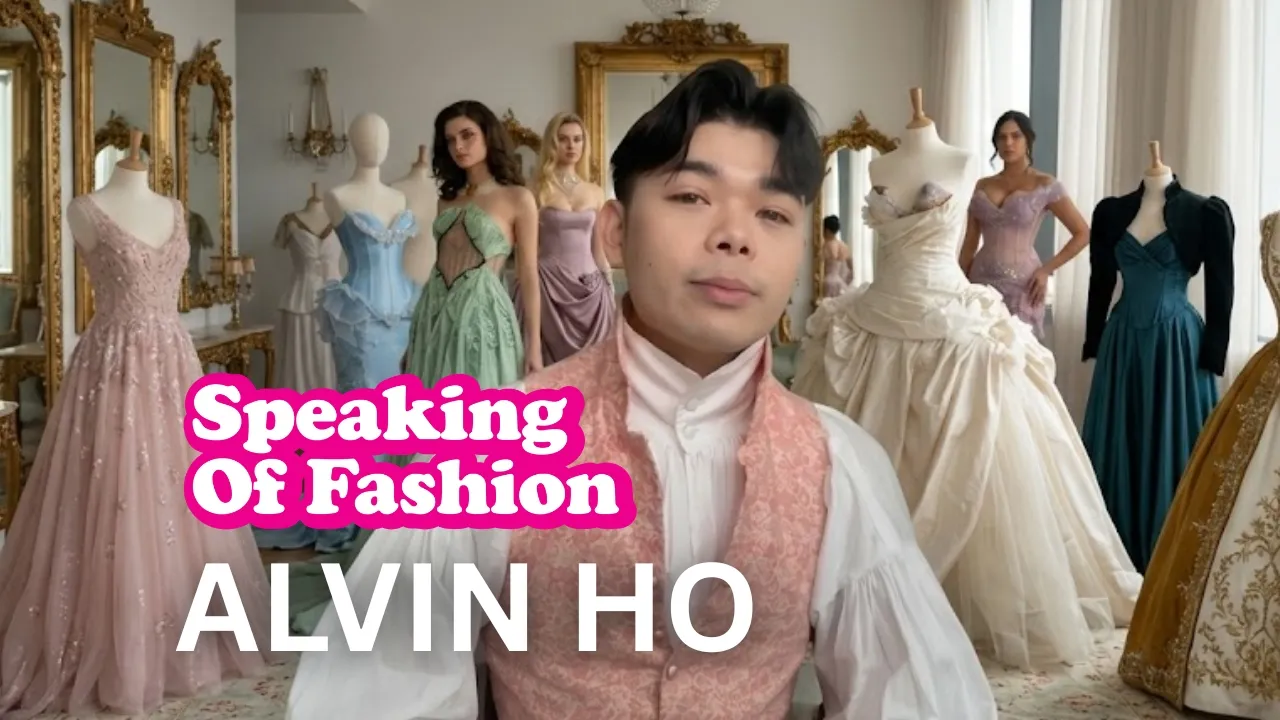
In this conversation with Brownfashiongal, designer Alvin discusses his journey from making clothes out of household waste at eleven to building his own fashion universe. He opens up about fantasy, bridalwear, social media, Asian family expectations, fashion’s gatekeeping, and creating a career without traditional industry connections.
Brownfashiongal: Alvin, I have read a lot about you, and even before reading about you, you were all over my Instagram anyway because of your fantastical work. I was like, “I’ve seen this page like a million times before,” because you keep popping up everywhere. I was really happy to see something familiar because I think it comes from a place of organic connection. There is so much to ask you, but I think the first most interesting thing that I read about you was that you started your work when you were eleven. That’s when you presented your first collection. That was insane. I need to know all about that.
Alvin: Yeah, no, because I didn’t know how to make any clothes, because you’re eleven. I used to make clothes for my Barbie dolls out of plastic bags and toilet paper and whatever I could find. That first collection was basically a trash-art project. I’m sure this is quite familiar to most kids, but it was basically finding sustainable materials and trash around the house to make clothes out of.
At that point, I didn’t really think of fashion as fashion. I thought of it as, “I just want to have fun.” So I spent a good month collecting trash. My mom hated me because I had a hoarding corner. But that was my first collection. I made three pieces. One was made out of lai see packets, which is basically every year during Chinese New Year you give out red packets. Then there were plastic bags, and the other one was newspaper.
It was a really fun experience. I always tell people that finding trash and piecing together rough patterns and making dresses is the best way to start because you kind of have a sense of where things go proportion-wise and stuff. So I think that it was a good place to start.
Brownfashiongal: That’s amazing. After looking at your work, no one can ever really picture that it started from a trash collection when you were a kid because the juxtaposition is so strong. But when did you decide to pursue it more as a career, or when did you really get serious about it? Did you attend fashion school or something like that?
Alvin: Yeah. I didn’t attend fashion school. I was reading up on your work as well, and I know that you love Galliano, Dior, and everything. For me, I liked a lot of how fashion can have a film aspect to it. There’s the theatrics of it, the clothes, the models, the makeup, the poses, and there is so much to those shows. McQueen, obviously, Mugler — that world really brought me into fashion.
Up to this day, I don’t think that I make the most beautiful clothes in the world. I think that I love doing this because of the world that I almost inhabit while I’m doing it, or the page I’ve created. I think that is the most magical thing. It’s the suspension of disbelief. Obviously, when you look at the page, it’s beautiful people in beautiful clothes, but everything is created. It’s staged. You know what I mean? What I’m wearing now is staged. But the way that creates a sense of, like, that’s their everyday — I don’t know why I love creating that universe whereby you take people into your world for a little bit every day and then they get back into it. I love that aspect of it.
In terms of how it got started, because I fell in love with that sense of theatre, I’ve always wanted to do it full-time. But obviously, I think you and I can relate because I come from an Asian household, and there are a lot more considerations. I do want to talk about those later on because I am someone in fashion, but I studied business management and entrepreneurship for both my bachelor’s and master’s degrees. I’ve never been formally trained.
The only real sense of training that I’ve done is a copious amount of unpaid internships and just sewing. I think I’ve been sewing for real for about nine years. And out of all that time, I think it’s that sense of theatre and the shows and being able to create my own shows, and now using social media as my vehicle to share them, that really motivates me and makes me want to keep doing this. So that’s how it found me.
Brownfashiongal: That’s amazing. And I think the point that you mentioned about bringing more theatre into fashion is so much missing from the fashion industry today. We barely have any brands who are sort of world-building. World-building in general is missing, and we’re missing that fantastical element from collections and brands altogether. A lot of these brands were built on this sort of heritage fantasy, and I think they’re just completely discarding that for God knows what and selling hoodies or whatever.
But I think, yeah, I love it. You want to portray a world of theatre and fantasy and sort of a world that you can step into, and that’s quite a feeling that one would get from your page. When you see those gowns, when you see those dresses, it makes you want to go to some French castle and run around. I was like, my God, if I was in a music video, this is probably what I would want to wear, or if I was getting married somewhere in Italy.
Your message does come across very well. But how do you sort of approach it? For example, how do you approach a collection? Where does your inspiration come from? Where do you do your referencing? Because I do see a lot of these historical references, be it corsets or shapes or structures. How do you make sure that it’s more relevant for today?
Alvin: Yeah. For me, everything is — every piece I make is like a character I’ve thought of in my brain. I know that makes sense. Because I didn’t come from a fashion background, being able to do this every single day is honestly the greatest blessing of my life. So I take it very seriously. Every single piece has a story behind it.
I think of that story from music, or just remembering something I’ve seen before, or it’s a feeling I have. Like, if I’m feeling this way, what would this feeling be wearing right now? For example, when I’m sad or when I’m really happy or confused, it comes to me, and I kind of imagine, like, as a character, what would I look like?
For example, the Phantom Bride look that I just posted was created because I was feeling really down. I was almost reminiscing about the past. And the Phantom Bride look is about having what once was yours taken away, or what the image represents. I don’t know if every single piece comes across in that way, but that is how I start the process. It becomes very cathartic for me to see everything together.
Brownfashiongal: Makes sense. And you know, the thing that you mentioned about building from character, I think one of the few designers that I know who does that is John Galliano. I read a couple of interviews about that, and he was like, whenever he puts out a look, it’s like he’s picturing a character. My God, that was the biggest achievement of my life. My God, thank you. Yeah, that’s going on my CV heading.
Alvin: Yeah, but he followed you and everything. It was so cool. I was like, “She’s done it.” I was so proud. So congratulations.
Brownfashiongal: Yeah, thank you so much. But yeah, I think that’s great because I think a lot of these — not just emerging designers, but also bigger brands — sort of lack their sense of narrative, which I wish more brands did.
Do you also feel that way? I feel that we have lost some of our fantasy and wonder, and world-building is so big. Brands are just putting a logo on everything and hoping it works out. Which I get, there’s a business aspect to it. But do you think fashion has lost its sense of fantasy?
Alvin: I think it’s coming back. So if we look at even just Paris Fashion Week, right? Rahul Mishra — beautiful mythology, storytelling, absolutely impeccable beading work. And then if you look at Ashi Studio, obviously, I’m just thinking about that umbrella. That umbrella was crazy. And obviously Schiaparelli, come on. And then Iris van Herpen with the kinetic stuff.
Even Dior — obviously, you can have your opinions on whether you like his collections or not, but I do really like the storytelling in which every single piece is inspired by something directly from the archives or a memory of Monsieur Dior himself.
I think that people are putting pressure on brands to make it happen because everyone on social media is talking about it. I think that it is coming back. I agree that there was a period of time where it was very sad and it was just about pretty dresses, or not even pretty dresses. But I think the fantasy is coming back, and I’m very excited for what’s next. I think it’s going to be amazing.
Brownfashiongal: Yeah, no, I feel that too. I think this couture season was incredible. I didn’t even expect it to be that good. Almost every collection delivered so well.
In terms of fantasy, my God, I loved the Indian designers. Rahul Mishra and Manish Malhotra, I loved. I think apart from that, Schiaparelli was beautiful. I loved Jean Paul Gaultier. That’s very controversial, but I loved it.
Alvin: Yeah, yeah. I know. No, I’m so sorry, but actually it was really good. I liked it.
Brownfashiongal: It was so good. I loved the experimentation of it. I loved the newness of it. And of course, newness is supposed to be provocative, but it was so good. And I hated his debut collection.
Alvin: Yeah, yeah, yeah. Did you see the reel of the girl with the stick for the finale?
Brownfashiongal: My God, they’re working with the stick, yeah. It reminded me of those vintage shows where models are practicing, like those ’90s runway shows. I loved it.
Alvin: Yeah. It was really cool. But yeah, what do you think? Do you think it’s coming back?
Brownfashiongal: I think you’re right. I think it’s coming back, and I think that push has been brought by Chanel and Matthieu Blazy at Chanel. I think he has sort of really created this enchanting world for Chanel, and I think a lot of brands are trying to get back into it.
Especially now with AI, I think we need more creative processes. We need more wonder. We need more humanness and things. I think AI is definitely sort of a way for people to counter this whole automation. I think Chanel definitely had a role in that industry alignment of, you know, “We need to be more creative.” The way they stepped up, I think, forced everyone to do it.
Alvin: Yeah, yeah. I think so. Their accessories were incredible. The giraffe bags — I know. It just was so much fun in it that I think was missing from Chanel. So I completely agree with you.
Brownfashiongal: Yeah, yeah. I think, yeah. I’m very happy to see Chanel back in action. But couture, we could say — did you have a favorite from couture?
Alvin: Ooh, I don’t know. I think I had to say Robert Wun. I know it’s very hard to choose, but maybe because we’re both from Hong Kong and stuff. I think seeing his growth as a designer — because, you know, I’m sure you and me have been following him for a long time, ever since before couture, while he was doing ready-to-wear — I think seeing the heights he’s reached and the caliber of the celebrities in the ensemble, and also the world-building and fantasy of it, that balloon dress is really cool.
The way that I almost try to decode how he’s created his pieces every single time he walks through the runway. And I’m also really proud of how he’s so proud of being from Hong Kong, and also the theatrics of it and how he embeds the culture in his work subtly. I think that his collection is not just about clothes, but it’s his journey, and seeing that is really inspirational for me.
Brownfashiongal: No, a hundred percent. I think Robert Wun was definitely almost everyone’s favorite because he always has this sense of fantasy. And this collection was definitely my favorite Robert Wun collection. I just loved the whole childlike wonder of it. I loved the references. They were so deeply layered. Every look was so deeply layered in reference.
I love a collection where I have to figure out what it means. It just stresses me out, but that means there’s work put in, which is beautiful.
Alvin: Yeah, yeah. I think it’s so smart that he also chooses themes that are universally acknowledged. One of the iconic ones was mind, body, soul — the bones. It just resonates because they’re themes that I haven’t — obviously, Victor & Rolf does childlike themes usually, but he did it in a way that was almost a bit menacing and a bit scary at the same time, but still very beautiful.
He strikes a balance in fashion that I’ve really never seen before. And yeah, just amazing work.
Brownfashiongal: Yeah. God, I love that we have the same favourite designers. I love that.
Alvin: Yeah, yeah, yeah. No, because that’s why I was so excited to talk to you. I think that we grew up appreciating similar themes and concepts. Obviously, I think your knowledge of fashion is much greater than mine because I live in my own world, but I appreciate being able to speak to someone who gets it, if that makes sense.
Brownfashiongal: Would you ever dream of going couture, or is that something that’s on your fashion bucket list?
Alvin: Yeah, obviously. I don’t necessarily — I just want to create a show that is about the theatrics, that has a set, custom music, and tells a story from one look to the next. It’s almost like I’ve always wanted to stage a theatre production, and it’s just models walking in and out, and then you see and hear the characters while they wear the clothes.
So yes, obviously, that is ultimately something that I’d love to do. But I think right now I’m honestly very happy with what I have. I love sharing the process of creating each look with the people who choose to follow me, and I really enjoy the back-and-forth interactions and that social relationship.
So obviously, that’s something in my peripheral, but right now I’m just really grateful for what I get to do every day.
Brownfashiongal: That’s amazing. But yeah, talking about these fantasy dresses, you do a lot of bridalwear. I need to know how you got started with bridal and how your experience has been so far.
Alvin: Yeah. I think when I first started, obviously, I don’t know about ever, but since I was a child, I’ve always wanted to be a bridal designer because it’s your ultimate fashion look. It’s your excuse to wear that big, poofy dress.
And I think I like it because it brings out that inner child of everyone. It brings out that feeling of, “I’ve always wanted to do this,” or, “This is something that I’ve always wanted to try, but I’ve been too scared to.” And this is your chance to release that: “Yes, let’s do it. Let’s make it happen.”
I’ve always wanted to do it, but I’ve never thought that I was worthy to do it for a long time. It wasn’t until my first bridal client from last year. It was before everything blew up. Mind you, at this point, I had about a thousand followers, and everything blew up for me less than a year ago.
At that point I was like, “Nah, this person can’t be real. Why would they ask me?” But after a while, I started getting more and more requests, and I realized it isn’t just people who can’t find anyone else. It’s people who are actually choosing my label.
So I’m getting to a point right now where I’m a lot more confident in terms of bridal design. I do feel like I’m very lucky, but also that I do have the skills and experience to create that fantasy.
A lot of brides have gone dress shopping, and I get it. You go to a store and find that dress. But for me, everyone is such an individual person that everyone deserves a custom dress. Everyone deserves that body-hugging cinch, that perfect length, that veil that has the beading that they want.
For me, the most rewarding aspect is being able to see a mood board and think, “Okay, I know what you want.” Then I find the materials and make that happen. Seeing people cry — obviously in a good way — and being able to witness someone be like, “The dress I’ve wanted all these years is finally in front of me, and it fits me perfectly.” That’s the moment that makes me feel so lucky to be chosen. It’s just so full circle, honestly.
Brownfashiongal: I think it’s the biggest honor for every designer to design a wedding dress. If I had to pick a designer, I would be the pickiest person on the planet. I would have to either go with my heart or just… I don’t know. It’s such a big deal.
When you approach bridalwear, what’s the first thing that you need to know about the bride to really sort of begin the design? What’s the first question that you ask the bride?
Alvin: It’s their story. I want to know about everything they’d love to share — their childhood favorite movie, how they met their partner, their interests, their likes, their dislikes.
There was this one bride who came to me for her second marriage, and she didn’t really think about her original dress that much because it was a very quick thing. This time was her opportunity, her chance to get that dream dress that she wanted finally because she didn’t think she deserved it before.
To hear that, and for someone to come to me, meant a lot. For me, it’s like being able to know where this desire to come to me comes from and why they chose me, and how they think the world fits into theirs. That conversation is honestly very moving for me. It’s also a great way to connect with another human being.
Even with my current brides, we’re on WhatsApp talking about what flowers should be used. So it’s a very intimate relationship with every single bride. And I think it starts from, “Do I get along with this person? Does this person like me as a person?” And that’s how it starts. I think that’s the best part of it, honestly.
Brownfashiongal: That’s amazing. So how would you describe your woman? How would you describe a House of Alvin woman?
Alvin: Okay, so how I think about it is, let me paint you a story, okay? It’s like you’ve saved up all your money to watch this opera. You get into there and it’s about to start, the lights dim, and you see someone in the box. She’s by herself, she has her opera glasses on, and she’s like — that’s how she is.
I always like to think that the House of Alvin person is someone who’s full of mystery. You don’t know if she’s a prince, a secret princess, or an heiress. You don’t know her background, but she’s quiet. She doesn’t really speak all the time. I’m an introvert, so I get that.
But all eyes are on her. All attention is on her. It’s that sort of quiet confidence. She doesn’t have to prove it. Her home is full of antiquities from all over the world, from her travels. She doesn’t have a big group of friends, but it’s quite intimate, and they’re close. She’s kind, she listens.
If you’ve watched Crazy Rich Asians, it’s Astrid. You know what I mean? It’s someone who comes from a wealthy background, don’t get me wrong, but she has a heart. She cares and she loves, and she loves culture. She doesn’t seem like she’s just some posh person and that’s it. There are layers to her.
I would love for people to see my pieces and want to decipher the layers. Like, who is the House of Alvin? That’s what gets me.
Brownfashiongal: That’s beautiful, and I love that you have a vivid image of your customer because I also feel that that is something that a lot of designers need to work on. A lot of these brands are struggling from an identity crisis where they don’t know who they’re selling to. I think it’s so important for designers to build a clear perspective of who they are catering to, because I think that is one of the reasons why a lot of brands end up looking messy. But I loved listening to that.
Alvin: Yeah, I’ve been thinking about it. Like, what is my woman? But that’s it.
Brownfashiongal: Yeah, no, I think it connects very well. I think the whole universe is making such a coming together so beautifully. I love that. Now I understand more about how you actually run the business.
You mentioned that you studied business. I’m guessing that comes a lot in handy. I would love to know how you manage the business part of it because I know fashion is one of the most glamorized industries, and there’s so much that people don’t talk about that goes into actually getting things done. I would love to know your thoughts on that.
Alvin: Yeah. I personally think that, again, firstly, I really like my clothes, but if you just put it in a room, you won’t think, “This is someone with this amount of platform or reach.” I personally think that the clothes are probably 22% of the brand, and 80% is about the marketing and the person behind it.
How do you get customers through the door? How do you lead them through the door? What makes them want to click the inquiry link? That is the big part.
A lot of people confuse the dresses with the brand. They think the dresses have to be amazing, but look at Shein. Look at these brands who have poor clothes but are billionaires. So what I think is most important, and what most people don’t see, is that I’m on my laptop a lot of the time looking for press opportunities or connecting with stylists. There is so much behind the scenes that a regular person doesn’t see.
Who wants to go to a theatre production and look at how the costumes are made and the backdrops? No one cares. But that is a huge portion. What people are seeing in terms of the dresses is the performance. That’s the part that everyone wants. That’s Paris Couture Fashion Week. That’s what these designers put through. But they don’t see the backstage operation.
I used to work as someone who lifted and managed the stock room in Dior. There were 20 people doing that every single day in just one boutique. People don’t see that aspect of it, and if they do, they like to gloss over it. But it is the truth.
So I think getting a business degree is important if you want to start your brand. You’ve got to have a sense of that. I think that to this day I still teach at UCL, which is a university here in London. Being able to be immersed in that environment where everyone is open and entrepreneurial really resonates with me because I am naturally an introvert. I don’t like talking to people.
It gets me out of that and makes me realize I can’t just be making clothes every day. I actually have to get out there and meet people and have fun and connect. So I think that’s my biggest takeaway, honestly, for any designer.
Brownfashiongal: Right. And you started your brand without basically financial backing or connections. A lot of people have the privilege of connections and people in the industry or family in the industry. So how has that journey been for you? How did you navigate that? And God, do you wish that it was different? Did you wish that you had a godfather in the industry?
Alvin: Yeah. I would love to be an Apple baby, let me tell you.
Honestly, I think that my journey has been a lot easier than most because of social media. I’ve been so lucky to be able to use it because Instagram is free. Posting is free. The videos have gone viral. I haven’t paid for them; they’ve just done it. So I’m grateful for the algorithm and the Instagram gods who’ve made it happen.
But at the same time, I come from a family who does security management. We do not know people in fashion. I created this because I was posting videos of my creations that I was creating on a pretty poor Brother machine. It was a really bad domestic machine. I’ve been sewing for the past eight years. It wasn’t until about seven months ago that I had my first industrial machine.
At that point, I was so scared to use her because I was like, “She is so…” I spent the first two months not using her because I was like, “This is weird. I don’t like her.” Obviously, now I love her and I use her for all my clients.
What I’m saying is that for a long time I didn’t have a lot of resources. Obviously, I had the privilege of not needing to support my entire family and being able to try outside of university and stuff, but I didn’t have the opportunity to go to fashion school for this.
I know my sewing and my corsetry from YouTube videos, from watching other people, or from my friends who’ve gone to fashion school and taught me. That’s how I’ve learned all of this.
I honestly think that a lot more people have a shot at this than they realize. I was giving up. When I created my final collection that went slightly viral, with the reveal dress, that was my last hurrah. I was like, “I’m going to create one last collection. I’m going to make one look that I really like, and that’s it. I’m not going to do this anymore.”
I was going to move back to help out, you know what I mean, in terms of interning at a consulting firm or doing something in security management. And that’s when everything blew up.
I think a lot of times things happen to you when you want to give up. I was watching an interview with Alexa Demie, who is Maddy Perez in Euphoria, and she was about to give up before Euphoria. So I think that a lot of creatives have the spark, but they don’t necessarily have the opportunities.
Social media is a way for you to create that opportunity for yourself. Because let me tell you, people in fashion are gatekeepy. They aren’t like — if they see you’re doing well, a lot of people don’t like that because they want to feel like they’re on top.
When someone has, for example, organically created a following, people don’t like to see that sometimes. They’ll say that they were lucky, which I am, yes, I know. But at the same time, I’ve had to work my ass off to get to where I am.
I’m sure you know what I mean. The amount of times I’ve posted and there have been no likes for so long, and I still kept going. An overnight success looks like that, but I’ve been sewing since I was eleven. It was just when I was 22 and I was about to give up that it happened. So it takes a lot of hard work, but it is possible.
Brownfashiongal: No, I totally get that. And I think it’s interesting that you brought up gatekeeping because it’s so real. When someone talks about it, it sounds like we’re complaining, but it is so ingrained in every step of the process and it’s everywhere.
I feel like almost even in regional industries, it’s so built in — the gatekeeping, the elitism in fashion. So you are in London. How do you navigate that?
Alvin: How do you navigate it?
Brownfashiongal: My God, it’s really difficult. Whenever you try to connect with someone slightly bigger than you — and I’m not even saying a celebrity designer, I’m just saying someone who’s like 20% more than you — there’s always this one sense of inferiority that they make you feel. It’s just so sad because everyone is just trying to find their way.
I think it’s so prevalent, even in the global industry. If I talk about the Indian fashion industry, it’s very, very intense.
Alvin: Yeah, yeah.
Brownfashiongal: So wait, when did you move to London? Or have you been born and brought up in London?
Alvin: Yeah, so I moved when I was eighteen, so about four and a half years ago. This was purely for university, so it wasn’t for fashion. But it became that.
Brownfashiongal: Did you feel that, coming from Asia, as a person of colour, being an immigrant, you faced any challenges because of that? Obviously, people prefer some people. I’ve noticed that a lot. Do you feel that was something you faced? Any sort of racism or something like that?
Alvin: Yeah. We could have a conversation about this for a long time. But yes. Obviously, if you’re white and you’re French and you speak fluently and you’re tall and hot and rich, the world’s your oyster, let me tell you that.
I’ve seen so many job listings where French is required. I’m so sorry, I love the culture, but I just — you know, that’s already a barrier for a lot of fashion students who want to get into it. Even for business, wanting to work in a headquarters is tough.
But London is so international. The building that I’m currently in, everyone’s from China, so it feels like I’m back home.
But what I’m trying to say is that, yes, there are bigots. There are people who don’t like the fact that you’re from a different country and feel like you’re taking their jobs. But I’m sorry, they wouldn’t be hiring us if we weren’t good.
We work our asses off. We go to school. Look at the grammar schools in London. A lot of the students are from minority backgrounds because people from, for example, South Asia or East Asia are really pressuring their children to be really good at their grades. That’s also a detriment, but that’s kind of why people are getting into these universities.
Brownfashiongal: Yeah. I know. We just have to work harder to get to the same level that they’re already at, and I think that privilege goes unacknowledged. Then we’re punished for doing well.
Alvin: Yeah. Exactly. The British have sent India back hundreds of years, so we have no choice but to do this. I’m not going to lie. Even with China, the Opium Wars and stuff, you really tanked us. I get there’s other things that go into it, it’s not just all colonialism, but at the same time, come on now. You took all our resources, and now you’re complaining that your economy…
Okay, sorry, I could go on forever about this.
Brownfashiongal: Yeah, no, this is a very intense topic. I think maybe we need to have a separate podcast for this topic altogether because there are so many instances. It’s unfortunately very prevalent, and I’ve heard this from so many people who are from South Asia, China, Japan, everywhere.
I don’t think it’s going to get better anytime soon. It’s going to take years and decades for it to really be an even playing field.
Alvin: But I’m so proud of you and also myself, honestly, for being able to find a way to do what we want. I don’t think you’re a nepo baby, so I’m very proud of the fact that we have found a way to do what we want.
I completely understand that a lot of it has to do with luck and algorithms and stuff, but to see you thrive, and for you to create your audience, and then for me to be like, “I’ve also kind of done the same thing,” it becomes so full circle in the sense that we don’t need to have the approval of this person who knows something in fashion to get to where we can do it. You know what I mean?
Brownfashiongal: Yeah, no, I think that’s beautiful, and thank you so much for your kind words. I just love it when I see someone trying to start something. I always engage with and follow anyone I see who’s like, “My God, this person deserves this.”
I just love meeting new people, and I think you’ve captured the essence of what unfortunately a lot of us face in the industry, which is not talked about at all. We definitely need more representation in the industry. That’s a given across every field, be it editors, writers, designers, stylists, everywhere. I think there’s too much monotony going on.
But one thing that I actually wanted to ask you about is the Asian parents thing. I’m Indian, I get that, and of course we are raised to win academically and get a consulting job. So how did you manage when you told them that you wanted to do fashion? How did that go?
Alvin: We need to have another podcast on this, let me tell you. I’m sure you get it. It’s very, very difficult.
I would love to tell people how difficult it really is. You never know when the next paycheck is coming in. Burnout is real, and it’s rewarded in this industry because you’re constantly needing to create. I need to create content, I need to make clothes, I need to talk to clients — it’s never-ending. You honestly could never sleep if you really wanted to.
Especially as a designer, you’ve got to stay up on all the trends. You’ve got to watch every single show, you’ve got to know about the story behind every single thing, the designers, you’ve got to network.
Right now there is a trend of historical clothing and corsetry and stuff, but who’s to say how long this is going to last? How long is my career going to last? I don’t know. I have no idea.
And so it is the truth that it is very, very hard. This is coming from someone who people come to me like, “I wish I could be like you,” and “I wish I could have the audience like you.” But at the same time, I never know when my next paycheck is coming in. That uncertainty is scary.
I think that’s why a lot of Asian parents are coming to us and are like, “You need to be careful because you don’t know when your next paycheck is coming. This is a high-risk, high-reward industry.” And that is the truth.
Being a designer is not just making clothes. It’s about being a business leader. It’s about someone who knows how to manage, who knows how to talk to suppliers, who knows how to create relationships. So it is hard.
The past two months for me have been some of the craziest two months of my life, and it’s not because of the clothes. It’s about navigating myself as a business leader, as someone who knows how to manage people.
It is hard because this is something that I love so much, and so I want to give it all I’ve got. But it becomes hard to decipher me as a person and me as a designer and founder.
Because I’m sure you love clothes, I love clothes, I love fashion. It has almost become a personality trait. It has become intrinsically tied to who I am as a person. So every single time someone hates my clothes online, every single time I see a negative comment about my clothes, it becomes something about me as a human being.
It’s hard. But it is possible, is what I’m trying to say.
If you really want to be in this industry, if you really want to, if you cannot stop thinking about fashion, do it. But I’m honestly grateful — I’ve never said this out loud, and my parents will be like, “I told you so” — but I’m really glad that I did a business degree.
I see the world further than what I think I would have if I just did a fashion degree. From what I’ve heard from people who’ve done fashion, the lecturers can be quite difficult. Sometimes you can’t even create what you want. Some of my friends have told me, “I couldn’t even create corsets. I couldn’t even create fitted clothes in my university.”
So if your parents aren’t allowing you to go to fashion school and you don’t have the opportunity to do that, it doesn’t mean that’s over. I thought that it was over. I thought that because I couldn’t go do fashion, my life was about business. No. You can create.
This is why one of my reels is like, “Just do both.” I sacrificed not being able to go out with friends. I probably made a lot less friends than I could have. And also to this day, do I have the biggest social circle? No, because I live in my own world.
But that’s the sacrifice I chose to make because I love fashion too much. I want to sew every single day for the rest of my life. That’s just the sacrifice I’ve made.
If you really want it, you can. But you need to take hold of social media, you need to be personable, and find a way to make people resonate with you as a person. It’s hard. It’s not easy. But it is possible.
And when it comes to Asian parents and the stereotype, I think you need to tell them the accomplishments. They’re human as well. You need to be able to make them feel okay. You need to reassure them. They’re human as well, and they come from a place of extreme trauma.
For example, my grandpa — there was no food. There was no food on the table. They had to eat grass. They had to walk to school. You know what I mean? It’s real.
Brownfashiongal: No, I know. India and China are so closely related to that because I think our parents and grandparents have been through so much because of a million factors. I think that’s why it’s also their concern and their understanding of how the world works.
But now the world has changed, so we need to guide their hand and navigate them through that.
Alvin: Exactly, because social media wasn’t a thing.
Brownfashiongal: One thing that you mentioned is the importance of a business degree. I’ve done a business degree myself, and I keep recommending it to everyone. I’m just like, I wish I could have done something else. Of course, I have those ideas that maybe this could have been fun. But the real-life value of a good business degree is undermined so much, especially in fashion.
If you’re working at a startup or a firm, it’s fine, but in fashion it’s also so important, the way it shapes you. I think you can pick up a lot of things now with social media, but I think business school teaches you so much resilience and just so much.
Alvin: Exactly. Honestly, I’m still learning so much about business every single day. University can’t teach you everything. I did four years of it. But it’s the resilience aspect of it. It’s the fact that you need to stay up every single night writing that essay about that topic that you don’t care about, right? That is boring.
You need to make those financial statements and make it so the balance sheet balances with the cash flow and the financial forecast and the income statement. You need to write an essay on the financial projections and justify all of them. That part of it, that mentality — exactly. That’s what running a business is.
Get a business degree.
If you have the taste in terms of knowing what you like and you have some skills, you don’t need to know all about couture to make beautiful pieces. A lot of people come to me like, “I don’t know enough about this.” I was piecing plastic bags together when I first started. Let’s not be out here trying to be like — everyone starts somewhere.
Actually, I would love to know from you: what were the limiting beliefs that you had when you first started? A lot of people tell you that you could never get where you wanted to be, that you’re just a dreamer. How did you overcome those limiting beliefs? And the reactions of people who now look at you and see what you’re doing with your own platform — tell me about that.
Brownfashiongal: I started this when I was in college, during COVID actually, because I was at home. When I was a kid, I always wanted to do fashion design. But to be honest, I sort of grew out of it. I just didn’t see myself doing that, and I ended up doing a business degree. It’s not like I had any family pressure to do business. I just wanted to do it. I was very happy to do it.
But I sort of rediscovered my love for fashion when I was in college, and then lockdown and the pandemic happened. I really got into it. To be honest, almost everything that I know today about fashion and luxury is what I learned during that one-year period.
Just scrolling through Tumblr. Literally, I was so deep in it. I was reading every article that existed. I was scouring Vogue Runway. That one year is when I really learned everything, and I was like, “My God, I need to do it.”
I’ve realized that I can’t be a designer. I don’t have that fashion and skill set. But I realized that I love researching and talking about it and connecting with people. That is just how this page grew.
And to be honest, fashion design is still a proper job. What I do — in India, people just… it’s impossible to explain what I do. When I say “fashion page on Instagram,” they’ll be like, “You’re telling people how to style outfits?” I’m like, “No, that’s not it. I’m not telling you five outfits for your date night.”
It’s kind of difficult because in India fashion design is a very technical sort of fashion. It’s approached from a very different lens. So I think it was very difficult to explain it. Even now, if some relative asks me what I do, it’s impossible for me to explain it in their language. I know what I’m doing, but I know they won’t get it.
So I think it’s definitely been quite challenging. When I started it, I kind of didn’t tell anyone. I was just doing it anonymously. Then, when I really got into it, I was like, “Okay, I’m doing this.”
I was doing it while I was working my nine-to-five full-time. But recently I’ve started doing this full-time, just two or three months back.
Alvin: My God, congratulations. That’s so cool.
Brownfashiongal: Thank you. It’s been quite a journey as well. It doesn’t make you any money when you’re starting out. You’re just sharing your thoughts online, so you need to build that up. But I’m glad that now I’m able to do that. It’s been a journey for sure.
Alvin: How did you make the switch to do this full-time? What made you do it?
Brownfashiongal: I knew that a nine-to-five, going to the office every day, I did that for a few years and I worked at a startup. But I don’t hate it at all. I learned so much at my job. I was in a marketing role, I learned a million things. I was at a startup, so I literally saw businesses being built from scratch.
I think it was definitely an amazing experience for me, and I took away so much. I think it really helped me build my confidence. That’s why I value a business degree so much. After college, I did work a corporate job, which gave me a strong foundation in how to actually execute something, how to actually get something done, and have that sort of confidence that even if something goes wrong, it’s okay, you can figure it out.
I think experience always helps. But now, this year, I was like, “I think it’s time for me to really focus on this and see how I can figure it out.” It’s very difficult to do it with a full-time job. You get two or three hours a day maximum, and I was working at a startup, which is so demanding. So I was like, “Okay, I need to make more time for myself now.”
Alvin: Well, congratulations. I’m so glad you get to do what you love. It doesn’t matter what other people are thinking about you because you are sure of yourself and you get to do this every day. Great job.


