
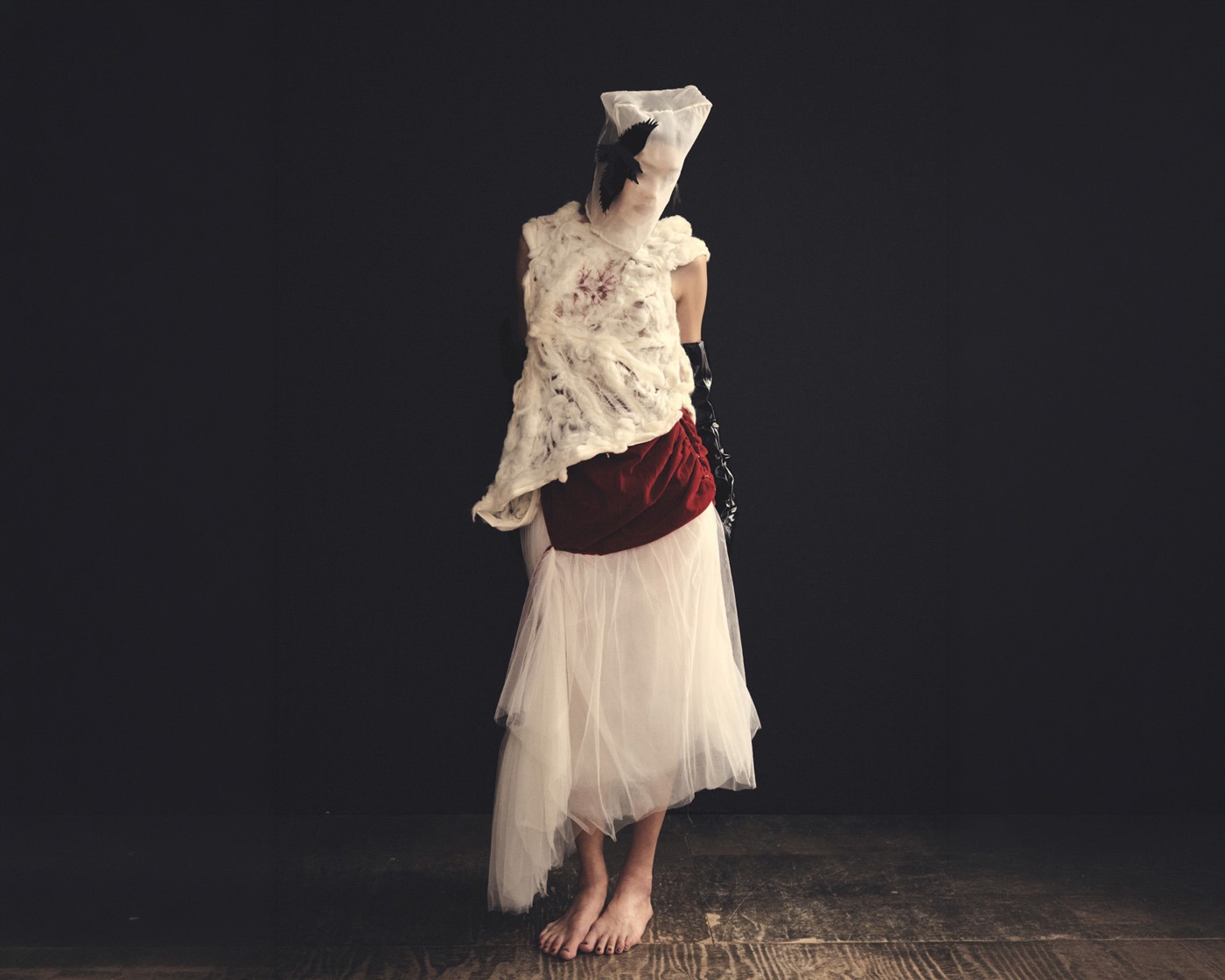
Somewhere between softness and strength, intimacy and distance, reality and imagination, there is a space that doesn’t need to be explained. It can simply exist. This space became the starting point for In Between Forms, a collaborative fashion editorial that brings together the work of three designers: Songlan Wu, Alice (Tingyu), and Yang Yang Xu.


Wool Top by Songlan Wu
Fabric with prints by Yang Yang Xu
The project grew from a shared curiosity about what might happen when three very different design approaches were placed within the same visual world. Songlan Wu contributed THE HUG, Alice brought garments inspired by Stream of Consciousness, and Yang Yang contributed her printed pieces and accessories. Rather than trying to make the collections feel the same, the team allowed their differences to become part of the story.
“We were interested in what could happen when these different forms and ideas came together in the same visual space,” Maki explains.
From there, the concept developed naturally through styling, photographing, and responding to one another’s work. The images became a conversation between the garments, the body, and the space around them. Unexpected combinations appeared during the process, shaping the editorial in ways that could not have been fully planned beforehand.
The references behind the project are just as varied. Alice’s work looks toward Stream of Consciousness, edwardian fashion, and classical ballet, bringing a sense of surrealism, theatricality, and classical composition into the images. Yang Yang’s printed pieces draw from Edgar Allan Poe’s The Raven and the experimental films of Kenneth Anger, introducing saturated colour, soft focus, and a feeling of ambiguity. THE HUG, meanwhile, brings something more tactile and emotional to the mix.


Top with Prints by Yang Yang Xu
Shirt by Alice (Tingyu Hu)
Skirt by Songlan Wu
Although these influences come from different places, they begin to make sense when placed beside one another. The editorial isn’t trying to tell the viewer exactly what to feel. Instead, it creates an atmosphere where different emotions can sit together.
For the designers, the idea of being “in between” is important precisely because it doesn’t have to be resolved. “It can be between softness and strength, intimacy and distance, reality and imagination,” they say. There is something quietly relatable about that idea. Emotions rarely exist in only one form, and the images reflect that uncertainty rather than trying to simplify it.
That feeling comes through differently in each designer’s work. There is vulnerability in THE HUG, a sense of searching in Alice’s designs, and a dreamlike ambiguity in Yang Yang’s prints. The team wanted those emotions to remain subtle rather than becoming too obvious. By leaving some things open, the viewer has room to decide what the images mean to them.


Wool Top by Songlan Wu
Skirt by Alice (Tingyu Hu)
Headware by Yang Yang Xu
The clothes also played an active role in determining how the photographs came together. Instead of thinking about the garments and the body as separate, Maki approached them as parts of the same form.
“The garments often determined the posture and composition,” she says.
The sculptural shapes of THE HUG, the delicate elements of Alice’s work, and the graphic quality of Yang Yang’s printed pieces each changed the way the model could move and occupy space. The body became part of the clothing rather than simply wearing it.
This relationship between softness and structure became one of the project’s recurring visual tensions. THE HUG explores softness through its forms and materials, while Alice combines the structure of clothing with the delicacy of ballet. Yang Yang’s prints introduce structure through colour and composition. Together, these different qualities keep the images from feeling fixed or predictable.
Bringing them together, however, was not without its challenges. With such different materials, colours, and forms, finding a balance between the three collections became one of the biggest difficulties during the shoot. Rather than forcing everything into a predetermined plan, the team stayed flexible and allowed the garments to guide the process.

Dress by Songlan Wu
Shirt, Skirt by Alice (Tingyu Hu)
Accessory by Yang Yang Xu
“The biggest challenge was finding a balance between the very different forms, materials, and colors,” Maki says. “We stayed flexible with the styling and composition, allowing the garments to guide us instead of trying to force every image to follow the original plan.”
That flexibility became an important part of the collaboration. Each designer approached clothing from a different perspective, and the final photographs grew from those differences. Some of the strongest combinations were discovered during the shoot itself, making the process less predictable and, ultimately, more personal.
Living in New York City has also shaped Maki’s way of looking at contrast. She describes the city as a place where different people, cultures, and visual languages are constantly placed next to one another. That environment has made contrast feel natural and encouraged her to look for connections between things that might not initially seem related.
That same instinct runs through In Between Forms. Surrealism meets classical references; sculptural silhouettes sit alongside delicate details; saturated prints exist alongside softer, more tactile forms. None of these elements needs to overpower the others.
Instead, they remain together, somewhere in between.
Perhaps that is what makes the editorial feel open rather than conclusive. In Between Forms doesn’t ask the viewer to choose between softness and strength, reality and imagination, or intimacy and distance. It simply creates a space where all of them can exist at once, and invites us to find our own meaning within it.


