
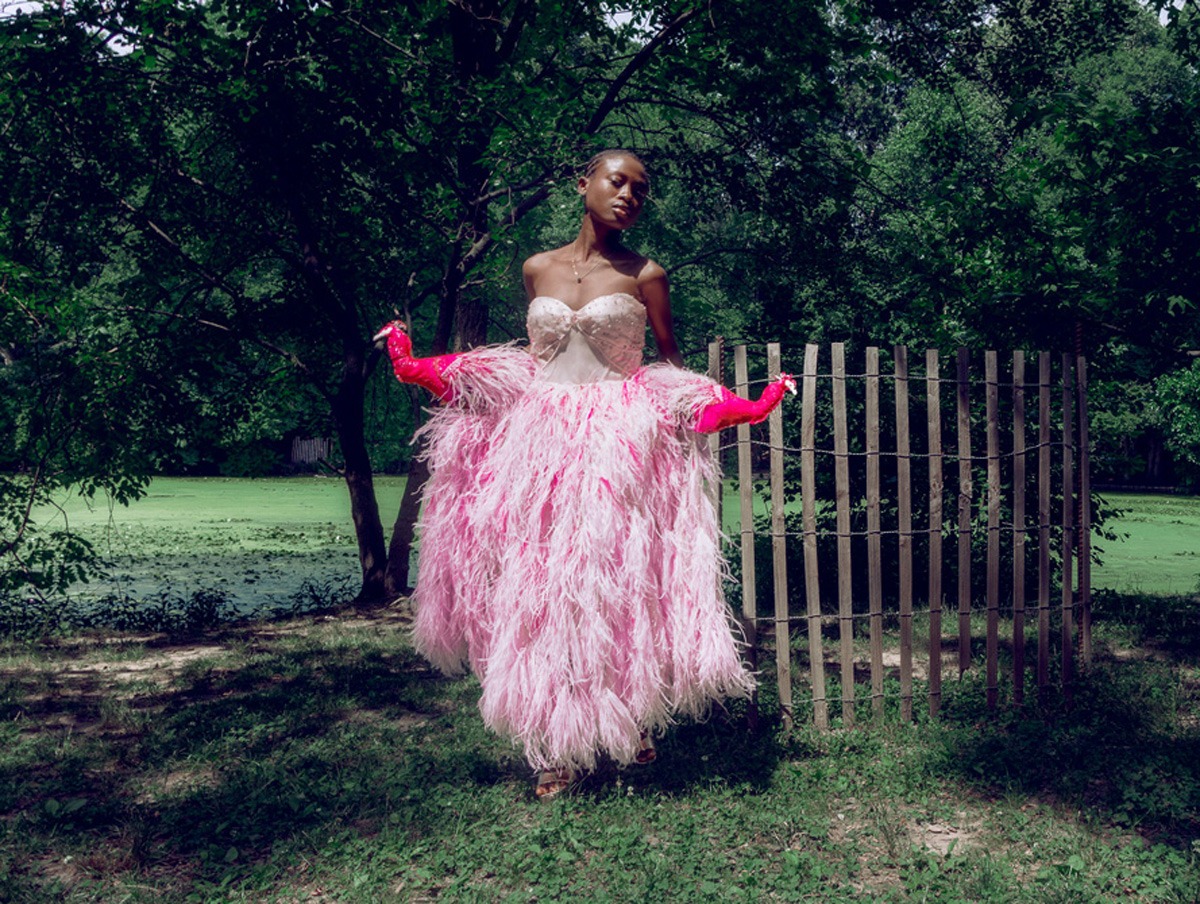
For Juleda Alili, fashion begins somewhere between memory and imagination. The Albanian-American couture designer’s practice is deeply rooted in nature, femininity, heritage, and the tactile intimacy of making. Her latest collection, Earthly Temptations, transforms those influences into an enchanted garden populated by flowers, peacocks, swans, and hummingbirds, an otherworldly landscape where beauty and desire coexist.
Described by Juleda as “a symphonic garden cultivated with enchantment and romance,” Earthly Temptations is an exploration of love, lust, vanity, beauty, and fantasy. Its visual language draws from botany, French Romanticism, classical literature, and the natural world, while its materials move between the delicate and the unexpected.


The collection’s origins are particularly intimate. Juleda’s earliest relationship with fashion was shaped by the women in her family. Growing up in the United States in a family that immigrated from Macedonia, she was surrounded by stories of female relatives who had worked as seamstresses and developed intricate weaving techniques. She spent summers in Macedonia observing the women in her family sew, while weekends with her grandmother in Chicago became an opportunity to learn the craft herself.
“From necessity to extravagance, from job to passion, I was enlightened about the endless possibilities that could be created from a piece of fabric and a stitch,” she recalls.
That inherited understanding of craft continues to inform Juleda, her namesake label, where sustainability is embedded into the design process. Her work combines complex femininity with texture, shape, and bold color, while drawing directly from Albanian culture, feminism, literature, and nature.


For Earthly Temptations, however, the garden became more than a visual reference. It became a philosophy.
Juleda’s memories of cultivating gardens with her mother and grandmother taught her about patience, dedication, growth, and imperfection. She sees a parallel between tending plants and developing a garment: both require time, consistency, observation, and an acceptance of transformation.
“Sketching a rough idea and producing a finished project is a similar cycle,” she explains.
This connection between gardening and couture is reflected throughout the collection. Juleda approaches each garment almost as a landscape, considering proportion, symmetry, color, geometry, texture, and movement. Her silhouettes interpret elements of nature rather than simply reproducing them.


One example is Madame Evergreen, a look inspired by the towering trees of her childhood environment and imagined as a “Goddess of the Woods fantasy.” Deep olive-green silk chiffon was soaked and hand-crinkled to create micro-creases resembling the texture of old tree bark. The material was manipulated to create an earthy, rough surface, maintaining the collection’s connection to cultivation and the natural world.
French Romanticism provided another essential framework. Juleda describes the collection as being entirely led by imagination, a kind of “sketchbook of dreams.” Rather than restricting herself to a single visual language, she allowed contrasting materials, structures, and textures to collide.
“Soft materials collide with tough materials,” she says, describing delicate embroidery hand-sewn onto wood panels alongside organic draping and an opalescent palette.


The collection’s romanticism is not simply softness. It is also about contradiction. Beauty exists alongside vanity; fantasy sits beside desire; elegance can carry an undercurrent of pride. Literature played an important role in developing these tensions, with characters including Madame Bovary, Esther Greenwood, Jane Eyre, and Mrs. Pontellier influencing the emotional world of the collection.
Juleda also uses wildlife as a symbolic vocabulary. Peacocks represent pride, transformation, royalty, and vanity, while swans evoke grace, perseverance, eternal love, and devotion. Hummingbirds represent joy and vitality.
These symbols become tangible through couture techniques. A peacock-inspired look incorporates sequins, glass beads, crystals, ostrich feathers, and cut beads, creating a shimmering interpretation of the bird’s extravagant display. Elsewhere, a white swan is embroidered with white cut beads and positioned against a rigid sand chest, contrasting softness with structure.


Perhaps the most unexpected expression of this philosophy is the use of beach sand. Juleda experimented with sand, seashells, wood, and water as organically sourced materials, pushing herself beyond previous work. For the Desert Swan look, she developed a mixture that could sculpt and harden sand into a structured chest plate. Creating the piece required several prototypes and hours of molding as she worked to achieve the desired shade, consistency, and strength.
This experimentation reflects a larger ambition for Juleda: to challenge the boundaries between fashion, art, architecture, and sustainable making.
For Juleda, sustainability begins with intention. Because couture garments are made to measure, she emphasizes careful calculation before cutting and sewing to minimize waste. Deadstock silks, natural materials, and biodegradable components become part of her approach, alongside techniques intended to maximize fabric utilization.

Looking forward, she imagines Juleda as a house where the natural and dream worlds become increasingly intertwined. She wants to create a physical space for experimentation across architecture, furniture making, welding, technology, and sculpting, while continuing to develop one-of-a-kind couture.
At the heart of that vision is the same impulse that shaped Earthly Temptations: curiosity. Juleda’s fashion invites its audience into a world where nature becomes fantasy, fantasy becomes form, and clothing becomes a vehicle for exploring the complexity of desire.
“I focus on nature as a mirror of human emotion,” she says.
In Juleda’s garden, beauty is never merely decorative. It grows, transforms, withers, seduces, and returns, much like the creative process itself.


