
For Sophia Tech, fashion has always been a way of expressing herself. But somewhere between developing her senior thesis at the Fashion Institute of Technology and digging deeper into her Cambodian heritage, clothing became something more personal. It became a way of understanding where she comes from, the people who shaped her, and the culture she was still learning how to connect with.
That process became SAMIKA Studios and its first collection, Apsara.


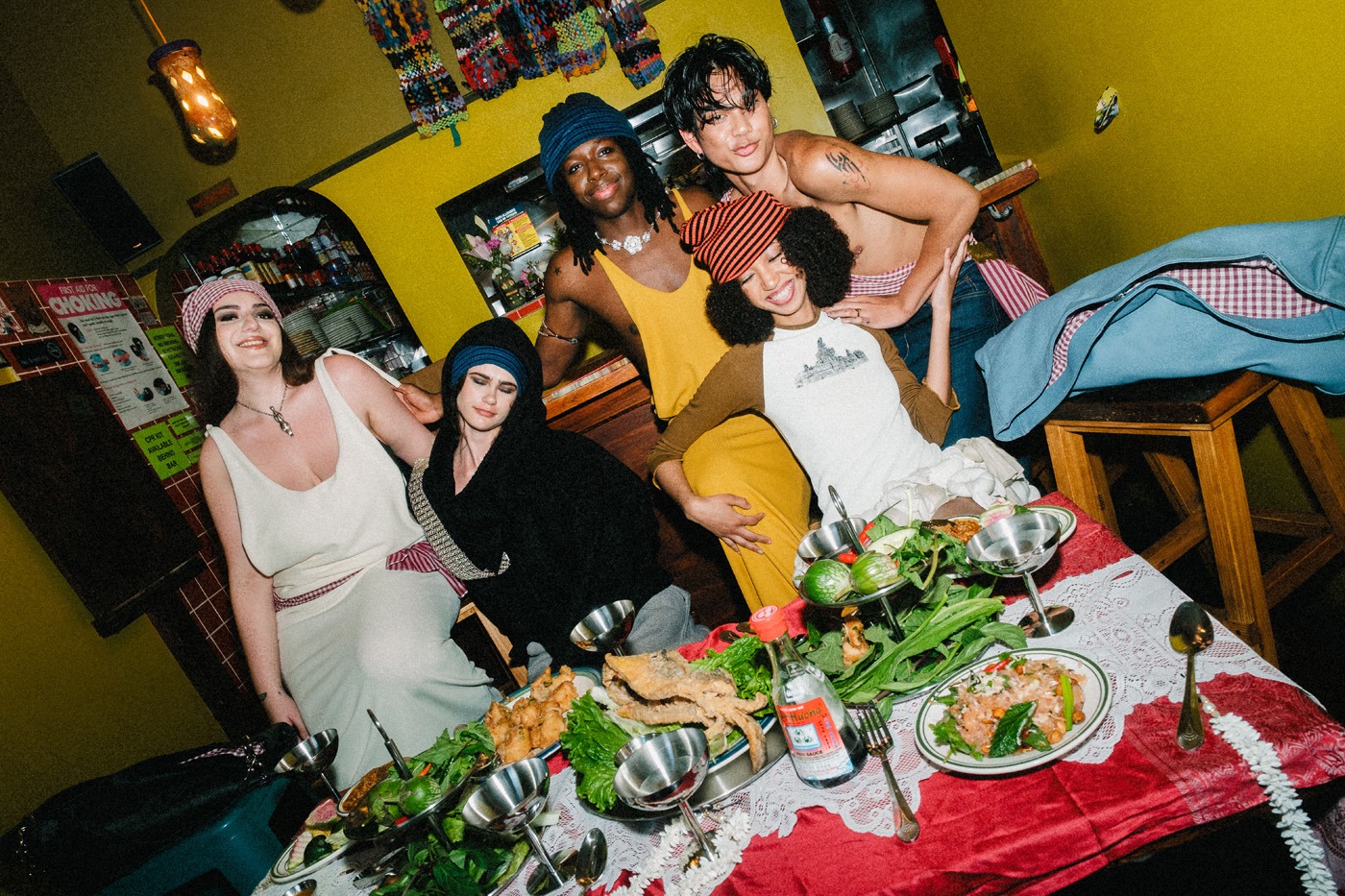
Named after the celestial feminine beings represented in the carvings of Angkor Wat, Apsara is Sophia’s contemporary interpretation of Cambodian identity. The collection brings together American streetwear with traditional Cambodian textiles, motifs, jewelry, pleating techniques, and references to the Apsara dancer. Growing up, Sophia remembers seeing statues of Apsara dancers throughout her home and her grandparents’ house. They were familiar pieces of her heritage, but through the collection, she began looking at them through her own perspective.
The name SAMIKA is personal too. Sophia’s great-grandmother, her Yeay-Tout, was named Samik, and her parents added the “-a” when naming her. “SAMIKA is truly a blend of two cultures and worlds,” she says. It is a fitting name for a brand born from the experience of being Cambodian American and biracial, and from trying to understand what it means to carry more than one culture with you.


Sophia grew up in a predominantly Asian community, but says there was a lack of Southeast Asian community around her. It was not until college that she began to more fully connect with and appreciate her Cambodian culture. Her relationship with that heritage is also tied to her family’s experience of immigration, where survival, resettlement, assimilation, and cultural preservation became intertwined.
Rather than approaching her heritage as something fixed, Sophia describes actively seeking out ways to celebrate and learn more about it. That distinction is important to SAMIKA. The brand is not trying to speak for Cambodian culture as a whole. Instead, it comes from Sophia’s own experience and from her continuing curiosity about a culture that remains very much present in her life.
“I think that my work is not something that is meant to be ‘new’ per se,” she says. “It is meant to showcase community and art that already exists through my experience.”

That sense of connection is what makes SAMIKA feel bigger than a clothing collection. Sophia believes that people want to feel connected to what they consume, and she has built the world around Apsara with that in mind. The garments are designed to be interchangeable, allowing people to mix, layer, and style them according to their own identity. Luxurious textiles sit alongside everyday fabrics, creating pieces that can move between elevated occasions and daily life.
But the clothes are only one part of the story.
For the campaign, Sophia chose to photograph the collection at Cambodian restaurant Bong, centering the ritual of sharing a meal. It is a simple image, but one that carries a lot of meaning for her. Food, she says, is an intimate way of sharing culture with the people around you.
“Our everyday rituals or routines, whether big or small, make up who we are and how we share little pieces of ourselves,” she says.
That could mean sitting down for a meal, listening to music with friends, or taking a dance class. These moments might seem ordinary, but Sophia sees them as small pieces of community that help preserve who we are. For her, fashion can exist within those moments rather than separately from them.


This is also why photography, film, music, and movement are woven into the world of SAMIKA. Sophia sees clothing as one medium among many, with each art form offering another way for people to experience and communicate culture. Together, they create a fuller picture of the community she wants SAMIKA to represent.
That belief in community has also shaped the way Sophia creates. She was part of The Debut, an immersive runway show created with three other female designers from FIT. The event brought together fashion, art, music, and food, giving each designer the opportunity to share their own world. It was created with a limited budget and tight time constraints, but friends and family stepped in to help with everything from food and modeling to hair and makeup.
For Sophia, the experience became proof of something she already believed: creative work does not have to be built alone.
“It has been such a testament that building a strong community where each person wants the other to mutually succeed is so necessary to success and building something of meaning,” she says.


That idea is ultimately where SAMIKA seems to be heading. Sophia hopes to develop SAMIKA Studios into a physical space where different art forms can exist alongside one another, allowing clothing to share an atmosphere with other artists and their work. She imagines a place built around collaborative artistry, where people can enter and feel welcomed.
“I hope that people feel a sense of belonging when they experience Samika,” she says.
There is something fitting about a collection so rooted in identity ending with a feeling rather than a statement. Sophia is not trying to tell people exactly what Cambodian culture is, or what it should become. She is exploring what it means to carry culture forward while allowing it to change with the people who live it.

At its heart, Apsara is about clothing, but it is also about the things that surround clothing: a shared meal, a familiar image, music playing in the background, friends coming together, and the memories attached to all of it.
For Sophia Tech, those everyday moments are where culture continues to live.
And SAMIKA is her way of inviting people into them.


