
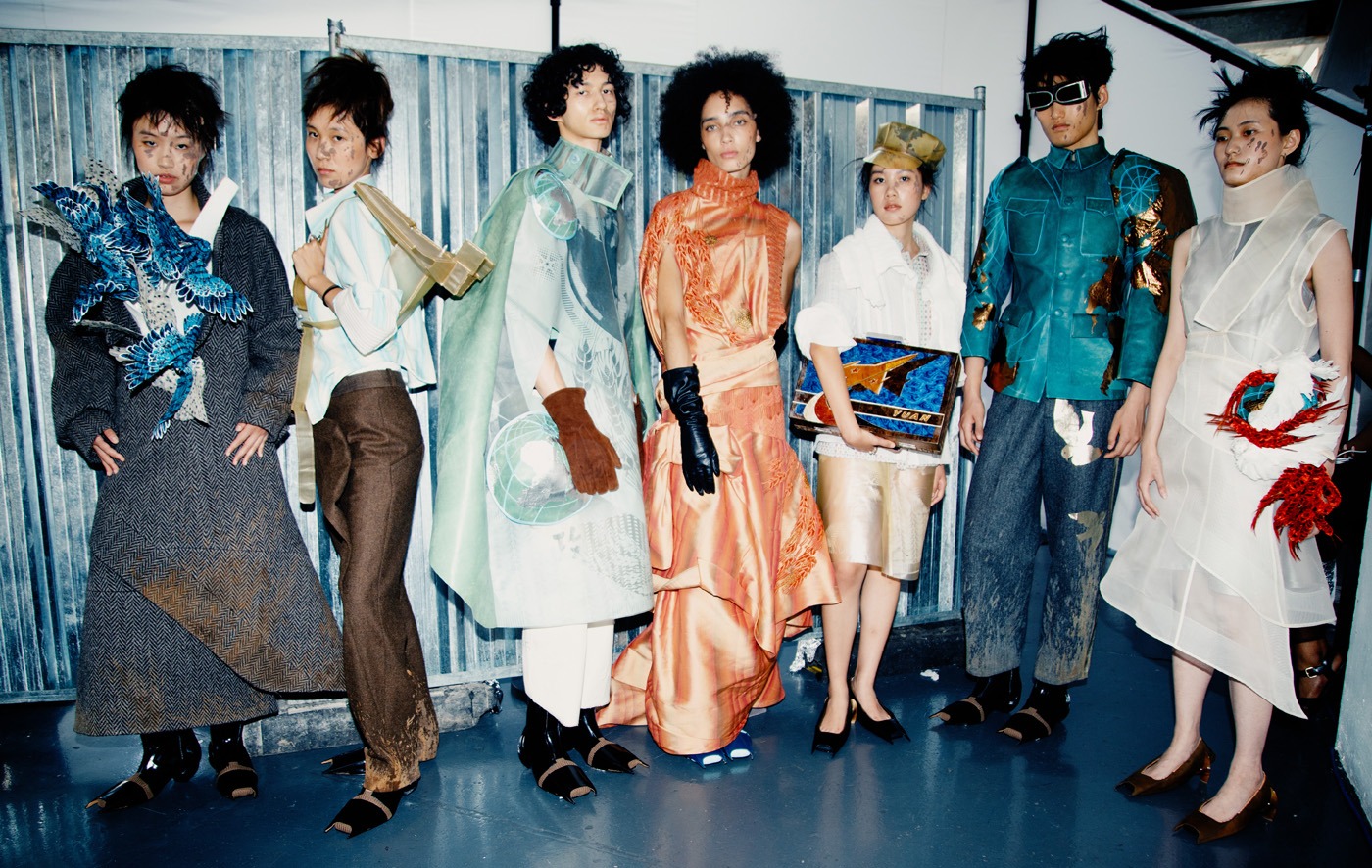
For his graduate collection at London College of Fashion, Yuan traces four generations of Chinese history through his own family’s memories, ending in a hand-built leather globe that took two weeks to construct, and a question about whether a shared future is still something we can imagine.
The globe took almost two weeks to make. It sits on the surface of a Zhongshan suit, its longitudinal and latitudinal lines built directly into leather, skived at the edges, bonded, hammered, stitched with a precision that left no room for correction. “Leather gives you very little room for error,” Yuan says, “because you can’t simply unpick a seam and sew it again in the same way you might with fabric.” It’s the most technically demanding piece in Echoes of Tomorrow, his graduate collection at London College of Fashion, and also its clearest statement: an old political garment, reworked to carry a very different question about the world.

That question didn’t start out as one about the future. Yuan, who works under the name Yuan, born Zhengyuan Lin, began by researching post-reform China of the 1980s and 90s, a period when economic reform, consumer culture, Western influence and newly reconstructed ideas of “tradition” arrived all at once, and older forms of hierarchy resurfaced alongside them. “I was becoming less interested in simply diagnosing how we arrived at this point,” he says. “I ask myself: this is where we are, so what comes next?” That shift in emphasis pulled him back further, to the internationalist imagination of the 1960s and 70s, and forward to the “global village” optimism he grew up with around the millennium, two very different eras that both, in his words, believed “people could move towards a more connected and collective future.”


The collection’s entry point, though, is personal rather than political. Yuan built the work from his family’s own archive, stories from his grandparents about being sent to Hainan Island, his grand-uncles working flood-control dams along the Nandu River in his hometown of Leizhou, and one story he keeps returning to: his grandmother’s classmates deciding to walk all the way to Beijing, refusing lifts along the way out of sheer conviction, before giving up in Shenzhen. “I love the contradiction in a story like that,” he says. “The conviction is completely sincere, but reality is always more complicated.” It’s that same tension, idealism running up against what actually happens, that runs through the whole collection.


Seven looks unfold across three chapters, People from the Field, Echoes of a Long Past, and Echoes of Tomorrow, moving from rural collectivism through the disorder of the reform years and into the present. In the first chapter, a Hanfu spiral-robe structure becomes a contemporary overcoat, doves emerging from the chest while traces of soil mark the hem, an attempt, Yuan says, to move past “stereotypical imagery” of the era and toward the more specific, human fragments passed down to him.
The second chapter is where the collection’s central method becomes clearest: not fusion, but collision. One garment appears to be built from the wrapped construction of the hanfu spiral gown, but its lower half is actually a Western suit jacket, forced to follow “an ancient Chinese logic of dressing and wrapping the body.” Elsewhere, a folded collar recalls the towel worn by workers in socialist propaganda imagery, reappearing on a silhouette that otherwise reads as a contemporary office worker. “I don’t really think of this as a harmonious ‘East meets West’ fusion,” Yuan says. “I’m more interested in collision. It reflects the historical conditions I was researching … where old and new systems of value could all exist simultaneously without necessarily resolving their contradictions.”
By the final chapter, the noise recedes. The silhouettes simplify, and the collection’s three recurring symbols, wheat, dove, globe, become more explicit. Wheat carries land, labour and collective memory; the dove, peace and idealism; the globe, the millennial belief in inevitable connection that Yuan grew up with and no longer fully trusts. “Looking back from the present, those ideas can feel almost naïve,” he says. “But that naïveté interests me. My research can become extremely complicated, but fashion is ultimately a very direct medium.” The final look returns to the classical structure the collection opened with, but lighter, softer, a sheaf of wheat, hand-cut from individual pieces of leather and wrapped in silk velvet, circling the waist.

Yuan is careful not to frame the collection as an argument. “I’m actually hesitant to say that I want the audience to ‘learn’ something specific,” he says. There’s real sadness built into Echoes of Tomorrow, an acknowledgment that the futures earlier generations imagined, including his own childhood version of a connected world, didn’t arrive the way they were promised. But he resists settling into nostalgia or cynicism about it. “For me, Echoes of Tomorrow is not about recovering a lost ideal,” he says. “It is about asking whether, after everything, we can still imagine another one.”


