
The markings look like stars. Pressed into orange leather, they spread across a dress in a pattern of small recessed points. They began as something far more ordinary: sunlight coming through a set of curtains and falling across a sofa.

That sofa is now clothing. The Room Remembers, the SS27 collection from London-based fashion and textile designer Yukito Lim, is made from leather reclaimed from the designer’s own couch, alongside deconstructed secondhand garments and deadstock fabrics. Presented at London Fashion Week with Fashion Scout, it looks at the living room as a space of intimacy, solitude and shared memories, and at what happens to those memories when the objects holding them change shape.
Lim’s habit of working with what already exists goes back to childhood, spent in the designer’s mother’s factory making clothes for dolls from leftover fabric. A vintage remake business in China followed in 2018, then studies in Fashion Design Technology and an MA in Fashion Textiles Technologies, both at London College of Fashion, UAL. During the MA, Lim also worked with Helen Storey on a project involving refugees in Malawi, using recycled materials and handcraft techniques.
The remake business shaped the approach. “When you remake a vintage garment, you work with its previous construction, its material and the traces of someone else’s life,” Lim says. It taught the designer to look carefully at what exists before deciding what to change.
The idea for the sofa arrived in a pub. Last year, over a drink with a friend in a Wetherspoons, Lim watched someone replacing the leather upholstery on a chair. Asking what would happen to the removed pieces, Lim was told they would be thrown away. “That stayed in my mind,” Lim says.
This year, wanting to change the living room, Lim faced a familiar dilemma. A new couch was tempting, but the old one, owned since February 2024, had been there through being a student, moving into full-time work and starting a company. “It carried memories, so I didn’t want to throw it away or sell it,” Lim explains. Remembering the pub, Lim decided to turn the leather into something wearable instead.
Taking it apart meant seeing a familiar object as panels, seams and construction, and some of those original seams survive in the garments so that traces of its previous life remain.

The title follows the same thinking. “The title reflects how a room holds the traces of our lives through the objects inside it,” Lim says. “My sofa remained there while my circumstances, relationships and daily routines changed. In that sense, it became a witness to my personal growth.”
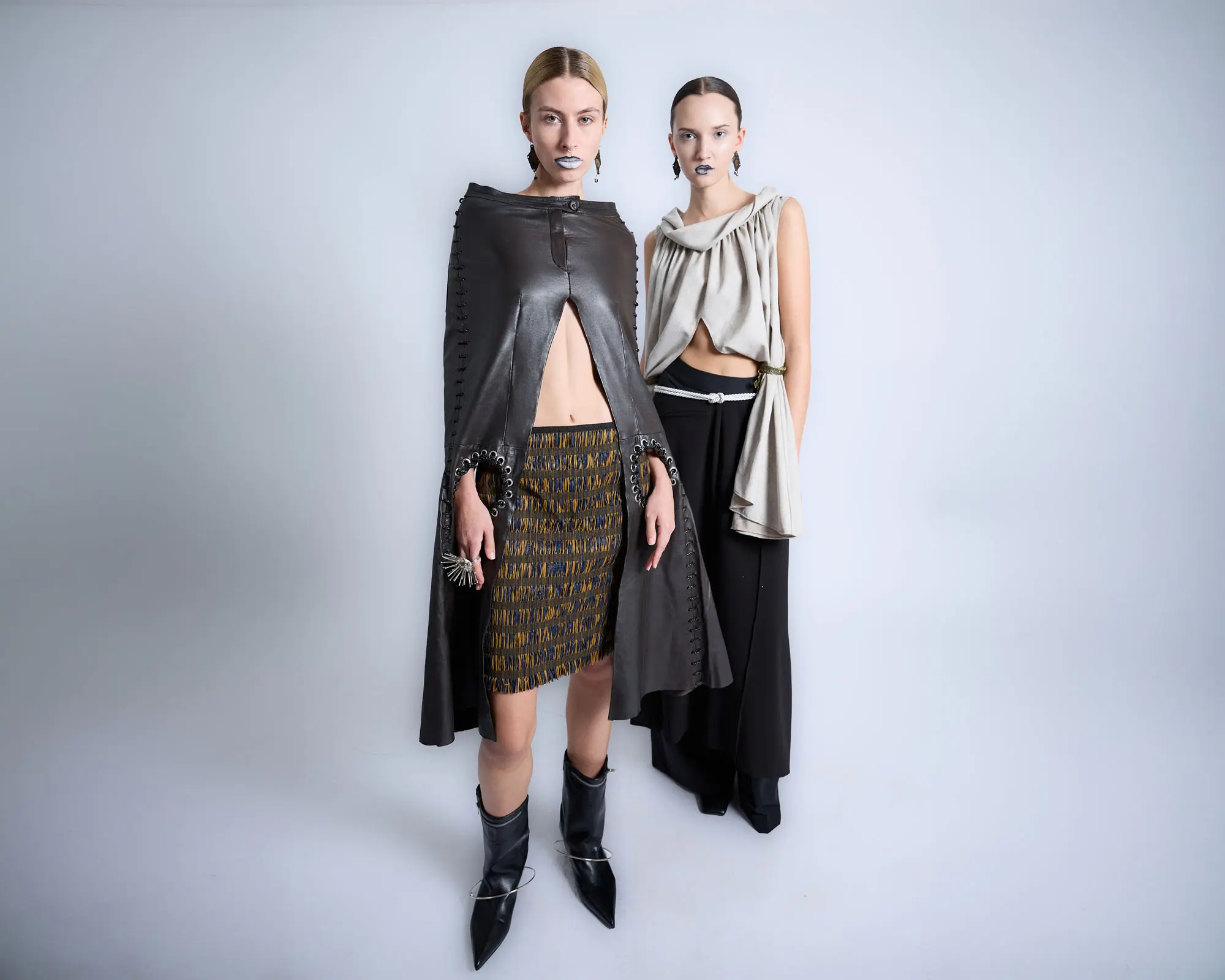
The curtains are the collection’s second starting point. They appear in folds, gathering, pleats, fringe and the way fabric is held in place, continuing an interest from Lim’s previous collection, RE, which explored curtain structures through detachable elements. Here, collected curtain holdbacks become part of the silhouettes and work as functional fastenings. The references run from a fringed skirt in Look 2 and a detachable folded top in Look 3 to a curtain-like top in Look 5 and pleated trousers in Look 6.


“I was interested in how a flat piece of fabric changes shape when gathered, folded or held back, and how that could translate onto the body,” Lim says.
Look 1 brings the two objects together. A dress cut from the sofa leather sits beside a panel of checked deadstock fabric, chosen as a contrast. The leather gives the dress its structure; the check brings folds and movement. Original sofa seams are retained, a curtain holdback works as a fastening, and the surface carries those debossed, star-like markings.

Their source is a simple memory. “I always enjoyed sitting there in the sunshine; it made me feel warm and comfortable,” Lim explains. “Although the markings can look like stars, their starting point was that everyday experience of light at home.”
Getting that light into the leather took more experimenting than any other technique in the collection. The couch leather is very thick, and Lim spent a long time testing temperature, moisture and pressing time to keep the recessed pattern clearly visible without losing the qualities of the leather.

Thickness was the wider challenge, too: leather made for furniture had to be shaped around the body, weight and existing seams included. “The challenge was finding a way to make the material wearable while retaining the character that made me want to use it in the first place,” Lim says.


The secondhand garments and deadstock fabrics take the collection beyond the front door. Lim was drawn to fabrics connected to everyday dressing, and to the situations they belong to, such as going to work or meeting friends. Through laser cutting, dyeing, knitting and textile manipulation, these materials take on new shapes while keeping elements of their history.


Now that the couch has become clothing, the designer is happy with how it turned out. “The sofa still carries those memories, but now it can stay with me in a much more portable form,” Lim says.

Looking ahead, Lim wants to keep working with existing furniture and everyday objects, and to encourage people to notice the materials around them and recognise what they could become. “An object doesn’t have to be thrown away when its original purpose comes to an end,” Lim explains.


At its heart, The Room Remembers is about keeping something while letting it change. The sofa has left the living room, but the sunlight that fell across it is still there, pressed into the leather. Through YL YUKITO LIM, as the designer puts it, the aim is to “make memories wearable.”


