
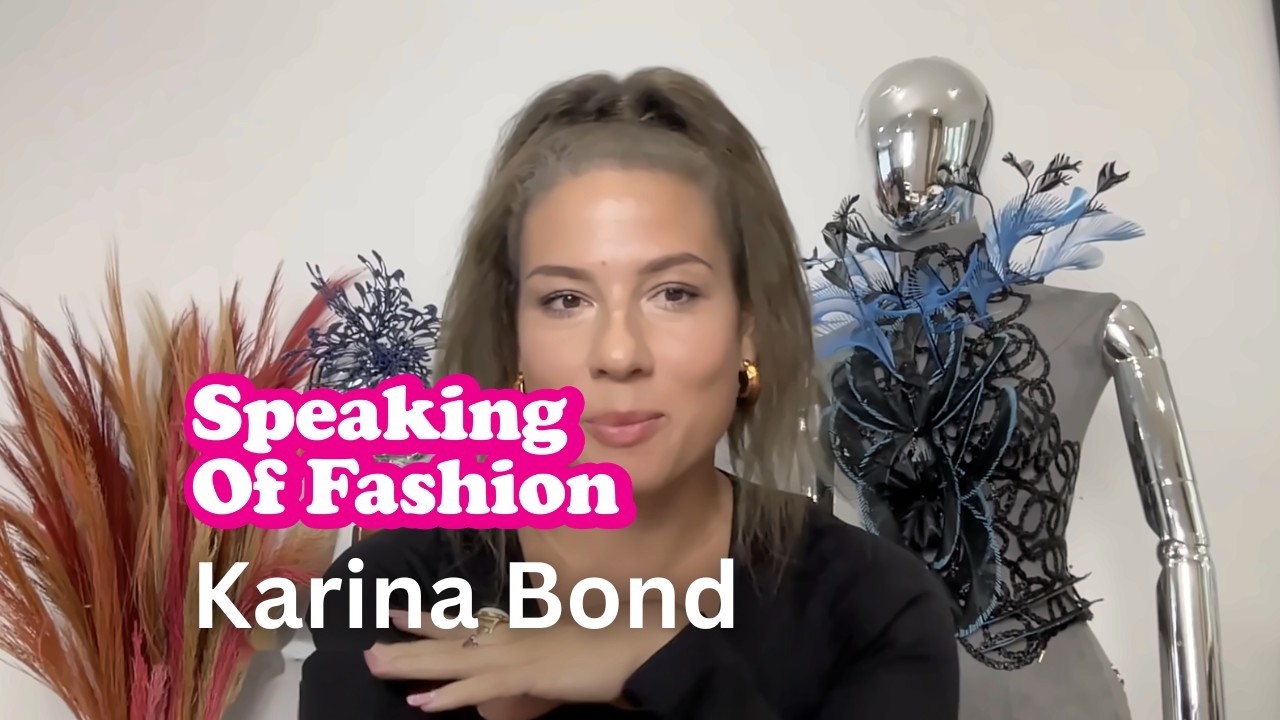
From hot glue dresses to 3D-printed couture, Karina Bond is building her own corner of fashion tech. The Central Saint Martins graduate, who got in on her third attempt, talks about pioneering couture 3D printing with a 3D pen, AI in fashion, sustainability and plastic, dressing celebrities like Jisoo, and why London may be losing its shine.
Brownfashiongal: Hi, Karina, welcome to Speaking of Fashion. I’m so happy to have you here, and I think we have a lot to talk about. You can consider me a rookie when it comes to 3D printing and everything fashion tech related, so I’m going to be asking you a lot of annoying little questions, just all the basics. To get started, who is Karina, and how did you get started in fashion? When did you realize this was something you wanted to pursue as a career, or is it something you always knew you were going to do?
Karina Bond: For me it was from the get-go. Ever since I could remember, I was drawing dresses. I knew what I wanted to do before I even knew that fashion design was a career choice. In primary school I was drawing dresses, and in secondary school that’s all I ever wanted to do. So it was a straightforward, yep, that’s where I’m going. And luckily my parents supported me through it. They asked, “Are you sure you don’t want to be a lawyer? Are you sure you don’t want to be a doctor?” And I said, no, I’m sure. Okay, fine. I was very lucky that my parents were very supportive, and they still are.
Brownfashiongal: That’s amazing. I think we often undermine the value of having supportive parents when you’re pursuing a non-conventional career choice. The only people who realize it are the ones whose parents aren’t allowing it.
Karina Bond: Well, it’s actually a family business now, because they both help me full time. A team within a team.
Brownfashiongal: That’s amazing. You’re so blessed to have that. Talking more about the details, how did you study fashion? Were you self-taught, or did you go to school? What was your fashion education like?
Karina Bond: From the get-go, Central Saint Martins was the route I knew about when I was still about seventeen. I thought, right, what’s the top fashion school? Parsons was far away, and the London-based one was obviously CSM, so that was the school I wanted to go to. But I only got in on the third attempt, so I was very committed. The first time, for the foundation, I got rejected. I went to Kingston to do foundation, and I actually discovered my love for fine art then as well, because I loved painting. This is why I do a lot of prints, and I think this is where the 3D pen comes in. I love drawing with my hand. So I did fine art for a little bit to widen the experience and see what’s out there.
A year on I went back into fashion, because it was what I wanted to do, and it took me another attempt before I got into Saint Martins and started studying fashion design with print, which I think was the best pathway for me. Originally I wanted to do womenswear, because that’s what everyone does: womenswear, menswear. But I found fashion print through my Saint Martins foundation, and it gave me the ability to draw and design textiles, work with patterns, and make my own textiles. I think that’s where my love for 3D printing also came in, being able to create not just the garment and the design but the actual textile itself.
Brownfashiongal: Right. How much would you say your traditional fashion education prepared you for running your own business, or for actually executing the garments you’re making?
Karina Bond: I don’t want to say barely, but barely. The main thing Saint Martins gives you is being able to design: the concept and the ideas. That’s what it’s great at. Technicality-wise, I taught pretty much everything to myself. And business-wise, I’m still learning. That just wasn’t a thing they taught. Which I guess is fine, because there’s so much you learn about design, you listen to amazing lectures, and you have amazing industry people coming in. There’s still a lot of value in going to uni and having been at CSM. I don’t regret a day of it. But a lot of it you do learn yourself and have to pick up yourself.
Brownfashiongal: And did you start your brand right after graduation, or did you work at a brand in between?
Karina Bond: I started the day I graduated. That’s something I wanted to do. I think I’ve always been very protective over my own ideas, and like I said, because I had supportive parents, I was able to live at home and not have to work a second job to do it. That really helped, and I was very lucky to be able to do that. But it’s all I ever wanted to do, and it was sink or swim for the first five years. After five years of working at it and figuring out what works and what doesn’t, I’m finally getting there. Ready-to-wear, for example, I’m still figuring out. And learning where you fit in the fashion landscape, I think that’s what takes the longest.
Brownfashiongal: That’s a bold move, starting your brand right away. I know a lot of people do it, but the probability of a brand continuing after five years is pretty low in fashion, is what I’ve noticed.
Karina Bond: I think it’s hardest for ready-to-wear brands. That’s the hardest thing to be right now. There are so many brands that make really nice, very wearable dresses that anyone can wear. What are you bringing that’s new? What can you actually sell that people will look at and say, yeah, this is different? That’s the hardest thing.
Brownfashiongal: Right. I’ve noticed that a lot of new designers are focusing completely on couture and custom. For example, Robert Wun is doing mostly couture and custom, even though I think he started off with ready-to-wear. It’s kind of interesting.
Karina Bond: It’s the same with Iris van Herpen, who did ready-to-wear for not very long at all and then realized this isn’t it. I actually went to talks by both Robert Wun and Iris van Herpen, and hearing them talk about the way they create and design, I can relate to a lot of it. It’s very imaginative, very fanciful, like a whole other world. It’s not so much a practical, yes, I’m making a dress and it will be worn by a certain person. It’s more, I’m creating a world. And I love that.
Brownfashiongal: I would love to know more about your inspirations. You’ve been to CSM, and I know you have a good understanding of what works and what doesn’t. Who inspires you creatively? Who are your favorite designers or creators?
Karina Bond: It’s funny, I do admire a couple of designers, but I get most of my inspiration from film, cinema, music, art, everything but fashion design. And when I design my collections, it’s not that there’s a set moment where I’m going to do my research for my next collection. It all trickles down through the months and years. I go to exhibitions, I read books, I watch certain films, and that’s what really helps inspire me.
Brownfashiongal: This brings me to a topic I was discussing with a friend the other day, which is the concept of having taste. You spend so much time researching and exploring, and that’s how you reach a point in your creative journey where you execute something. When we think of fashion production right now, especially at mass-market brands, the cycle is very simple: you see a trend on Instagram, you recreate it, and you push it out. So I want to understand how important it is, especially for emerging designers and students who are just discovering what it is to have a creative journey, to do research and build your own taste, since you’ve experienced it.
Karina Bond: It’s a good question. Trends will always be there, and trends are relevant. I used to be so against trends, but I have come to realize that for certain brands they are relevant. I get it. But it’s about not getting lost in the doom-scrolling of Instagram and seeing what’s relevant. It’s about what you actually like yourself. I have so many different interests. For example, I do figure skating, which is so irrelevant to fashion, but I love it. I also love surfing and sailing, so many hobbies that are not related to fashion. When I do those things, that’s when I get some of my most creative ideas, because it’s so different and I don’t have the pressure of needing new ideas. It’s when I almost switch off my brain from research, from wondering what’s next, and just let my brain relax. That’s when I get the best ideas.
Brownfashiongal: That’s amazing. Society in general is struggling with a lack of hobbies, I feel, and it’s so important. Most people are just doom-scrolling all the time. Very few people are actively engaging and trying to build hobbies and interests, which obviously leads to a better creative understanding and execution.
Karina Bond: A hundred percent. Funnily enough, you’re on my piano right now, because I had to move my laptop. I’m not joking. That’s what I mean: I live and breathe my hobbies. All my friends say, “There’s Karina learning a new hobby this year.” But that’s what keeps my brain flowing.
Brownfashiongal: I love a woman with multiple hobbies and interests. And I think that’s especially important with the kind of work you do, because your work is inherently so custom and so niche. It’s not massy; you’re not selling a button-down shirt. So it’s important to keep yourself surrounded by things like this. Now I want to get a little more into the execution part of it. Let’s start with explaining to someone who doesn’t know what 3D printing is: what is 3D printing?
Karina Bond: It’s basically the same as 2D printing, but instead you’re printing layer by layer and building whatever it is. If it’s a cube, imagine the cube being built layer by layer until you reach it. That’s pretty much all it is. And the beauty of it is that you can design whatever you want. This is why I always love to compete with AI fashion. Speaking of research, I will happily research AI fashion. I think it’s hilarious to look at, because I’m like, you think that can’t be made in real life, but actually it can. So that’s basically all it is: like 2D printing, but in layers.
Brownfashiongal: And how did you decide that this was something to build your brand or your creative language around? It’s not something you can do at scale, I’m assuming, especially with the current infrastructure. Maybe I’m wrong in that assumption, but how did you land on 3D printing?
Karina Bond: I think the fact that you can’t do it right now is what draws me in. It’s the fact that you can’t do it at large scale. It’s something new that hasn’t been explored, so I was really drawn to it. But I’ve also always been drawing designs, and a lot of times I was told off for it at uni, because I’d draw designs that can’t be made in fabric. I’d draw something and my tutors would say, okay, this is interesting, but how does it translate to real clothing? And I’d say, well, do you mean it’s not real clothing? This is just how I see it. So 3D printing is a way for me to translate something that fabric just cannot do.
And for me that’s a natural step in the future of fashion: moving away from sewing machines, something we’ve been doing for hundreds of years. The technology behind making clothes has not changed in hundreds of years. So that’s what’s exciting to me.
Brownfashiongal: I have a hypothetical question. Do you ever see a point in the future where people have their own 3D printers and design things for themselves to wear, or is that too far-fetched?
Karina Bond: I think that’s totally possible. We’re not chefs, but we have ovens. It’s the same. I’m very excited for that. I’m even more excited about the fashion technology around 3D printing: 3D scanning, and ways to produce clothing that isn’t by size, this is a 14, this is whatever, but is truly custom-fitted to your body. I think that’s very doable. I don’t know if it’s in the next hundred years, but yeah.
Brownfashiongal: Your designs have a very clear futuristic appeal. If I were to see a dress you made, I would assume tech, future, even though it has very beautiful organic references. For a non-fashion person it feels extremely futuristic. Do you think that aesthetic of futurism is a part of your brand, or is it something that just happens when you use technology like that?
Karina Bond: I think it’s a natural aesthetic. Going back to the fact that I like trying new things and things you can’t make with fabric, your eye naturally thinks, this doesn’t look like a fabric garment, therefore it must look futuristic. The futuristic aesthetic itself is interesting to me, because what is the futuristic aesthetic? How do you perceive it? This looks futuristic, but what about it is futuristic? I guess the way it’s made, because it’s a new technique. It’s a fashion tech technique. So it comes with the aesthetic.
Brownfashiongal: You mentioned that you can create something AI can envision, and that 3D printing gives you the freedom to create what we couldn’t even think of before. Do you see your work as an answer or a counter to AI-generated fashion? In the end, AI fashion isn’t real, and you’re executing it. I want to understand what you think of these AI-generated designs and how they factor into your work. I think I saw a comment under one of your posts saying it was AI, and I thought, that’s so random, because it’s so clearly not.
Karina Bond: What’s fascinating is that some people think it might be AI. I read somewhere, or someone told me, that we’re the last generation who will be able to tell the difference between what’s AI and what’s not, because AI is becoming so real. So being compared to AI is kind of flattering, actually. AI is seen as a tool you use to make something you can’t make in real life, so to be compared to that, I’m like, okay, I’m doing something that people think cannot be done in real life. To me that’s a compliment.
As I said before, I’ll go on Pinterest and look at AI fashion, and it’s interesting to me to see what people translate into AI fashion that they think cannot be made in reality. For me it’s always a challenge: can I make this in real life, when people think it can only be made in AI? And I do use AI. I think if you don’t get on board with AI, you’ll just fall behind as a brand from a commercial perspective. So I actually quite like AI and its tools in some ways.
Brownfashiongal: I get that. AI is such a controversial topic, especially in this current climate, that people either love it or hate it. It’s very difficult to find someone with a neutral stance. And in the end, so many productivity tools and basics are being rebranded as AI. I was reading a piece saying that even the remove-background feature on Canva now counts as AI, and I thought, that’s crazy, that existed before AI. But you mentioned that you use AI for research and design inspiration. What would you say to a person who’s completely anti-AI, because there are a lot of them? How do you deal with that criticism?
Karina Bond: What I’ve realized is the difference between a human brain and AI. For creative thinking, AI is very logical: one plus two equals three, and so on. The true beauty of creativity in a human brain is that we can combine two completely opposing thoughts into one idea, and I feel like that’s something AI can never do. Well, maybe it will, but for now at least it can’t. So, knowing that, I use AI as a supplement: okay, I have this idea, this is the clear idea, it’s my own, now expand on it, give me more options, tell me how I can improve it. That’s one thing. But using it to completely generate a whole collection, for example, is completely different, and I would be anti-AI for that reason too.
Brownfashiongal: Got it. Fashion tech is a huge domain, and there are so many startups and new techniques popping up where people are experimenting with how to bridge the gap between tech and fashion. Are there any other areas or domains that you think have a major growth opportunity, or that excite you in fashion tech?
Karina Bond: I’ve gotten a lot more interested in combining 3D printing not just with occasionwear but with sportswear. I’m quite into sports; I play paddle tennis, all sorts of things. So going outside of this-is-high-fashion and 3D-printing-is-high-fashion, and combining the two, is super interesting. And there are so many fashion technologies. I mentioned 3D scanning, and I think that could be huge in the fashion world. I want to be able to go into a Karina Bond shop, get 3D scanned, and have my garment printed for my measurements. And using fashion tech not just as a way to produce clothing but as a creative tool. I think that’s the difference, because at the moment we use it in production, but actually using it for creativity and design is important.
Brownfashiongal: I want to understand a little more about the intersection between 3D printing and sustainability. Whenever we talk about fashion tech, questions about sustainability are hounding the fashion industry. So out of ten, how sustainable is 3D printing, and how sustainable is it not?
Karina Bond: I think it can be incredibly sustainable. Is it at its most sustainable? No, because there’s only a very limited number of filaments you can use, and I’m trying my best to work on this in the future. If we can make a filament that’s as soft as any clothing you wear, and you can 3D print that, it will probably be the most sustainable thing you can produce, because at the end of the day, with 3D printing there’s almost no waste. And being able to 3D print, like I said with sizing, means there’s no wastage or stock required, because it’s printed completely to your size. Those are the main benefits. It’s not a crazily complicated process, but it’s still at its very beginning.
I also think things like deadstock material or upcycling, you won’t need to do that. I think that’s a very past kind of thing that’s still considered sustainable. We need to move a bit beyond it. I think it’s a bit primitive compared to what we can do now with 3D printing and fashion tech.
Brownfashiongal: I think you brought up an amazing point, which is how upcycling, and the whole upcycling aesthetic, is held at the pinnacle of sustainability, but it’s really more of an aesthetic. Most of the brands that do it aren’t really focusing that much on upcycling; it’s the aesthetic of upcycling that’s being sold, I feel.
Karina Bond: But also, okay, you upcycle one thing, someone buys it, and then it goes to waste. It gets binned. You’re only slowing down the process, but the end goal is the same: it ends up in the landfill, potentially, potentially not. So I think it’s about imagining new ways to be sustainable, rather than saying, I’m using a new material, so it’s sustainable, but you’re still making a million of those things. I have lots of opinions on this.
Brownfashiongal: I love that. This reminds me of the whole conversation on the internet about polyester, and how Gen Z is absolutely hating on polyester, rightfully so, since polyester is very questionable, and using it as an insult. Have you heard of that?
Karina Bond: I have. I’ve seen it in my comments, because at the end of the day, what I make is technically plastic. And I actually have something to say about that, because I find it so interesting that people say, my god, it’s plastic, so it’s bad. And it’s like, no, not quite. Yes, sure, some plastics are bad. But a synthetic material does not equate to being bad or unsustainable. For example, this is made out of PLA, which is made from polylactic acid, which is made from sugar cane and starch. So it has a natural-material beginning. I’ve explained that terribly, but I find it interesting that synthetic materials aren’t necessarily a bad thing if they’re produced correctly, used correctly, and recycled correctly, if the circular economy thing works. Even cotton and leather have so many harmful processes, and they’re natural materials. Everything has a price.
Brownfashiongal: Exactly. I was going to say the same thing about fur: people say fake fur is better, but it really isn’t; it’s in fact so much worse for the environment. And it’s kind of interesting that one of the biggest insults Gen Z has right now is based on a fabric. If you think about how polyester started in the market, it had very noble origins. It was so much better than everything else. And now, with ultra-fast fashion, Shein and Temu have gained such a bad reputation. One more question: one of the biggest criticisms people have regarding polyester is that luxury brands are selling one-hundred-percent polyester garments for two or three thousand dollars. What’s your take on that? Is it a valid criticism from consumers, or is it something brands have to do?
Karina Bond: No, brands absolutely don’t have to do that. That’s ridiculous. It will always be ridiculous in my mind when it’s a T-shirt that’s 2K because it’s Louis Vuitton. Who cares? Well, clearly people do, because they buy them. I don’t even like to take up my brain space thinking about it, because it will just drive me insane. But people do crazy things. That’s still insane to me, but hey, that’s the world we live in.
Brownfashiongal: Unfortunately. You show at London Fashion Week, and talking about the bigger scope of the industry, there are so many brands like yours doing incredibly innovative things, but I’m not sure how much of a support system these tech-forward, creative brands actually have. Do you think the industry is supportive of emerging designers who are trying to do something different? It’s very different if you’re doing an evening-wear gown brand, but when you’re truly experimental, how supportive have you found the industry to be?
Karina Bond: Creative-team-wise, I’ve had a lot of support from London. I feel like London creatives like to support one another. It’s more the organizations that aren’t as supportive. How do I put this politically correctly? I’ll focus on the positives. The best support you can get as an emerging designer is surrounding yourself with creatives: makeup artists, hairstylists, fashion stylists, shoemakers, milliners, and so on, supporting one another, working in a group, collaborating. I think that’s the best thing.
The last thing I would do as an emerging designer is try to find support through funding, applying to certain things, and trying to get on the schedule, because that’s a lottery in itself. I don’t think it reflects your talent or how much you can achieve. Being in a creative team who support one another, who make things work and do things for free and can make a beautiful product, is a much better way of getting support.
Brownfashiongal: Makes sense. London has a reputation for being the most supportive for emerging brands, and rightfully so; so many amazing young brands have come out of London. But does it actually hold up to its reputation as the hub, the holy grail of emerging designers, or are there things that can be done better?
Karina Bond: I think it still thinks it does. But having spoken to so many other creatives in the London scene, and some real veterans (I work with a really good choreographer and show caller who’s been around for decades), it’s not the same as it was. Maybe that’s because there are so many other fashion weeks, like Copenhagen and Madrid, I believe, that do it just as well and have so many talented designers who are finally getting the spotlight. London is competing with some really incredible designers who are just as good, if not better, and whose ideas are just as amazing. So I think it is losing its shine. It’s not what it was in the nineties or the noughties, which is fine; it’s just evolving. But I do sometimes feel that London needs to get off its high horse, be a little more humble, and accept that there are so many other amazing cities that do fashion weeks just as well.
Brownfashiongal: I’ve heard this sentiment from a lot of people, so I think there’s definitely something that needs to be done. Even though I think the British Fashion Council is pretty active, there’s always room for more.
Karina Bond: Well, listen, this is what I mean. London has this reputation that we’ve always been one of the top cities, and I don’t think that’s the case anymore at all. And as proud as the British Fashion Council is of London designers, yeah, that’s the truth.
Brownfashiongal: I get it. We talked about this before: you’re so good with social media, and your work is incredibly eye-catching. When you’re scrolling through Instagram, it’s something you’re bound to stop at. I say this with respect: it’s very social-media friendly. Has that social media virality actually translated into sales, revenue, or business opportunities, or is it just likes and comments as of now?
Karina Bond: I definitely think virality equates to sales and business opportunities, a hundred percent. Even with the bags, I’ll make a reel that has nothing to do with the bags, and if it goes viral, I sell more bags instantly. It’s very interesting. Most of my clients for the bags are in the US market, which I find quite interesting too. And with certain reels going viral, like a 3D-printed top, I’ll get a stylist requesting it pretty much for the next day, to be sent to LA or somewhere. It does equate. So for me, content creation and virality are very, very important. The more followers you have, the bigger the foundation you have when you pitch to stylists or brands. I can say, this went viral, therefore I’m a reliable person to work with to make something successful. More people believe you.
Brownfashiongal: That’s amazing. I ask this question to almost everyone functioning on social media, and you’re the first person to say that it’s equated to business opportunities. I wonder why. Maybe it’s because your brand is so clear in its vision, and the offering is so clear when you enter your page that you know exactly what this brand stands for. This brings me to another question: I noticed you’re focusing a lot on bags. How did that decision come about?
Karina Bond: I think it was an easier thing to start with commercially, because it’s a small piece of 3D printing and it fits into a 3D printer. You can fully print something that you can then sell straight away. It was also an easy way to experiment and learn how to use a 3D printer and how to do 3D modeling, which, by the way, my dad now does all of. I’ll do a design and he’ll translate it. Together we worked out how to use these 3D printers. We’re all self-taught. So the bags are a small experiment toward a much bigger picture. With the bags I’ll sometimes try a 3D pen bag as well: I’ll 3D print the base and 3D pen the design, which gives me an idea, on a smaller scale, for perhaps a fashion piece.
Brownfashiongal: Amazing. So the bags are one hundred percent 3D printed. I want to learn more about the 3D pen you mentioned, because I see you use it a lot in your work, and when I’ve seen the videos of you using it, it feels pretty magical. How does it work? I want to know the tech behind it.
Karina Bond: I didn’t realize people didn’t use it for fashion. Let me go slightly back in time to how it started. At uni, for my graduate collection, I made a dress out of hot glue. I used a hot glue gun and about a million hot glue sticks to actually draw the textile thread by thread and make it into a dress. Then I got commissioned by Toni&Guy to make some tops, and they wanted me to use the same technique. It looks like this hand-drawn silicone thread thing. But the issue with the hot glue was that under certain lights it would start melting, because it had a very low melting point.
So I had to find something else, and it was my dad who found the 3D pen. He said, why don’t you try that? I saw that it was mainly used for arts and crafts and kids at school, and I wasn’t sure it would be good for high fashion, but we tried. The filament it comes with, the one people normally use, is actually PLA, which is what the 3D-printed bags are made out of. It’s a hard filament, so when I made it, I thought, okay, you can’t actually wear this. And all it is is the 3D printing filament you’d insert into a printer. Give me two seconds, I can show you.
So this is the filament, the stuff you put into a 3D printer. It goes through a little nozzle in the printer and prints layer by layer. With a pen it’s the same concept. You feed it in, turn it on, it heats up, and then you draw with the melted filament like you would with a pen. The thing with hot glue is that you wait maybe thirty seconds for it to set. This cools in about five seconds. In some of the ads they show you can draw upwards, in every dimension. That’s why it’s called a 3D pen.
The funny thing is that the actual technique is really simple and very straightforward; it’s just a filament. But the pens aren’t meant to be compatible with TPU, which is the rubbery kind of filament that bends and that you can wear. I thought, I’m going to try it anyway. If it breaks, it breaks; it’s not that expensive. I tried it and it worked. When I uploaded it, I realized, wait a second, I might actually be the first person to have done this. So I held on to it and thought, my god, this is an idea. I need to hold on to this, pioneer it, and experiment as much as I can, because this is technically 3D printing as well, in a hand-drawn couture way. I call it couture 3D printing.
Brownfashiongal: I love that. The pen is what really fascinated me when I was going through your material. It feels so different, and I don’t think I’ve seen anyone use it in their core brand direction. That’s pretty fun. I also noticed you’ve been dressing a lot of celebrities, Jisoo being the latest. Congrats on that, that’s a big deal. How does a young designer get their pieces onto big names? What is the process, for someone who needs that exposure?
Karina Bond: Honestly, it took time. That’s the best thing: time, and just showing up and saying, I’m still here, I’m still a designer, this is my passion. The stylist I worked with for Jisoo also styles Björk, whom I absolutely adore. I think I emailed her three or four years ago when I first started, and she was one of my goal stylists. When I first started I emailed everyone and got no responses, which is fine. You just keep showing up. I started with smaller celebrities with smaller followings and showed, yes, this was worn to an event. Sometimes I had friends who weren’t even famous but were invited to a premiere or something, and I’d ask, can you please wear my piece, so it would be seen at this important event. Sometimes the event is more important than who wears it, because then you can say, this was worn to this premiere, so I’m a good designer and I deserve to be worn by a celebrity.
It’s things like that, and building over time. There are still celebrities I’ve loaned to who haven’t worn it, because there are so many times you loan to celebrities and they don’t wear it. Even Lady Gaga, who I’ve loaned to, hasn’t worn my pieces yet. I’m still waiting for that. It’s still a process. There are so many celebrities I want to dress: Lady Gaga, Anya Taylor-Joy, so many. Work in progress.
Brownfashiongal: Lady Gaga is right up your domain. I think it’s going to happen. I can just see her in your pieces. One last question from my end: there are so many things fashion gets right, but more that it gets wrong. As someone running an experimental brand, what can the industry do better to support designers, not just in London or in tech, but in the fashion industry in general?
Karina Bond: I think the issue is that we only see something as successful when it’s been praised by all the publications and the right people have ticked the box and said, yes, this person is important. It’s so rare to see innovation being supported at a very experimental level, before everyone else has caught on. I think that’s the essence of human nature, but it would be great to have more. You’ve got the LVMH Prize, and I might apply this year, we’ll see, but I’ve put off applying because I’ve felt I need more time. At the same time, the hardest thing to get through as a brand is your early years. Like I said, it’s sink or swim. So if there were more support for real emerging designers, not emerging designers who are ten years into the business, that would be amazing.
Brownfashiongal: And I don’t know if anyone who’s been in the industry for ten years qualifies as an emerging designer.
Karina Bond: I’m specifically saying ten years because the British Fashion Awards have their emerging and breakthrough designer categories, and most of those designers have been in the industry for eight to ten years.
Brownfashiongal: Really? Interesting, I never noticed that. I don’t think ten years counts as an emerging business in any domain, never mind fashion. Even a tech startup isn’t considered a startup after ten years.
Karina Bond: Exactly.
Brownfashiongal: Okay, amazing. I think that’s pretty much all the questions I had in mind for this conversation. It was amazing speaking to you, Karina. Thank you so much for joining us on Speaking of Fashion. I hope you had a good time.
Karina Bond: I did. I love talking about all of this.
Brownfashiongal: I think we have a lot more to talk about, and maybe we can do another conversation sometime in the future. I think this was like a mini YouTube course for me. I learned so much, and I need to go back and read up on so many things. That’s the point of conversations like this: viewers can hopefully take away something new and meaningful, because most of our audience are young students and independent designers. Thank you so much for sharing your knowledge.
Karina Bond: Any time. Literally, any time.
Brownfashiongal: Thank you so much for joining us.


