
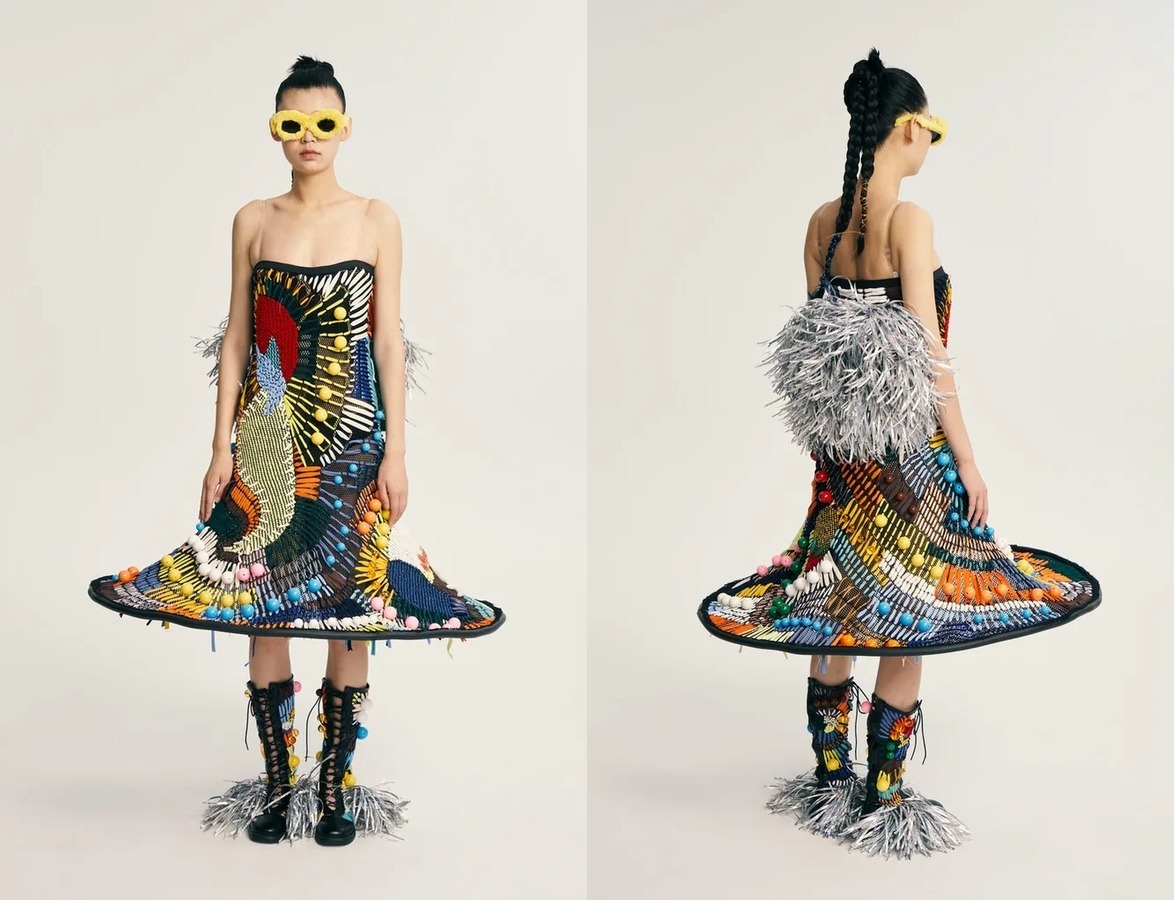
The dress takes more than 60 hours to weave, but its argument begins with the repeated movement of a hand. Cotton strings, metallic tinsel and thin hemp build an image around a fishnet foundation, gradually forming a queen bee across the upper-left bust. In Sophia Wang’s Be(e)have, the work of making the garment becomes inseparable from its subject: the routines through which individuals contribute to a collective, sometimes without noticing the pattern they are following.
Wang, a fashion design senior at Parsons School of Design, approaches the body as a space for visual storytelling. Her interest in theatre and world-building extends beyond the dress to boots, sunglasses, hair and make-up. The complete look carries the same metallic textures and bee-like references, allowing a question about obedience to unfold from head to toe.

That question predates the garment. In high school, Wang created an installation using carefully constructed mirrors and wires to examine hierarchy and collective obedience. The queen bee appears as a form of “sacred authority”, an image through which she considers the relationship between an individual and a larger structure. Be(e)have returns to that investigation through clothing, giving the abstract system a physical weight and a place against the skin.

The colony is Wang’s metaphor, not a lesson in biology. Her concern is how people surrender autonomy to authority, accepting instructions and repeating familiar actions without questioning them. A garment built through hours of repeated gestures offers a way to consider that condition from within the process itself. The maker is not simply illustrating routine. She is living through one.
Before each weaving session, Wang takes off her accessories and changes into pyjamas, protecting her clothes and keeping small possessions from disappearing among the materials. She lays out the strings and begins, usually with a film playing in the background. Work occupies roughly two hours on weekdays and four at weekends. After two weeks, physical strain makes the rhythm harder to ignore.
“A parallel gradually emerged between this instinctive cycle and human labour,” Wang explains, “where repetitive actions become so deeply embedded in everyday life that they are performed almost unconsciously.” The repetition provides the connection she wants the finished dress to hold. Individual movements accumulate into an image, just as familiar tasks can accumulate into an entire way of living.
The image itself begins with research into laboratory photographs of queen bees under a microscope. Wang makes numerous illustrations and tests colour combinations before translating that research into woven form. The bell-shaped base supplies a symmetrical outline, but she deliberately unsettles it. Placing the queen on the upper-left bust establishes an off-centre focal point, with colours and patterns radiating across the silhouette.

The tension is between the order of the whole and the particular detail that interrupts it. Wang does not usually favour symmetrical garment design, and the displaced graphic prevents the bell shape from becoming too settled. Varied strings give the surface differences in texture as well as colour. Silver tassels extend from the back and the boots, carrying the bee reference into a more mobile, tactile register.

The hem offers another interruption. Wire boning, with foam piping around its exterior to make sewing easier, allows the skirt to be manipulated into different shapes. “Transformability symbolises individuality and the potential for different forms of expression within the mass public,” Wang says. The structure can hold a collective outline without insisting that it remain fixed.


“Although people may appear to function as one unified collective, every individual has the potential to take on different forms,” she explains. It is a possibility embedded in construction rather than added as a separate message. The wearer can change the shape of the same garment, finding variation within its existing framework.


Holding that framework on the body proves more difficult. Strings, beads and metal boning make the dress extremely heavy, and the intended strapless construction struggles to stay secure. Experiments with drawstrings and zips do not provide the desired result. A corset is deliberately ruled out because its structure would interfere with the bell-shaped silhouette.
Several fittings lead to elastic, which gives the model the strongest sense of support, together with transparent shoulder straps. The solution preserves the shape while acknowledging the body that must carry it. “Creating a polished fashion look goes beyond garment design,” Wang says. Her full-body approach requires each component to work with the others, practically as well as visually.


Transformability continues in her current collection, which explores interior and exterior through the relationship between backstage and frontstage. Drawing inspiration from Petra Blaisse and the movement of theatrical curtains, Wang experiments with magnets that let a long coat fold into a shorter jacket. Optical-illusion pattern cutting suggests one shirt growing out of another. In Be(e)have, that interest is already present at the hem: a carefully built structure that leaves room for a different shape.
Designer and Creative Director: Sophia Wang
Photography: Jinjin
Model: Xu Li
Make-up and Hair: Cherry (yingtao)
Styling: Sophia Wang
Support: Otto Sun
 About the designerSophia WangParsons School of Design, The New School
Sophia Wang is a Parsons Fashion Design senior who loves visual storytelling, theater, and world-building. She explores the intersections of fashion, art, and cultural hi…
View profile and collections →


