
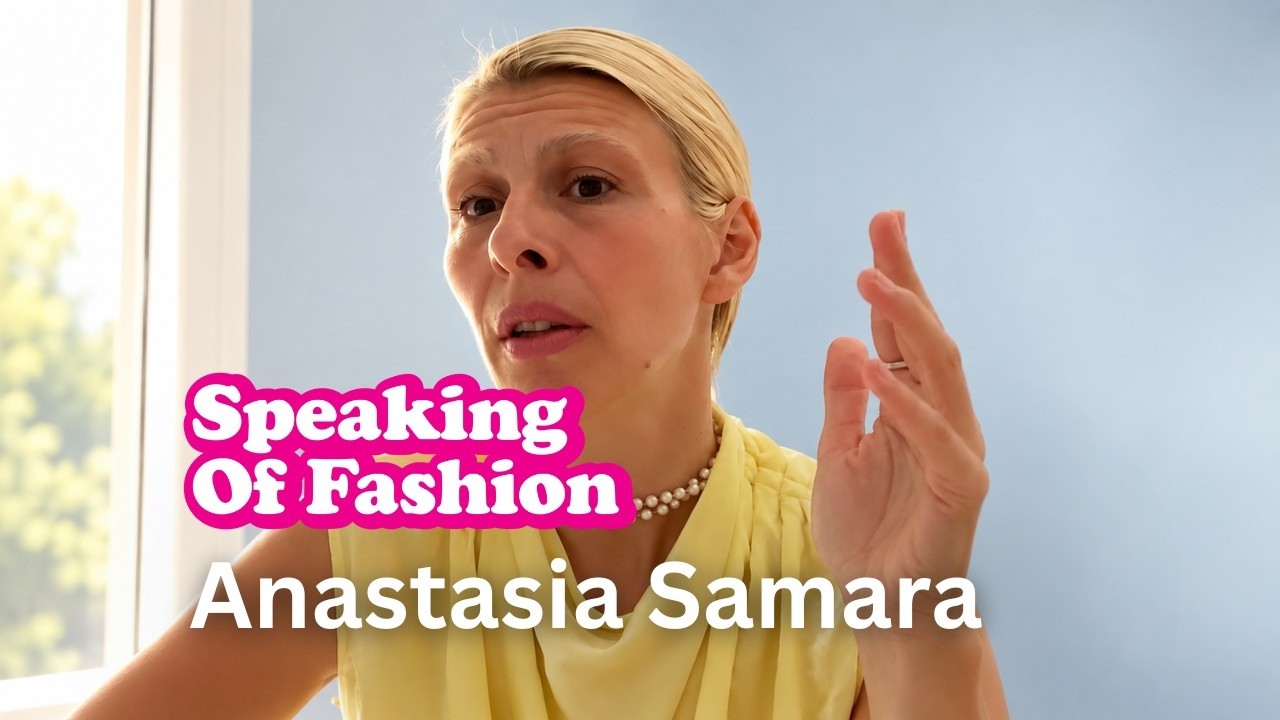
Stylist and fashion critic Anastasia Samara traded a career in public health for her obsession with clothes. In this conversation with Brownfashiongal, she discusses Paris’s disappearing dress culture, fashion’s designer musical chairs, Jonathan Anderson at Dior, Chanel’s renaissance, Demna at Gucci, the state of fashion editorials, and why finding your personal style takes effort.
Brownfashiongal: Okay, perfect, it’s recording. Anastasia, welcome to Speaking of Fashion, and thank you so much for joining me. I’m so excited to finally speak to you. For a little bit of context for our viewers, Anastasia and I have been chatting on Instagram for months now. We talk about almost everything that goes on in the industry, so when we decided to speak to someone who knows the industry, Anastasia was the first person who came to my mind. I would love to start by learning a little more about you, what you’re up to in the industry, how you fell in love with fashion, and what you’re doing right now.
Anastasia Samara: I’m a stylist and a fashion critic. I’m also an ex-academic in public health, which makes my profile a little atypical, because I didn’t start in fashion at a very young age. I started not very long ago, actually. I’m obsessed with clothes, which is the guiding force behind all my efforts, my analysis, and my approach to clothes.
It started when I was still an academic and began collecting clothes for myself. I don’t wear clothes for the sake of fashion; I do it for my own sake. I dress like this outside, and I don’t wait for an occasion to wear something. As an academic, I have a mind that always wants to know, understand, and search, so I wanted to go more in depth. I started studying the history of clothes, designers, and construction. I already knew things about construction, silhouette, and quality, because my parents used to work in the clothing industry, though not the fashion industry.
So I have an obsession with quality. My mom always paid attention to great cotton and great silk since I was very young. I’m allergic to bad material. Whenever I go and buy something, the first thing I do is touch it. I have to get in contact with the fabric.
It happened quite naturally. I always loved fashion. When I was young, I watched fashion TV and I went to university with a copy of Vogue, even though I was studying dietetics and it had nothing to do with it. I always had that as a big love. By studying it, it grew on me, and I found myself being good at styling. Eventually I started commenting and analyzing from my own perspective, and I found that this is something I’m good at and something that fascinates me: going as deep as possible into the emotion of clothes. I have a very emotional relationship with clothes. I’m not a typical journalist who describes facts; it’s a very visceral interaction in my case. So the angle from which I approach clothes is a little bit particular. Then I abandoned my other career and entered this one. It’s a beautiful adventure, because fashion is a wild industry, although I think almost all industries are wild today.
Now I’m much more focused on critique. I wouldn’t say journalism, because people might misunderstand it; I haven’t studied journalism. And I will soon be a contributing fashion editor at a nice magazine that is starting. I’m not going to talk about it yet, but I’m very happy about it.
Brownfashiongal: Oh my god, congratulations! Amazing!
Anastasia Samara: Thank you. It will allow me to really express my voice on another platform. Instagram is a very good platform, but it’s also good to write for magazines and contribute that way. That’s my trajectory. I think fashion chose me, in a way. I’m obsessed with it. It’s my thing.
Brownfashiongal: You’re from Greece, but you’re based in Paris, right? Paris is the city of fashion. How do you think Paris has shaped how you dress or how you approach fashion? You’ve been there for a while, so I know it’s part of you now. I’d love to know your experience of what goes on in the city.
Anastasia Samara: It’s funny, but Paris didn’t shape me at all. It’s a little bit disappointing. Of course, Paris is the capital of fashion in terms of production, where the money is, where couture is. Everything is based there, and it has a huge history in couture and clothing in general. But if we talk about inspiring environments, I think today there aren’t really any. Maybe Tokyo. I haven’t been to Japan, but I think it’s still very inspiring there because people do care a lot about clothes. Paris is not a place where you go out and feel inspired to dress. On the contrary, I feel that not many people dress.
It’s a very interesting experience, because on purpose I take the metro, and very often people look at me because I stand out: I dress up. It’s interesting to observe that socially. Everybody is dressing casually now, which annoys me so much. Even for occasions. I went to a very important event at an embassy once, and I was shocked to see that especially the women could not put together a proper, high-quality gown. Not something that looks like a good gown but isn’t. And the hair, I was shocked; I didn’t expect that at all. These are people who go to different events and are invited all the time, so they’re supposed to have a wardrobe. It’s not the average person with another kind of job, which I would understand. But this casual thing is everywhere now.
Even in Paris, I live in my own bubble. I dress for myself. Even when I go to stores, and of course, because it’s the capital, you have many flagship stores, it’s not something that really excites me. Even the shopping experience has become a little bit casual, flattened. We’ll talk about that. So Paris is that fantasy, but in real life I don’t experience it at all.
Brownfashiongal: That’s interesting. I think there’s this thing called Paris Syndrome, right? When people actually get to Paris, they’re disappointed by what’s around them. A lot of people have said that to me.
Anastasia Samara: I love France because I speak French and I studied in France, so it’s like home to me. I have a lot of love for the country and for Paris in particular. It’s a beautiful city in terms of architecture and everything. But it’s not a place where, if you didn’t know, you’d immediately say this is a fashion place. You will not see it.
Brownfashiongal: Got it. You mentioned how casual everything is now, and I agree. Apart from the very niche fashion industry, people don’t dress up anymore, and I think that’s also because so much is going on in the world, economically, politically, and so on. But when you go shopping, what attracts you about a garment first? Let’s say you’re looking for a dress. Is it the brand, the silhouette, the color? What’s the first thing you spot?
Anastasia Samara: It’s a number of things, but I would say construction and quality, the quality of the fabric. Color can be anything, because if the fabric is good, the color is going to be excellent. Color depends a lot on fabric, right? I wear a lot of color, I wear black, I wear everything, as long as I feel attractive. My shopping experience is very quick, which means either I love it or I hate it. I don’t have doubts. It takes me literally five minutes to check what is what. Either I find it interesting because there is innovation, which I always search for, and innovation is going to be in the silhouette and the construction, or I’ve seen it before.
I’m also not a staples kind of person. I don’t go for staples; they’re so boring to me. And there are a lot of staples in the big houses. If you go to some of them, you have a whole section that completely dilutes the signature or the vision of the house. It’s for the average consumer: poplin skirts, high-waisted, or a little detail like a little flower just to say it’s this or that brand. And the very good pieces are very often in a corner.
Brownfashiongal: That brings me to my next question. There’s such a rise of fashion journalism and criticism online, but a lot of these thoughts come from people who might not be actual luxury shoppers, who might just be consuming fashion as a fantasy. Is that damaging to the industry, do you think, or is it just part of it?
Anastasia Samara: You mean people who discuss clothes but haven’t had the luxury experience themselves?
Brownfashiongal: Right. There are so many negative comments and opinions online, people saying, “I hate this brand, I hate this designer,” but they’re not the actual luxury consumer, which is to say the brand isn’t designing for them, so they might not find it suitable. What do you think about this gap? Is it damaging to the industry’s reputation?
Anastasia Samara: This has many facets. I don’t want to use the word luxury in terms of price tag, but in terms of quality, because it disturbs me when people buy something just because it’s very expensive, to show off. It’s not my thing. I find it vulgar and stupid. Most people who haven’t had personal contact with good clothes, whether buying or even just exploring, because not everybody has the money, but if they haven’t explored and haven’t felt how it feels, it’s very hard for them to talk about luxury or quality. So many times the comments are just very harsh for the sake of it. You know how the internet works. It creates more noise, especially when there isn’t knowledge to back it up, because you also have to read. It’s not just understanding clothes, but understanding them through the years: what has been done, who has done it, how it has been done. Exceptionally, you might have young people, or people not yet in contact with luxury, who have that capacity, that eye to judge. It exists.
I don’t want to be gatekeeping, saying unless you buy expensive, you don’t have the right to talk. I don’t like that, because on the other hand you have people who buy luxury and are clueless. They think they understand luxury, but they’re not elegant themselves. Saint Laurent used to say, and I love this quote, that elegance starts from the heart. The chic and elegant person is the one who carries the clothes first. The clothes by themselves don’t mean anything. It’s a combination of the two: the clothes reinforce your elegance and you reinforce the beauty of the clothes. It’s an interaction, back and forth. So you have a little bit of everything, but certainly in most cases, if you haven’t been in contact, it’s very difficult to understand that kind of energy and the universe of fashion.
Brownfashiongal: 100%. I think that gap will always exist in the industry: people commenting without that knowledge, and luxury consumers who are actually buying but might not appreciate the art behind it. I don’t think that’s going anywhere. Coming to this whole internet commentary thing, you’ve been sharing your thoughts on Instagram, and I love your videos where you actually try on the outfits, because that’s so rare. With your page, you get to see how it looks in real life, the colors, the weight, because the runway and real life are obviously different. How did that happen? Did you plan it? Because that’s becoming your signature commentary style.
Anastasia Samara: No, I didn’t plan it. Everything happened very organically. I would go because I wanted to see what from the catwalk translates to the store. To me this is so important, because otherwise it remains just a fantasy for the industry itself. For whom are we making the catwalks? I always ask this: for whom is the vision? I’m not saying everything has to be translated, that’s impossible, but a part of the vision should be infused in the store. We should be able to feel it.
That’s how it started, out of curiosity to check what’s happening. I would always choose a piece that was particularly interesting to talk about, and then of course I would talk about the whole collection, the idea behind it, and the things that were attractive to me. It happened very naturally and I’m enjoying it, because these are things I would wear myself. That’s another thing in my case: I don’t put things on to impress anybody. As extravagant as they look, these are things I would wear myself. Of course, sometimes I buy them and sometimes I don’t, because sometimes the price tag isn’t realistic. It doesn’t make sense, even if you want to spend money on it. Price tags are on another level now. They have to fix that somehow. It’s very weird.
Brownfashiongal: I think there’s definitely a gap, because luxury brands are trying to be ultra-luxury and fast fashion brands are trying to be luxury. It’s a whole shift that’s happening. Now I would love to get into some spicier questions. Recently we’ve had this insane musical chairs across the industry, with designers switching from brand to brand, and it’s a vicious circle at this point. A lot of brands are looking quite similar, in my opinion. When that shift first happened, I was so confused about which look belonged to which collection and which designer. I’d love to know your thoughts on this musical chairs.
Anastasia Samara: I think it’s very problematic. It’s a kind of schizophrenic behavior of the industry, trying everybody out to see what works as quickly as possible. In any industry this can’t work, and much less in creative industries, because creativity isn’t something on command. To a degree, through experience, a designer can deliver things quickly, but they’re still human beings and they need to pause to deliver something interesting. Creative people are not machines. It’s very stressful for them, and it doesn’t allow storytelling. You need a good number of years to be able to tell a story about a brand. You can’t judge a designer on how he sells in the first season. It’s absurd. In the past, designers often had their own houses, the name was the designer, so they could stay and express themselves, and that’s why we have a signature. They took the time to go into detail. Every creative profession needs time to unfold; it can’t be forced like that.
Then, as you say, you get confused in the end, because the codes get confused and they shift. Balenciaga is a great example, where Demna left such a signature. What he did wasn’t Cristóbal Balenciaga, it was Demna, which was fantastic. But now Piccioli: what is he going to do? He wants to fit into Demna’s Balenciaga, to not lose the customers, but at the same time he has his own signature and wants to do a little bit of original Balenciaga, which fits him so well because he’s great at couture. It ends up being completely wrong for him too, I think. The pressure is unbelievable. And for what? I’m not even sure it sells more, which is the purpose they’re doing it for. It’s almost like an autistic thing, just doing it for the sake of doing it. It’s not even that it guarantees much more money. Not necessarily. Balenciaga didn’t do well. The first collection was not good at all. They didn’t have people in the store, because it was so confusing.
Brownfashiongal: I totally get that, and you pointed out perfectly how one brand is now being designed through three different designers’ visions.
Anastasia Samara: And it’s very harsh to judge the designers like that, because many of them are really tired people.
Brownfashiongal: Yeah, because Pierpaolo is a brilliant designer. And I think the reasons for these decisions might be corporate and management pressure, because of course fashion is a business. But apart from Chanel, I think most brands are just passing by. Chanel is the one that has really been revamped in terms of sales; every other brand is doing pretty much the same. So I don’t get the point of the whole reset.
Anastasia Samara: Exactly. It’s not even for financial reasons at this point. So what is it for? It’s almost like a habit, an automatism. You do it and you don’t know exactly why; it’s a subconscious thing. You do it even though it’s harmful. It’s so weird. You need to change that.
Brownfashiongal: I think sooner rather than later, because we’ve had this media shift, and hopefully in the next couple of years people will realize that this model and strategy isn’t going to work and give designers more time. In the early 2000s we had designers in a house for so long, like Nicolas at Louis Vuitton or Olivier at Balmain. They did so well because they had the time to build it up. Now, since we’re talking about brands, I would love to know about one particular designer and brand combination, which is Jonathan Anderson at Dior. Some people love it, some people hate it, but I want to know what you think.
Anastasia Samara: I am a huge admirer of Anderson, so maybe I’m not even objective. I love what he does. I find him brilliant. What I love about Anderson is that he’s very contemporary, and his take is always a bit whimsical. When I watched the first couture collection, it was clear to me that I liked it. But the second one, on first take, I have to be honest, I thought, I don’t like this at all. The folds don’t sit right and the drapes don’t sit right. Then I cleared my mind for a week and checked it again, and I thought, you know what, this is actually very interesting, because it’s a very contemporary take on traditional couture.
Take the pleats, for example. They did the show at the Musée Rodin, and I went and saw the collection. There was a dress from Christian Dior that was beautifully pleated, with multiple panels of pleats, in the classic, timeless way. And then I saw how his dress tried to somehow freeze the pleats in time. How do you make a pleat not move and look weird, intentionally weird? It might not look very digestible, because it doesn’t sit, it doesn’t even flutter with the wearer, it has this bump here and there. But it’s intentional, not a mistake. And I find it at least interesting, something to talk about, because it’s a new way of approaching how a pleat can sit. We’ve done pleats so much. What is a new way of seeing a drape, one that doesn’t look like a classic ancient Greek drape or a flawless drape, but looks like a weird drape that doesn’t sit right?
In that sense I find him brilliant, and I really feel for what they give him to do, because the house also has a lot of limitations. He can’t do whatever he likes. Within that frame I think he does very well, with the weight he has on him of doing so many collections. We have to be a little bit thoughtful about that as well. Their way of working is very competitive, and I don’t know how many hours they work. We have to judge based on that too. So for me he’s one of my very favorites.
I also love what he did in menswear with historical dressing. He would take a detail and just put it on a shirt, without elaborating much. I would want him to elaborate a little bit more. But not to approach the historical clothing just to deepen his own thing. And I would want him to take off the denim, because I’m a little bit tired of designers putting denim everywhere just to ground the looks. It’s the easiest solution. They need to find other ways to ground and balance the looks. That’s my opinion.
Brownfashiongal: You mentioned something very nice, which is that we need to understand his perspective and how much workload he has. He’s doing his own label, Dior, Uniqlo, so much. Do you think people who talk about fashion, commentators on social media, have lost their sense of empathy toward designers, and don’t look at them as humans? Do you think that empathy is missing when we talk about fashion designers?
Anastasia Samara: Empathy is missing in general in our society. That’s the problem. Fashion just reflects what’s happening in the world. There’s a distance and a judgment, because now we have the internet, and many people are not in direct contact with the collections or the designers, even journalists. They judge from afar. It’s very different when you talk with a designer and they tell you, I did this and that, and this was the difficulty, and this was the challenge. You see the human aspect instead of just the clothes. It’s even more true when you see clothes on a video than when you see them in real life. There are so many things you don’t notice, things that might be very complex to make or very interesting. And we have to judge fast, always, so we end up missing things. I think empathy is missing. But at the same time people want to be politically correct, so they don’t have a strong opinion either. It’s a very weird thing.
Brownfashiongal: I think the fear of saying something wrong is driving how we communicate, which is so true, because sometimes you do something you feel is not even a big deal and people have a million takes on it, which is part of being on social media, of course. But that’s a tough line to balance. Okay, now I want to talk about Chanel. Chanel has had a renaissance, I feel. It’s been reborn after a few really tedious years. Chanel by Matthieu is doing amazing, loved by critics, selling amazingly. I would love to know your take on it.
Anastasia Samara: I liked him a lot at Bottega Veneta. At Chanel it’s a little bit tricky for me. If we put Dior versus Chanel, the two big brands, I think Anderson is taking much more risk. The thing that made Blazy so successful, in my opinion, is that he found a very intelligent way to not take much risk but create desire through embellishment, which he also uses enormously in couture. He doesn’t take a risk in the silhouette. He doesn’t want to introduce anything we haven’t seen before. He doesn’t want to be disruptive. That’s a bit problematic for me, because when everybody’s happy, there’s a problem. It’s a kind of people-pleasing behavior. When everybody’s happy, that means you’re not doing something well. I like when people hate it or love it, because that shows there’s something to talk about. Otherwise, it’s so beautiful, the shoes are fantastic, I like what he does. It is creative, I’m not going to say he didn’t create anything, but it is safe.
That’s my problem with Chanel. When I made the video on Chanel, many people attacked me: “What are you saying? He’s a great designer. How can you say that?” I’m like, he definitely does great things, but it’s the ateliers that do the great things when we talk about embellishment. And embellishment can go on forever. You can do thousands of collections with variations of pearls and sequins with no end, and for sure it will look beautiful. But what does it say? Even the cuts were very often very conservative. A conservative lady who doesn’t want to take a risk but wants to look beautiful will wear Chanel, and that’s why I think it’s doing so well. For Dior, you’re not going to have the same kind of woman who would wear Anderson’s Dior, right?
Brownfashiongal: Right, 100%. I think the Chanel woman in general is slightly more conservative, and Jonathan Anderson is definitely catering to the more Gen Z, Gen Alpha audience. I think he’s thinking about how the brand will do later on, and his Dior is going to be really loved maybe in ten or fifteen years. History will be kinder to him, I feel. Matthieu is doing amazing; it’s very glamorous and everything. But I want to ask you one thing: how much of this Chanel mania do you think is PR?
Anastasia Samara: I’ve talked with many people about that. I don’t know. It might be a big part of it. We don’t know which part of it is true and which is not. But I do believe it might be true, because I’m not sure they lost the Karl Lagerfeld client. I think that kind of client is still there, and maybe they gained a bit of other clientele because they injected a lot of color and modernized the classic Chanel shoe. Let’s be honest, accessories, which gets on my nerves, we focus so much on accessories and so little on clothes. It’s a big problem.
Brownfashiongal: Oh my god, I need to know your opinion on those Chanel barefoot shoes from the collection, if you’ve seen them.
Anastasia Samara: I saw them. You know what? They’re not wearable besides going to the beach, which I find fantastic, going to the beach with this kind of shoe. Fashion is also about illusion and extravagance, and it has to keep that aspect. It should never become too serious. So it looks ridiculous, because you can’t wear it, but I find it interesting as a design. I find it quite funny and cute. Whoever has the money to buy that shoe can buy it and wear it on a yacht or whatever. It’s fun.
Brownfashiongal: I think so too. It’s for collectors, it’s a celebrity thing. No one is going to wear it out on the street. I think it’s cute and fun, and I love it. That’s the nuance we need, because recently a celebrity wore it and people were like, “You can’t wear that.” It’s not meant for even a regular Chanel customer to wear on the street. When an item is made for editorials or just for fun, versus when it’s actually supposed to serve a utility, I think that nuance is missing from the industry.
Anastasia Samara: But I think this is what’s killing fashion today. Our society has become very functional and much less performative. If we think this way, we don’t create any culture, we don’t create any more civilization. Why do we build these fantastic buildings? Just build. Why do you make music? These things aren’t functional, but they’re very valuable for the human psyche and for human well-being. We can’t reduce fashion to something just functional. That’s absurd. It opens your mind a little and creates a fantasy. Fashion should remain a fantasy, and it’s losing that a lot, which is a big issue. It should shock a little and make you laugh. All of these things are very important.
Brownfashiongal: 100%. I think creativity and whimsy, whimsy is an overused word now, but that sort of fun is definitely missing from fashion. Chanel is one of the few brands doing that. Apart from that, everything is too corporate, too gray, too dull, I feel. Okay, I want to talk about one of the few women designers leading a big house, which is Louise Trotter at Bottega Veneta. Matthieu came from Bottega, and Bottega has had amazing designers, first Daniel Lee, then Matthieu Blazy, and now Louise Trotter, all brilliant. I want to know your thoughts on her Bottega.
Anastasia Samara: It’s very interesting, because when I saw the clothes on imagery or on video, I wasn’t at the show, I really liked what she does. But then when I went to the store, I changed my mind, and I was shocked to change my mind, because I realized the cuts are gigantic. I don’t know if anybody would agree with me or if it’s just in my head. On the catwalk, these loose cuts and big silhouettes look very elegant and chic. But in real life, I’m sorry to say, they start looking clownish, because when the cut is so large and becomes even larger, it doesn’t make sense anymore. If a thin woman wears it and looks a little bit fat, you can imagine how a normal person would look. This is my own take, because I tried the clothes and I didn’t realize they would be so big. I understand loose silhouettes, many brands do them, and I have clothes like that. But I felt these were way too large, so I started losing a little bit of my enthusiasm.
I also want to start seeing women being sensual again. We have either vulgar or completely covered, and we don’t have playfulness. It doesn’t need to be provocative in a bad way; it can be sensual. That’s so important as well. If we cover women up completely because we project intellectualism through that, I don’t like that.
Brownfashiongal: I think Haider Ackermann at Tom Ford is doing sensuality beautifully. I think he’s the only one doing it very tastefully, very elegantly, true sensuality, not vulgar and not too obvious.
Anastasia Samara: Finally, yes. It’s a breath of fresh air. I love what he does at Tom Ford, and there is a whole atmosphere. The casting is out of this world, how he does the hair and the faces; the faces are all very strong and sharp. It’s a very good example of how we should start storytelling again, where the designer exudes the aura and energy of what they want to say. Who is that woman wearing these clothes? This is that kind of woman. He gives that suggestion.
We’ve reached a point where we talk about the clothes, which I love on one hand, but who is wearing these clothes? Of course there’s casting behind that, but besides the casting and the clothes, it’s just a catwalk. Even the models don’t really express. There’s no theatricality; it’s still very muted. I understand that in the past it was modern to move away from theatricality, but because life functions in cycles, I think we need to reintroduce it. It’s starting to become boring. It’s like a lookbook in the end.
Brownfashiongal: I get that. This whole sensuality conversation reminds me of Gucci, so I would love to know your take on Gucci by Demna, because again, it’s very controversial. People are either loving it or hating it.
Anastasia Samara: It is controversial. To me there’s not much to say. Demna was fantastic at Balenciaga. I think he was given the green light, he expressed himself fully and thoroughly, and that was great. But Demna does Demna. From Vetements, he brought that essence to Balenciaga; that’s why they took him. But I don’t see him at all at Gucci. He’s a kind of designer who has to have his own brand. It’s such a shock going from the Gucci of Alessandro to the Gucci of Demna. I don’t think he’s saying anything at all at this point. I went to the store and there was no coherence. Even though it’s not, it looked cheap the way it was presented. It didn’t sit right with me at all. I don’t think Demna’s Gucci is a success.
Brownfashiongal: I slightly agree. First, there’s no right way to change a brand. If we take Pierpaolo at Balenciaga, he’s been trying to keep the Demna magic alive, and that’s not working either. But when you take Gucci, where Demna has switched up the brand completely, that’s not working either. There’s really no right way when a designer with such a strong perspective enters a brand, because they’re obviously going to try to make it their own. Which is such a shame, because I really loved Alessandro’s Gucci. It was such beautiful storytelling, and it was selling so well. It was commercially successful. So I don’t really get why the switch-up.
Anastasia Samara: I found him fantastic as well. The designer brings their own… it has to be personal. When it’s personal, it’s beautiful, because you bring out your own particular elements that nobody else can copy, and that’s what makes it so charming. But what should we have in mind when we think of Gucci at this point? Nothing, in the sense that so much has happened. What identity are you going to talk about? You’ll talk about the designers who designed for Gucci, Tom Ford, Alessandro, which is great. But Demna wants to do a little bit of Balenciaga Demna, but kind of Gucci in an Italian essence, and it doesn’t give anything. And it looks very vulgar too. I don’t like it.
Brownfashiongal: I think he’s targeting a very different audience, a very new-money audience. Maybe people who just need a logo bag.
Anastasia Samara: Or maybe even people who are discovering fashion now and feel that this is so exciting and new.
Brownfashiongal: One other house I’m really concerned about is Moschino. Moschino has been one of my favorite brands, and I feel that they’re flailing right now. There’s nothing really going on after Jeremy Scott left. Of course, there have been a few designers and a tragedy. Hopefully we’ll be seeing a new collection soon. I would love to know what you think of what’s going on at Moschino.
Anastasia Samara: I love Moschino too, the original Moschino, because it was the funniest brand, so playful. It still is, to a degree. I liked what the last designer did, Adrian. He’s a collector too, which I appreciate enormously. He’s passionate about clothes. But that’s the problem with this kind of brand. It’s like McQueen. I’m not saying that Adrian did what is happening at McQueen; McQueen is a disaster right now. But as with McQueen, when something is very personal, it’s very difficult to continue. There may be some houses that just don’t need to be there. Moschino was like that, so the clothes were like that, so you have to be like him. Then it’s copying, or how are you going to do that?
I think we need to focus so much more on new voices and the creative geniuses who are coming up, because there are always interesting young designers to look at. Help them develop their own brand, like they helped Galliano and McQueen. It’s much richer than keeping the name of the house while we don’t know what we’re doing. It’s like a ghost at this point, trying to find who would fit an aesthetic, but what is this aesthetic then? In 2026, what are you going to say? So focus much more on nourishing and supporting young designers and creatives. Support is always, in the end, financial; they need that. They can bring new blood and nurture fashion again. Otherwise we’ll end up talking about fifteen houses that will exist forever and some young designers that people like me buy from, who eventually can’t survive, and that’s a big disaster. It’s like an aging person who doesn’t want to retire, who wants to be there until they die, until it rots completely.
Brownfashiongal: I agree. There are so many houses that could use a different strategy, and so many houses being revamped now that I don’t think needed it at all. But one brand that’s doing amazingly well without that hype is Saint Laurent. Anthony Vaccarello is doing such a good job. He’s continuing the aesthetic, and he has such a strong point of view. He’s been there for almost a decade. I would love to know what you think.
Anastasia Samara: I totally agree with you. I find what he does fantastic. He managed to have a very tight set of codes that he uses for the house, and it’s a sweet spot. When a designer finds it, they know exactly what they’re doing, they stay within a narrow line when it comes to colors and silhouettes, and they keep going. He keeps developing and exploring that, and this is fantastic. He’s a great example: if you want to wear something really sexy today, you wear Saint Laurent, and it’s chic, and it’s still the essence of the house. But he’s injecting new things, like the fantastic nylon windbreakers for men, and even the nylon dress that I tried, which was so fun to try because it’s so gigantic.
Brownfashiongal: Yeah, that one. That’s iconic.
Anastasia Samara: I realized that in nylon it’s much better than if it were in silk. It’s so funny, because people would say you wouldn’t want such a dress in nylon, that nylon is not a good material. Not true. There are different degrees of nylon, and it depends how it reflects and what energy you want to give the dress. If you take this dress and put it in plain silk, it starts to resemble a little bit of Piccioli; it goes in that direction. Or you have to embellish it, because then it looks too plain. Even though it’s a very flamboyant silhouette, it’s a very simple cut. It’s completely loose, there’s not much tailoring happening, it’s just some ruffles. The volume is extravagant, but in terms of construction it’s very simple. So for me, nylon makes it very contemporary, like a princess of today. She wears jewelry and she wears that and everybody looks at her.
I think he’s doing great. I really love what he does, and I love the colorways he’s choosing for men as well. I also like the fact, which I think more designers should do, that the womenswear and menswear are on the same line. They’re not completely different universes, and you see how they dialogue. If you put them together, it’s a fantastic couple, a guy dressed like that and a woman, which we will never see in real life, unfortunately. I always crave that. I want to see a couple dressed like that, both of them in Saint Laurent, out on the street. When am I going to see that? These are my own delusions.
Brownfashiongal: I know, that would be so cool.
Anastasia Samara: Fashion is to be celebrated. These clothes are so beautiful, but you see them only at private events. Somebody should go out and have a coffee dressed like that. It’s very important. It’s very inspiring.
Brownfashiongal: I would love to see the things we see on the runway around me. It’s so rare. Okay, I want to talk a little more about the state of fashion editorials right now. They’re so bland. It’s a fact. There’s nothing creative happening in editorial. We have a rare few good ones here and there, but most of the time they’re very bland. Have you seen the recent Vogue September issue? That was a big talking point because the imagery was so bland, the styling was just all right, on a gray background. Especially for a September issue, that was quite shocking for a lot of people. I would love to know what you made of that.
Anastasia Samara: Yes, I’ve seen it, and to me it’s not even shocking, because I know this is intentional. They intend to make it that way. It should look like a business, and at this point it is just a business. Vogue is commercial. When I look at French Vogue, the editor they put in wants to make everything as if she were an influencer for wellness. I find that very problematic.
It’s funny how some things that start out as very avant-garde, the pinnacle of chic, where you go to find how you should dress and get inspired, end up becoming commercial because they’re so successful, and then they lose everything. At this point, nobody from the industry really cares about Vogue. It’s still the biggest business, it’s very established and very commercial, but it has lost its authenticity because they don’t want to take any risk on anything. I see bad editorials of this kind even in independent magazines. It’s a general problem.
And then they put this title, “Just Kids,” and I’m like, no, this is the wrong title, because “just kids” means spontaneity and there is nothing spontaneous about that. You just put the big brands together with a little bit of styling, just a little bit, and that’s it. And it’s by Meisel. But you know what? At this point Meisel has given so much to the industry. I think he’s just doing it for the money. He doesn’t even care to create. I think very few people stay true to creativity until the end of their career. When he did Zara, I think it was him, I was like, why? You’ve had enough money. You’ve made a lot of money. And then we come to greed, which is another discussion about our society: everybody is greedy. There’s no threshold where you say, I want to stop before I start losing my creative voice. There always has to be that. Otherwise it’s just empty pages, and we’re going to look at clothes we already saw on the catwalk.
I don’t even know why we’re doing editorials anymore. Why are we doing editorials in magazines? To say what? If an editorial is the most creative aspect of a fashion stylist’s work, then it has to serve a purpose. What is the purpose of that today? Just to say we’re doing an editorial, to fill the pages? When it starts becoming an administrative kind of job, it doesn’t go well. It loses everything authentic and beautiful about it and becomes completely stale. Then it shouldn’t be there. We should stop doing editorials altogether.
Brownfashiongal: 100%. After this Vogue September issue I went down a rabbit hole of looking at old editorials, just to remember what art is. I posted a few of them on my Instagram and saw the beautiful reaction people had: “My god, we need to bring this back. This is true art.” So it’s not that people don’t want it. Editorials used to serve a commercial purpose back then, and people had amazing budgets. Now we don’t have any budgets, and there’s no real purpose, like you said. It’s just a task, a box to check on your magazine checklist: I’ve done an editorial. I think that’s why no one cares about it anymore.
Anastasia Samara: It’s much more interesting, if you’re doing an independent magazine, to put all your focus on writing or something else, introducing new voices of designers, doing something that can bring something. Or reduce it to one big editorial, put all the budget there, do one fantastic thing, and that’s it. It’s like the internet: everybody is talking, but in the end there’s so much noise and so little that we say.
It’s also an issue that we always want to go back. It almost means that as a generation we have nothing else to say, which is not true. There are always people who have interesting things to say. I don’t want to be nostalgic. I appreciate what has been done, obviously, but there are ways to express in a contemporary way, and we have to find them. We have to get rid of old formats that force the same thing when it doesn’t work anymore. Why would we be interested in a gray background at this point? To say what? And the clothes are styled almost like a campaign, basically. We’re afraid to mix brands, afraid to trash it a little, not really trash, but not keep it polished. Just break it a little. The purpose of an editorial is a fresh eye. Otherwise why is the editorial there? There’s no need. We’ll do consultancy and campaigns and celebrity dressing as stylists, and that’s fine.
Brownfashiongal: 100%. And when we talk about styling, most of the looks we see now are full runway looks. There’s not much styling anyway. Even on the red carpet, most people are just wearing looks straight off the runway. So the stylist’s job is now just to pull and coordinate the look rather than actually put something together, I feel.
Anastasia Samara: But this is very sad, because you kill all creativity.
Brownfashiongal: Yeah, and this is where the conversation about supporting independent and emerging artists, be it a photographer, a writer, or a designer, comes in. We might have individual ecosystems, like the British Fashion Council, in each country, but I don’t think there’s any kind of support system for upcoming creatives, and hence we only have these big publications to look at.
Anastasia Samara: I think it’s a general problem of mentality in our society. We are entering an era where things are very categorized and established, and the day you decide you fully… I wouldn’t say mastered it… the day you put something in a box, you have killed it. You need space, and a little bit of flexibility and spontaneity, in order to bring new people in. When you bring new people in, they’ll want to do it their way. They might introduce something that looks a little bit outrageous. They need to break the mold. We have created such a mold, a corporate mold, and everything has to fit in. But then you’re killing fashion like that. There is no fashion anymore; they’re just clothes. And to be honest, we don’t need to produce more clothes. There are enough clothes for people to wear. Fashion is a fantasy and it should inspire people. It’s not there to dress people. People don’t dress anyway. They wear a pair of jeans and a T-shirt.
Another topic is when I see creatives doing that. It’s like an epidemic. I have a big issue with that. When I see stylists, because now it’s a uniform, jeans, it’s like you’re above the clothes, which is so contradictory, because you’re working in an industry of clothes, and if you are not obsessed with clothes, nobody else will be. You need to be the inspiring power toward society. People should see you and get inspired. If I see you and I don’t know you’re a stylist by the way you look, for me it’s an issue.
For journalists I understand, because sometimes they’re very intellectual people who lean toward the academic, and I know how academics are. They’re always in their heads, so sometimes they forget everything else. They’re not necessarily tasteful in the way they dress, but that doesn’t mean they don’t have a beautiful way of writing. It’s a particular category. But even designers: look at how McQueen used to come out, or Galliano, or Lagerfeld. So this contemporary jeans-and-T-shirt thing starts not being contemporary anymore. It’s becoming a thing of the past for me, because contemporary is something new, and when something is repeated way too much, it starts becoming old, right? Fashion is an industry that moves very fast, and its beauty is this excitement of the new, much more than other art forms, because in a way it’s a little bit more superficial, which I don’t think it is, but it’s clothes, which are very powerful at the same time. We need to bring back this excitement, this extravagance, so that editors are people you see in the street and say, this person works in fashion. You have no doubt about that. I miss that so much.
Brownfashiongal: I think that also goes hand in hand with how generalized personal style is because of social media. Especially with younger people, most people dress exactly the same, and there’s no real inspiration behind how they’re dressing. It’s whatever is trending, if they put in any effort at all. Even if I don’t talk about the luxury fashion industry, the personal style epidemic is a real thing, I feel. People just don’t have personal style anymore. That’s also because algorithms are dictating what to wear, and also because people don’t care as much.
Anastasia Samara: I’m not sure it’s that they don’t care. When I hear people saying “I don’t care about clothes,” it’s usually people who don’t have taste. Very often it’s because they don’t understand it, so they prefer to reject it because they feel uncomfortable otherwise. I think all people care about how they look, but very often they don’t know how to do it. And there’s nobody to inspire them. As I told you, you go to a store and what they show you is the most basic thing, and then you go out and everybody else is also dressed like that. This is coming from the corporate environment. The people sitting at the top of the fashion business are not fashion people themselves, and they don’t understand anything about clothes. They’re going to make it look like a bank in the end. They wear a suit and that’s their uniform. But that doesn’t mean that people who work in fashion should end up with a uniform as well.
Who is the average consumer going to get inspired by? It’s always a risk to be very personal, a risk to have a strong voice, based on knowledge, of course, not just shouting whatever. It’s a risk, but it pays off, because eventually people will appreciate it and get inspired by you. I see it as a social experiment. When I go out and dress, people always stop me and tell me how beautiful what I’m wearing looks, because they’ve never seen it, especially when it’s a catwalk piece. I’m not saying that for me; I’m saying it because I’m observing it as human behavior. It shows that people do get inspired by clothes when you show them.
Brownfashiongal: I have one final question for you. For a younger person who’s trying to find their personal style, it’s relatively difficult, because people don’t go out as much, especially the younger generation. They’re on their phones all the time, influenced by whatever advertisement they’re seeing. How would you suggest or guide a younger person to build their own personal style?
Anastasia Samara: That’s a very difficult question, because very often they don’t know where to look. As you said, everything is so homogenized. In the past it was easier because there were very few channels of inspiration. You would watch fashion TV or buy a magazine, and it was very gatekept, which created a mystery as well. You had to be a persona. If you work in fashion, you have to have a strong personality. It goes with it. I can’t interview you and you’re just a boring person with nothing much to say, and you work in fashion. That’s something I don’t understand. So it’s very hard for them. They go to a store and they don’t know where the good pieces are, because nobody shows them. It’s a very good question, and I think it’s very, very hard. They really have to search for themselves, be interested in it, and take the time to explore. If they don’t explore, they will not find. There’s so much noise that it gets lost.
Brownfashiongal: I think just researching, being aware, looking, and finding people who reflect something you’d want to dress like. There are so many ways to go about it. But you’re right, there’s so much noise that it’s impossible to figure out what’s right for you. Do you need to people-watch, or read a book, or watch movies? It’s endless.
Anastasia Samara: You really need to have a love for it. Today it doesn’t come to you; you have to go and search for it. You have to love clothes enough to say, okay, I’m going to explore and see who is interesting, who I can get inspired by, and what I aspire to become. You have to be very active about it.
Brownfashiongal: I agree. I think people need to find something they love and cherish it, and buy long-lasting pieces, not just do fast fashion hauls and throw them away.
Anastasia Samara: Oh my God. This is such a disease.
Brownfashiongal: I know. Fast fashion is traumatizing. We even talk about it.
Anastasia Samara: Traumatizing, exactly. That’s the word.
Brownfashiongal: I think that’s about it. That’s pretty much everything I had in mind to speak with you about. Oh my god, I had an amazing conversation. Thank you, Anastasia, so much for joining us. I loved speaking to you. I think you have some of the strongest and sharpest opinions in the industry right now.
Anastasia Samara: Which eventually I think will cost me. But yes.
Brownfashiongal: Oh my god, I think that’s the price we have to pay to say what we feel. But I’m so glad you’re doing it, because most people are just trying to please someone: “This is great, I love this brand, I love this design.” You’re so honest and real, and you have such a beautiful perspective on things. I loved speaking to you.
Anastasia Samara: Thank you so much. It’s very kind of you to say that. I really appreciate that you’re giving me the opportunity to talk about this. It’s an honor.
Brownfashiongal: The honor is all ours. Thank you so much for joining us.


