
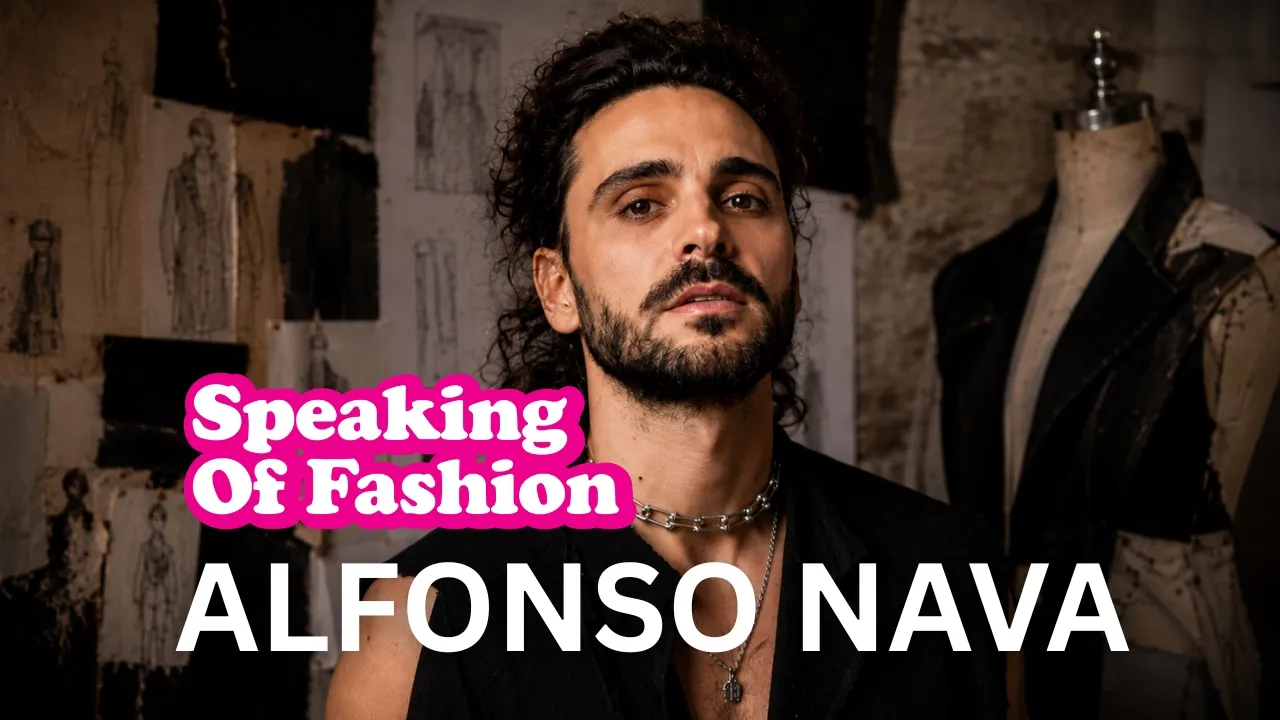
In this conversation with Brownfashiongal, designer Alfonso Maria Nava opens up about fashion as a form of art, the emotional meaning behind clothing, and the importance of finding your own creative vision. Drawing from his journey from human rights law into fashion, Nava discusses the pressures of constant production, the impact of fast fashion, and the growing influence of AI on creativity. He also shares why social media became an essential tool for emerging designers and why, in a world increasingly shaped by algorithms and trends, staying connected to your own personality may be the most important statement you can make.
Brownfashiongal: So, Alfonso, before you got into fashion and after you got into fashion, what were some things that really shocked you about the fashion industry? You came into fashion later in life, after working in the legal field, so what was the biggest cultural shock about actually working as a designer?
Alfonso Maria Nava: The first thing that really shocked me, also because of my background, was the constant pressure to produce something. I was coming from a legal context where I was working in human rights, so I always had an eye for sustainability.
There is this constant pressure to always produce something new. You have to put out an entire collection, maybe two collections, in six months. I find this quite crazy because this is another thing that disconnects fashion from art. You cannot be inspired all the time.
My suggestion to people who ask me for advice is always: focus on one garment. Focus on one garment and try all the experiments possible on that garment. Try to communicate your feelings through one garment.
This goes very much against what we are used to thinking about fashion. We think about fashion shows with an entire collection made of 30 pieces. This was shocking for me, and actually, I strongly believe that we have to change our mindset around it.
If we want to save fashion, if we want to save fashion designers, and if we want to give people working in this field the attention they deserve, we have to remember that we are not just products. There is soul and there are feelings behind them.
Brownfashiongal: Completely. And how did you actually learn the technical side of fashion when you got into it? Did you teach yourself sewing and everything else?
Alfonso Maria Nava: I think everything started from necessity. I wasn’t starting a brand or starting a fashion pathway just because I wanted to. It was a necessity to reconnect with myself and with that little child who had dreams.
When I was a kid, I loved making little modifications to my clothes. So, during this transition period, when I decided to quit my last job in the legal field, I started asking myself: Who are you? What do you like? What could reconnect you with yourself and with your essence?
That memory of modifying clothes as a child was something that connected me back to myself. From there, everything started.
Almana wasn’t about starting a brand. It was a necessity to reconnect to myself and to that little child who had some dreams, and to reconnect that adult to the little child. I wanted to give color to my life—the colors that I wanted for my life.
It wasn’t an easy transition. A lot of people asked me whether I had money or financial resources to make this change, but I didn’t. I just had the necessity to do something and the necessity to feel that I was leaving something to the world and to myself. I think that, for me, it was my biggest gift.
Brownfashiongal: That’s a beautiful story. And I love the way you’ve connected something you ended up doing—fashion, sewing and designing—to your childhood. I think that also comes across in your work because I was looking at your designs, and they do have this playfulness and wonder to them. I remember this blazer that you did with the two faces.
So many of your clothes have that sort of childlike wonder, which I think comes from this place of curiosity. It’s rare to see a story that is actually reflected in the work a designer is doing.
Alfonso Maria Nava: Yeah, absolutely. Thank you. I think that, at the end of the day, fashion is a very powerful form of art.
I want to literally connect what I make to my identity and then let this identity flow into the people who feel my designs and wear them.
I think of fashion as an artistic language that you can literally wear every day. A painting is on the wall, a song you can listen to, but a piece of clothing you can wear every day. You don’t leave it at home; you carry it with you around the world. It becomes rooted in you and in your identity as well.
So it’s powerful.
Brownfashiongal: Fashion as art has been one of fashion’s favorite questions. Everyone is always talking about it. Especially with the recent Met Gala theme, there was this whole idea of fashion as art. So I’m guessing that you believe fashion is art?
Alfonso Maria Nava: Yeah, I totally believe it.
I’ve had plenty of conversations with people about it, especially here in Berlin. Creativity is all around. So many people work in some kind of creative field, and there is always this conversation about how people see different forms of art and how fashion positions itself among those forms of art.
I feel that many people have stopped seeing fashion as a form of art. And then sometimes we wonder about the damage caused by fast fashion.
First of all, there is pollution, environmental damage and exploitation of people. Absolutely. But there is also a kind of emotional damage that fast fashion creates.
It makes people think that fashion is just something you wear because you overconsume fashion. You buy too many clothes, change trends every week, change every season, refresh your wardrobe—and then, of course, that removes the magic.
Fashion is losing its own sense.
Fashion starts from the hands, the heart and the mind of a person designing a piece of clothing. There is an emotion behind it. There is a process behind it that is made through emotion and the development of emotion.
Maybe someone is extremely sad, extremely happy, extremely in love—I don’t know. Whatever the emotion is, there is a process that comes from it.
But fast fashion cuts that process because people see trends and different clothes every day. They don’t think anymore about what is behind a piece of clothing or about the people who make fashion.
Brownfashiongal: Right. And I think most people don’t look at clothes emotionally anymore, especially younger audiences. Fashion is self-expression, but for a lot of people, fashion is becoming how you present yourself. It’s your visual identity.
It’s almost like how we play a video game and have different skins and avatars. I think a lot of people are treating fashion like that, and I think it’s really sad.
Because, like you said, fashion is so much about what the designer is feeling. When you look at a designer like Dior, you have a sense of what they were trying to say, what era they came from and what they designed. Or take the Antwerp Six—there’s so much cultural heritage that these brands and designers carry, which I think is really missing right now.
And I feel now, with AI, things are becoming even more complicated. People don’t even need to feed trends into the fast-fashion model anymore. Everything can be AI-generated. You can do an AI sentiment analysis and have the next trend ready.
What are your thoughts on this collision of AI and fast fashion coming together for the industry?
Alfonso Maria Nava: It’s my daily bread, you know. In Italy, we say something is your “daily bread” when it’s something you talk about every day.
The most sustainable garment, in my opinion, is a garment that carries a story. It’s a garment that carries emotions.
Artificial intelligence can absolutely be helpful, but it shouldn’t replace creativity. It shouldn’t replace that creative process that comes from the feelings each of us have.
Otherwise, that could become a problem because then you create standards—a standardized process and standardized garments. And this is, of course, going to help fast fashion become even more powerful.
Technology can be helpful. I’m not someone who condemns technology completely. But it has to be used in the smartest way, and it cannot be seen as something that replaces human emotions, human creativity and everything that comes with that.
This would be the biggest mistake.
Brownfashiongal: Definitely. And I feel that standardization of art and creativity is so common now. It’s even in the little things. We see AI-generated invitations that are going viral, AI-generated songs, movies, Instagram reels—everything.
And in fashion, there are so many AI-generated fashion brands existing in the market right now. People are generating things and pretending to be a brand when it’s not even true.
Alfonso Maria Nava: Yeah, and this is another problem.
I feel that each of us has our own personality, but the world is telling us that we should all be the same. And this problem you’re talking about—generating songs, fashion brands or whatever with artificial intelligence—is connected to that.
In terms of showing your personality and showing yourself to the outside world and saying, “This is me. This is what I carry because of my process of life. This is who I am, and it’s my design representing who I am”—you cannot do that with artificial intelligence.
Maybe you can create a few collections and they look great, but are you really giving voice to yourself? This is the question.
We can make things that are beautiful for you and maybe less beautiful for me or more beautiful for another person. But what matters, in my opinion, is that you are giving voice to your personality, to yourself. With a technological tool, you cannot really do that.
Brownfashiongal: Definitely. This also brings me to this point that recently I’ve been seeing the word “taste” everywhere. People are saying that there’s no taste left anymore.
Taste is, of course, very subjective. What might be high art or high fashion to me might not be to you. Background, culture and religion all play a factor in how you perceive things.
But there’s also this question of whether AI simply doesn’t have taste. It really cannot generate something that has cultural significance. It cannot lead a movement or really connect with people on an emotional level.
And I feel that there is so much lack of taste because even something as small as a new caption that a brand has put out on Instagram can seem AI-generated. Brands are now using AI-generated models for their campaigns, even big brands, which is a shame.
I also feel that this will create space for new human voices. Eventually, customers are going to figure it out and get sick of AI. Right now it’s the new shiny thing, but after five years it could overwhelm everyone.
I feel the designers who are coming up right now and aren’t using AI are going to have a strong edge. What do you think about this situation for emerging designers?
Alfonso Maria Nava: I would reconnect the matter of having taste with feeling taste. Most of the time, it depends a lot on our culture and where we come from.
My taste as a European white Italian man can be different from the taste of a person coming from Ecuador, for example. This is very important to recognize—to avoid colonizing taste.
This is another problem of our current world. We are trying to colonize even taste.
At the same time, there is a big risk when everyone follows the same trends. It’s difficult to say, “I don’t follow this trend. I just create my own things. I work on my own vision.”
This creates a little army of people with the same taste, the same preferences and the same vision of what is beautiful and what is not.
This is very dangerous, and it also goes in the direction we were talking about before—cutting the emotions from clothing and from the process of making clothing itself, which is a creative process.
Once we have the same taste, there is no personality anymore. There is no vision about what is beautiful and what is not.
I don’t care if something I make is beautiful for the audience. I care if something I make gives you a thought. Maybe you don’t like it. Maybe you wouldn’t wear it. But it’s transmitting something.
This is the essence of what I’m trying to do: let the pieces of clothing speak for themselves in a strong way.
Of course, people liking it or not is important because I do this professionally. I need to sell my designs; otherwise, I don’t pay my bills or my rent. But I try always to make something for the sake of who I am, my personality and what I want to communicate to people, before the sake of selling and making money.
Otherwise, I would have done something different.
Brownfashiongal: One thing I would love to ask you is: we’ve talked a lot about how fashion needs more emotion and design needs more emotion. But which designers or brands have shaped your fashion vision? Who do you connect with on an emotional level when it comes to fashion?
Alfonso Maria Nava: I couldn’t name just one because, honestly, when I think about my inspiration, I think about many designers.
I don’t think they necessarily shaped the way I see fashion or design. I mostly think that I appreciated their taste and their vision, and somehow they helped me build my own vision.
There is a big risk in having someone who inspires you. Of course, I think we need designers who can be inspirational for young designers, but at the same time, we have to create our own pathway with our own vision.
From my point of view, there are many. Rei Kawakubo and Gaultier for storytelling. I really love Kawakubo with Comme des Garçons for using fashion as a philosophy, as a way to be.
Then I could name all the Yohji Yamamoto collections for the way they show imperfection, which at the end of the day is just beautiful.
And Margiela as well, especially in the way he questioned the luxury world.
So I think those three, four or five designers helped me find my way toward my own vision.
Not that my vision is already complete—absolutely not. I think everything is constantly developing and improving, I hope so at least. But they definitely gave me an impulse in some direction.
Brownfashiongal: But Alfonso, if I talk about you as a designer, you’re not just a designer. You’re also a content creator. You’re very active on social media, and you’re always sharing behind-the-scenes content and showing how designers actually design.
I’ve noticed that your content presents it in a very relatable, watchable way. If I didn’t know anything about fashion, I think it would entice me.
So how do you balance those two sides?
Alfonso Maria Nava: First of all, we should go back to how I started content creation because I wasn’t the person most keen on social networks. Until around 2018, I didn’t even have Facebook or Instagram.
For me, social media was something completely new. I wasn’t very comfortable showing myself.
But again, I think everything is connected. We were talking before about Almana. How did I start with my brand? It was a necessity. Social media also started from a necessity—a necessity mostly to be seen.
This is another struggle for young designers. Either you have money, maybe your parents have money, or you have money yourself, so you can take the risk of making one, two, three or four collections with many pieces and see what happens.
I didn’t start from those conditions. I had to find my own way.
The necessity of coming out with this project was so strong that I started wondering how I could make it work. Then I found the answer in social media.
I started making reels about sewing, fashion and my vision.
At the beginning, it was very difficult to balance the two things. I remember that during the first year of my Instagram, it was very hard to spend the day working on my Instagram account and reels. Sometimes I didn’t have enough time for the other things that were actually my priority.
Of course, I use Instagram and reels as a tool to be seen naturally and reach a bigger audience. But what feeds me, what feeds my personality and my feelings, is designing, making clothes and creating—showing up with something that is an intellectual language, something that isn’t just decoration.
So I needed to find a balance.
Now, after about a year or so of finding that balance, I can say that I can do both things at the same time. But it wasn’t easy.
To answer your question directly, becoming a content creator was a necessity and a way to give voice to what I really wanted to be: a designer.
Brownfashiongal: In today’s scenario, if we remove the big-name designers, almost everyone in fashion needs to have a solid online presence.
I know you do it because of fashion, and a lot of your content is educational. You’re teaching people what it’s actually like to be a designer because fashion is one of the most romanticized and glamorized industries in the world.
People who don’t work in fashion think it’s all parties, after-parties and drinks all the time. But it’s really not.
I love that you’ve shown that unseen side of fashion. But for a designer who never thought about becoming a content creator, do you think it’s unfair that a designer has to become a content creator in order to be visible?
A designer is already wearing multiple hats. Now content creator feels like another requirement.
Alfonso Maria Nava: Having a strong social presence nowadays is quite essential, unfortunately, because that wasn’t part of the game before.
You can create something beautiful, successful, or express your language and way of communicating brilliantly, but then no one is seeing it.
In a world where we are bombarded with reels, social media, news and everything else, having a strong online presence that positions you somehow in this world is essential.
Is it fair? Probably not.
I don’t think anyone was thinking about becoming a designer and a content creator. At least I wasn’t.
But then you realize that you need to do both.
At the same time, I think you can find something quite sweet inside this world of content creation. It can reconnect with what the designer does in terms of expressing their language.
Every artist, at the end of the day, has to be a good communicator. Maybe not with their voice, but at least with what they do.
If you can connect content creation with your way of communicating and find your own balance—especially your own personality and rhythm—it’s a very powerful tool.
Social media gives you another option. It’s not just, “Okay, I invest my money in my brand and everything is good.”
You need to show up. You need to show your vision to the world and let people understand it and feel it. It takes time, of course, but it’s quite essential nowadays.
Brownfashiongal: And I think that’s especially interesting because a designer already has so many things to do. Now you’re also expected to be a communicator, a content creator and a public-facing personality.
Alfonso Maria Nava: Yes, exactly. And I think that every artist, at the end of the day, has to communicate. Maybe not with their voice, but through what they do.
So if content creation can become part of your way of communicating, then it can be very powerful.
Brownfashiongal: So, before you got into fashion, you were working in the legal field, including human rights. What would you say is the social element or cause that you would want your work to reflect the most?
Alfonso Maria Nava: We talked a lot about the many problems of fast fashion. Of course, there is pollution and there is the struggle that people behind the big fashion brands have to go through to make a living, sometimes working 15 hours a day.
That was the main thing in my previous job, so of course I have a big attention towards sustainability in fashion.
I also feel that right now sustainability is another trend. People try to feed their audience with a lot of nice words about sustainability, but then, once it comes to making revenue out of what you do, you forget about sustainability.
It just becomes a little thing that you have in the back of your mind. But actually, your brand is not sustainable anymore because revenue becomes more important. Then you’re just part of the same game.
So I think socially it’s very important to recognize what fashion, and especially fast fashion, is doing to the world.
I really want to stress this because it seems that we talk enough about it, but we don’t. We need to educate the audience.
The only way to educate the audience is by showing again and again and again all the bad that fast fashion is doing.
Of course, it’s polluting the world and exploiting people, but then it’s also cutting the feelings from people themselves.
I think it’s very important to try to reconnect first to clothes as something that carries identity. It’s the only way to avoid clothes becoming disposable, where you can buy them and throw them away.
If you know what is behind a piece of clothing, you want to wear it for all your life. Maybe if it gets a hole, you want to repair it. You don’t want to throw it away.
So I think it’s really important to address this issue. It’s really important to reconnect to what is behind a piece of clothing. Then, of course, all the social problems may get a bit better, starting from this point.
Brownfashiongal: You’re right. And I think a lot of these problems, whether it’s underpaid workers or environmental damage, stem from fast fashion.
A lot of these problems simply wouldn’t exist if we didn’t have fast fashion. And I think you made a really amazing point about how we need to push out the same message again and again, because that is how we were convinced to buy fast fashion in the first place.
If you go back 20 years, people used to buy a bit more mindfully. Tailoring existed. Tailoring has completely slipped out of this world, which is so sad.
People used to get custom garments made, high-quality garments that they would wear for years. Just like how we’ve been convinced to buy H&M, Zara and Shein, I think we need to convince people that fast fashion is harmful.
I think that’s a very important point.
Alfonso Maria Nava: Yeah. I think that sometimes this is also the mission.
Of course, I have a mission as a designer, but I also have a mission as a human being.
I feel that sometimes, by doing what I’m capable of in my little garden, I can try to fight fast fashion, overconsumption and this capitalistic system that is always behind us telling us that we need more.
You need to be more perfect. You need to be more beautiful. Beautiful for who? You need to wear the newest clothes made by the newest brand, which is the newest trend.
I’m tired.
Besides everything, I have a mission as a human being and then, of course, as a professional in the fashion field.
The mission is to let people understand that there is something behind each piece of clothing. There are emotions. There are people. There are people who have feelings, and these feelings are transmitted into what they design and create.
Once you really understand and become aware of all those things, I feel that it would be much more difficult to take a piece of clothing and just throw it away like it was nothing.
So I think we should start from here: reconnect the clothes themselves to the people who made them.
Brownfashiongal: That’s beautiful. One thing you said that really stood out to me is that a lot of designers talk about their vision, but no one talks about their mission.
Companies have vision statements and mission statements. I think we need to bring back that philosophy in fashion as well.
You also said that today fashion is reduced either to trend consumption or luxury performance, which is exactly what it is.
People are either buying fast fashion to follow trends, or they’re buying logo-branded things just to feel more culturally relevant.
I think this statement sums up a lot of the problems we’re seeing—fast fashion, lack of taste, lack of creativity and lack of emotion.
Alfonso Maria Nava: Absolutely.
It’s a problem of lack of personality because, again, the capitalist world wants us all to want the same things. We cannot create problems. We cannot be outside the box.
But then it’s all a system that’s feeding itself.
I would really love for people to somehow wake up and start feeling who they really are from the inside, and show their personality without any fear of being outside.
Show up with personality.
Of course, always respecting civil rules and everything, but show up with personality and without fear of being judged.
It’s hard.
And I feel that it’s also one of the biggest problems for the younger generation. People are becoming more and more standardized and wearing the same clothes.
How do you wear something that makes you feel okay with yourself and also in the eyes of society?
Either you wear fast-fashion brands, buying a trend for nine euros, or you wear big brands with big logos, and then you are part of a culture that’s accepted.
But then you are betraying your personality. You are betraying yourself.
We only have one life, so you’re not giving voice to your real self.
This is another question I always get asked: How do you find your vision?
I think that to find your vision, you have to shut the door to what the world is showing you every day.
Ask yourself: Who are you emotionally? What are your feelings? What do you want to transmit tomorrow? If you die tomorrow, what do you want people to remember about you?
Those are all questions I used to ask myself to understand who I am and what I want to give to this world, both professionally and personally.
I think this is also the only way to shape your vision without allowing all the outside elements to distract you.
Brownfashiongal: I think that’s very true. Like I said in the beginning, it’s almost impossible to find a creative person whose work actually reflects the vision they claim to have.
Today, people can create a story, an article or a statement that they say they believe in. But are they actually following it? That’s the biggest question.
And when it comes to taste, we think we’re dressing uniquely. But in the end, it’s all just the algorithm.
My algorithm is different, your algorithm is different. We think we have a different perspective, but we really don’t.
I think that’s why there’s this whole conversation about how personal style doesn’t exist anymore. People simply don’t dress how they would want to.
Even if people think, “This is something I like,” it’s most probably something that was pushed to them by the algorithm or an Instagram ad.
The idea that personal style doesn’t exist anymore is a big concern, and I think it’s going to really shape how we perceive and consume fashion.
Alfonso Maria Nava: Yeah. At the end of the day, we’re going to all have the same taste and the same vision. We’re going to become part of this big army where everyone is the same.
And then we cut out all the differences that people have—and those differences are what make humanity nice and beautiful.
Brownfashiongal: Hopefully that won’t actually happen. All we can do is think positive, I guess. Optimism is so important in this day and age.
Alfonso Maria Nava: I fight for it, you know. I fight for it every day.


