
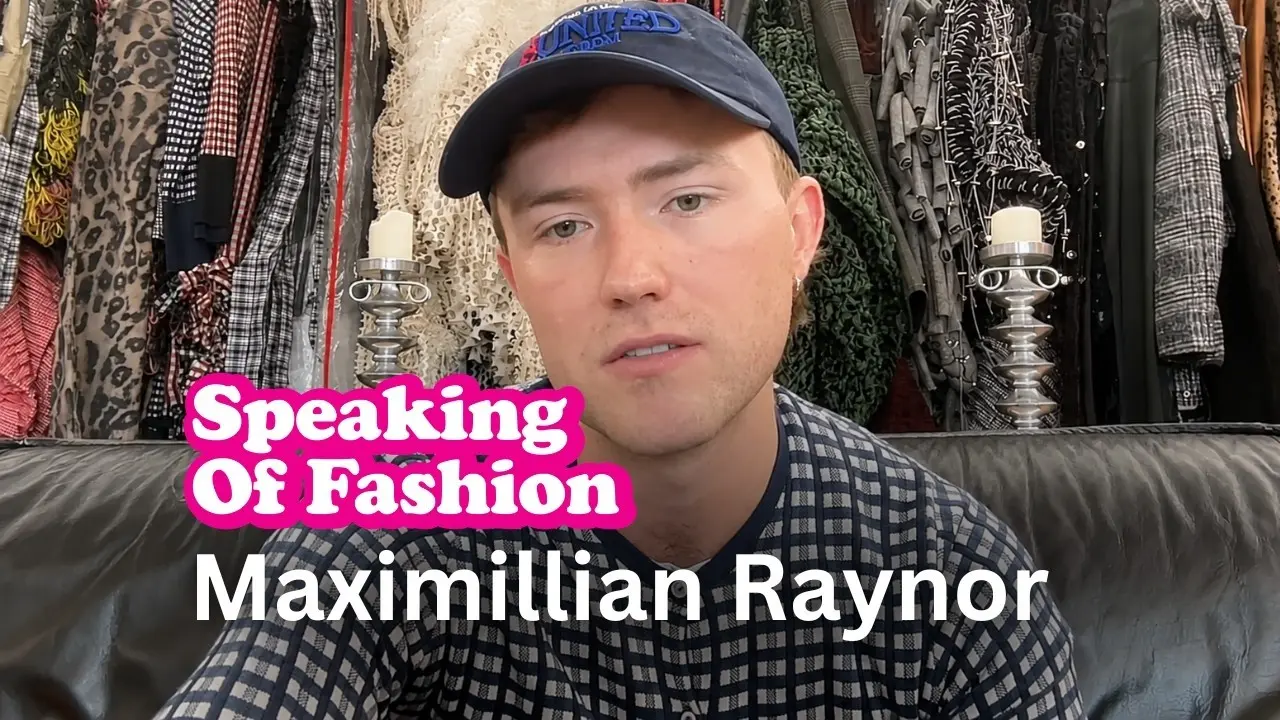
From being rejected by Central Saint Martins twice to eventually teaching there, Max Raynor’s journey is a lesson in persistence. In this conversation, he discusses creative education, social media’s influence on young designers, celebrity dressing, building a sustainable brand, and why success in fashion rarely follows a straight path.
Brownfashiongal: One of the first things I really wanted to understand, before we get into the details, is how you got into fashion because you went to CSM and you’re also teaching there, which we have to get deep into. Tell me a little bit more about your background. Did you come from a fashion family? How did you decide to go to fashion school? How did you get into it?
Max Raynor: Well, it’s the classic “as long as I can remember.” I was a child when I was already saying that I wanted to be a fashion designer. The kind of story in my family is that I tripped over my mum’s foot in a car park and smashed out my front teeth quite badly. Luckily, they were my baby teeth. In the hospital, I was on medication and was sort of in a bit of a druggy state, demanding and screaming for pens and pencils and scribbling out these drawings that I was telling my mum were fashion designs at the age of three. She was kind of like, “Who is this crazy kid and where has this come from?” Then that love of drawing developed over the years. I didn’t really play sport as a child, I didn’t really play games or apps or anything like that. I was always just drawing all the time.
As I began to read and become obsessed with stories and characters, I think those worlds blended. I was also a big musical theatre kid, so I loved performing and acting. I think maybe that comes across now in the way that I work, that sort of love of theatre and theatrics. So those were the earliest years.
Brownfashiongal: Okay, and how did you get into CSM? Tell me more about your CSM experience. CSM is, of course, the holy grail of fashion schools, so I would love to know what it was like for you. What course did you do?
Max Raynor: So, yeah, I became obsessed with Saint Martins really young, I suppose because of Galliano and McQueen, the classic story. It became this singular obsession and goal that I wanted to go there. I didn’t get into the foundation and I was quite devastated because I’d done a lot. I’d made a collection every year from the age of 15. I was doing these big fashion shows at my school in Derbyshire, so it felt like I had this absolute arsenal of work under my belt.
Looking back now, with what I know, that vast number of garments weren’t really developed in the way that Saint Martins would want. It was very much glamorous evening dresses for friends back in Derby, and it wasn’t really rooted as much in the zeitgeist of what London is about. So I then went to Ravensbourne for a foundation year and was able to channel what I had, which was a knowledge of fabric, colour and proportion, but align that with more zeitgeist research and more of a finger-on-the-pulse approach to what was urgent in London at the time. I think that approach was really helped by Ravensbourne.
Then I didn’t get in again, and I was like, what? I was just so devastated. So I went to Kingston for a year, which was an amazing experience. It was during Eleanor Renfrew’s time there, and I was thinking of staying. Then I overheard in the school canteen that somebody else was reapplying to Saint Martins, and the bitterness and jealousy I felt in that moment I thought was a pretty toxic thing to feel. So I went home that night and reapplied on UCAS. I thought, if you want something that badly, you don’t give up.
That time was just like a breeze. My interview was so smooth and so chill, and I just think at that point I was ready. So I enrolled at Saint Martins on Fashion Design with Marketing, which is now called Fashion Design Communication, and loved it. And then, yeah, the many years that followed.
Brownfashiongal: So you didn’t get into CSM two times and now you teach there. That’s a big jump. How did that happen?
Max Raynor: Yeah, I also teach on the foundation that I didn’t get onto, which I kind of love. Things take time, and there’s always reasons for the journey that you end up going down. You can use that old phrase, “everything’s meant to be,” but I think it’s more that you take what you’re given and you work with it. If you’re ambitious and driven, no matter how many no’s you get, you can flip them and turn them into future yeses, and that’s definitely what I’ve done. Now I lecture with Stephanie, who’s the head of Fashion Design Communication at Saint Martins. I lecture on the foundation as well, and I’m glad with where it all ended up with the whole CSM journey.
Brownfashiongal: That’s amazing. That’s such a full-circle moment. You have experienced the institution both as a student and as a teacher. Is there any difference or contrast that you see?
Max Raynor: Yeah, I think there’s a lot of lore around Central Saint Martins and there’s a lot of misinformation, ambition and aspiration. People do become quite obsessed with it because it’s seen as the best in the world. But actually, I think there are brilliant institutions all over the world and certainly all over London. Saint Martins is not for everyone, and I think that we need to demystify the institution that it is.
What’s so special about it is that it is quite rule-less, and you can study in a way that is free of the kind of formulas that exist in other establishments, this idea of getting people to be really employable and doing lots of tech packs and lots of other things that actually are the skills you do need when you get into the industry. But instead, Saint Martins puts the focus on incubating creativity in its rawest form. I found it to be a very liberating environment.
Brownfashiongal: I think after the pandemic and everything, maybe things have changed. Everything has changed, so maybe that could have played a role.
Max Raynor: Yeah, so much changed. And now, being on the other side of it as a tutor, there’s a lot of anxiety in students and a lot of fear. People are so painfully aware of how competitive the industry is. I think people always were, but maybe there was more of a gung-ho attitude pre-Instagram virality.
I think there was a big moment that changed Saint Martins when those Frederick balloon pieces went viral. I really noticed a shift in that moment, this genius moment that Frederick created. But then it felt like people were pursuing going viral rather than just creating incredible collections.
Brownfashiongal: It’s great that you mentioned that because that was one of my first exposures to CSM when I was getting into fashion. That was such a turning point for me because I remember watching that video so clearly. It was a big moment.
Max Raynor: Yeah, because I think what Frederick achieved there was that he distilled everything that Saint Martins is about. It was so simple and some could say gimmicky, but I don’t think it was, because sitting there, I remember it just felt poetic. It felt like it captured the time and the moment and these characters behind this translucent latex. It was really special.
But then what happened after that is I felt and observed this pursuit of gaining a hundred thousand followers in two weeks, which is what happened for him. That trickle effect has still reverberated, not just at Saint Martins but all over the world, with students thinking that the way their collection will be received on Instagram is some kind of measure of the success of what they’ve created. And it’s absolutely not the case.
The best collections are the ones that are completely authentic to what that person wants, whether that person wants to design a brilliant, very desirable pair of jeans or whether they want to do the wildest inflatable garment. It has to be because they want to do that, not because they want to gain traction on socials.
Brownfashiongal: And I think now that social media hype approach is just trickling up everywhere. Every luxury brand is trying so hard to go viral. It’s really sad the way that it’s turned into a marketing tactic. Eventually everything turns into a marketing tactic.
Max Raynor: Yeah, but you can also look at it in another way. Maybe that’s cynical of me, of us, to think that virality can’t be quite special as well. Sometimes things go viral just because they are brilliant. People that have a great knowledge of marketing do extremely well, especially in this era that we’re in. Many of the great successful alumni from Saint Martins are people that understand marketing. It’s not always about the design.
Sometimes I think students focus too much on what they’re making and not what they’re going to do with what they’ve made. The amount of students that I tutor who have no plan for how they’re going to market the final collection, they haven’t really consulted with their network or their community about how we’re going to shoot this, what the art direction is, who the cast is, what emerging makeup artist we’re going to bring in, how we’re going to shoot it, whether it’s going to be a film, an animation or a totally social-media-free exhibition and panel discussion.
When I’m brought into the final years at Saint Martins by Stephanie to tutor them in the final weeks before they show, the key focus of what I do with the students is talk about that. I’m not going to talk about what fabric you’re picking. I’m not going to talk about colour palettes or shapes or any of the things that normal design tutors would discuss. We spend the entire tutorial discussing how they intend to market it to the world and, if they are anti-social media, what we’re going to do instead.
Brownfashiongal: I’ve been in, as someone who’s running an independent brand themselves and someone who’s interacting with young designers and students, how much of a gap do you see between how ready designers are to run a business? I’ve seen so many amazing brands right out of college who were doing amazing things, but the brands don’t exist anymore. What do you think about that gap?
Max Raynor: Well, I mean, it’s a near-impossible task to translate a creative graduate collection into a functioning business. Certainly at places like Saint Martins, you’re really not designing product with the mind to sell it. So then you have this tricky period where you’re like, what do I do with all these ideas? How do I sustain an income?
Quite a lot of graduates and students are entertaining the idea of having a brand or are certain that they would like to launch their own brand, as I was. There’s this huge transition that you have to go through. I thought doing the MA would be the thing that helped to teach me how to transition. In many ways it did, and in many ways it didn’t, because I feel like the MA is there as a platform and I loved it there. I really respect Fabio and Debbie and the whole tutoring team there.
You learn how to understand yourself as a designer, which actually in the end helps to translate into business. But we certainly didn’t talk about all the practical things involved in actually launching a business. I had to learn very quickly how to run a business. It’s those incredibly boring things that I’ve now learned since leaving the MA that I wish we’d had more time to discuss.
Brownfashiongal: You also worked at JW Anderson. I’d love to know more about your experience there.
Max Raynor: It was actually during my BA. It was only an internship, but it was an amazing one. I was working very closely under Sean McGirr, who’s now creative director of Alexander McQueen. It was a very small team, and we were the three on menswear. I loved that. At that time, Jonathan already had the support from LVMH, he was working at Loewe, and it was COVID as well. Jonathan was obviously spending a lot of time in Paris with Loewe, so there was this independence that Sean had.
I was very, very inspired by Sean. He was an incredible mentor and had a very kind approach. He let us be very independent. I really was left to develop an idea, sample it, discuss with product development and then eventually take that into a fitting with Jonathan and Benjamin. You were there for the entire start-to-finish process, and we were given a lot of trust. If your research was picked, you would work on that research. If your design was picked, you would work on that design.
It was a crash course in product as well, not just designing wild things for social media, but asking, how can we do a beautiful trench? How can we do something for Uniqlo or Moncler? Jonathan is a genius. He’s the genius of our generation. I was very lucky to have spent some time in his proximity to see how he worked and how that studio worked. I learned a lot and hopefully take that through into my practice.
Brownfashiongal: Jonathan is at Dior now, of course. His Dior has been rather controversial. What do you think of that?
Max Raynor: Well, I love it. I really love particularly the menswear. I think Jonathan is best at menswear, in my opinion. He captures how I would want to dress and how a generation of young guys probably do want to dress, and strikes that balance between something fresh and new with something very understandable and archetypal.
The exploration in couture is really interesting, and sometimes it takes longer for things to land as well. I revisited the Dior Couture up close and thought, wow, no, this really is incredible. The way that it’s inspired by an artist as well. So I think if there’s any takeaway, it’s just give things more time and actually look at them.
Brownfashiongal: I think that’s a very consistent problem with social media. People just jump to conclusions without even knowing anything about the collection. There’s an “I hate this” or “I love this,” which is so unfair, especially with fashion week, where it’s taking months and years to make a look. You can’t really judge it via an emoji on your story.
Max Raynor: Absolutely. I don’t know if people do watch the whole shows, but I feel like people receive it all through clips and then they form an opinion from that. It’s kind of like judging a film off the advert without watching it. You can’t write a review of a film if you haven’t seen it, and that is what’s happening all the time now.
Everyone’s entitled to their own opinion, and that’s the era of social media. It’s not a new thing. We were having these conversations when I did a Showstudio panel when I was in first year at university. Hopefully, as we progress, people are becoming more skeptical of social media and becoming more invested in how they consume.
I try to be a bit more immune to all of that now, especially with my own brand. I don’t really think response on social media is very real. TikTok’s really interesting as well, because people are very, very free with compliments. I get sent wild messages and really amazing comments, and if you had an ego or believed in social media, you’d start to believe, “My God, my work’s actually amazing because all these people are telling me it is.”
But I think it’s better to just not listen, because what would happen in reverse if they all started telling you it wasn’t good? If you believed the good, you would then believe the bad. So I think it’s better to just not really listen to any of it and just trust the people that you trust and whose taste you trust, not some random person somewhere in the world. Of course it’s flattering that they love your work, but it could very quickly change, so I try not to put too much weight on it.
Brownfashiongal: You mentioned celebrity dressing. Your stuff has been worn by almost everyone, from Lady Gaga to Rita Ora. For a young designer who has never done it, how would you describe the process?
Max Raynor: First of all, it’s identifying what kind of celebrities you’d want to dress. Sometimes I speak with graduates who want to dress celebrities, but their collection wouldn’t make sense on any celebrities. If you’re geared towards that VIP market, you might want to have a certain element considered. Most of the stars we dress like to have a waist, for example. Unless you pick someone like Erykah Badu, who’s never going to want this cinched look, gear your collection towards someone like that.
Be very aware of who you want to dress. If you look at my early work, obviously Chappell Roan and Lady Gaga might like it because it’s in that universe of how those women dress and express creativity. It felt like, whilst I was thrilled and shocked when it happened, it felt very right that those would be the two women who would wear that collection.
But don’t design for them. The moment you try to design for them, it’s not really about you anymore and they probably wouldn’t be that interested because it doesn’t feel as fresh. At least be aware of them from a marketing and positioning perspective.
The point is, start posting your work regularly. Social media is probably the only way to do it. If there’s an alternative way, I would love to know. For me, it was always Instagram, Instagram, Instagram, and now obviously TikTok as well. The more you put out there, the more likely it is that a celebrity stylist is going to see it. And it’s also free. You don’t have to pay for a showroom to put it in front of people.
I’ve never paid for a showroom, I’ve never paid any money to any celebrity to wear anything, and I’ve never paid anybody to try and help a celebrity wear anything. I worry a lot about the brands that do pay thousands of pounds to be on these racks in the hope that a stylist is going to wear it.
Stylists know what’s going on. They’re going to pick what they want. So just be as authentic as possible. Tag as many relevant accounts as possible. When I’ve done stylist jobs, the first thing I’ll do is go on the graduate pages and look at the tagged section. If I’ve been given very limited budgets or no budgets for an editorial, you can use that opportunity both to expose a designer and show their work, but also to put together an interesting package because you don’t have the money to get it anywhere else.
If you’re a graduate expecting to dress a celebrity, ask yourself: how the hell are you going to be found? You need to get active on social media. You need to tag, message and send your work to everyone if that’s your goal.
Celebrity culture is not for everyone. I found it very natural because I just love these women. I love their music, I get along with them when I meet them, and it makes sense to me. I wanted to be a singer and an actor when I was a child. I understand their practice and why they do it.
If you’re somebody who was obsessed with architecture as a child and loves sportswear, maybe it doesn’t make sense for you to dress a singer who’s inspired by drag. If it’s not your universe, don’t try to dress Lady Gaga. Find your people. Maybe Tilda Swinton would make more sense for you, or maybe you want to dress a tennis player. Gear the clothing towards those people.
The shortest answer is: tag accounts on Instagram, be as visible as you can possibly be, have a really coherent message and don’t be too intense when the stylist does come.
Brownfashiongal: Is there someone else you still want to dress? Is there any dream celebrity you would love to dress, or are you done with your checklist?
Max Raynor: No, of course. The checklist goes on and on. Gaga was definitely one, and Lisa Rinna and Julia Fox were three that were very high up my list, so I was very happy when those happened. But there’s so many, like Nicole Kidman, Cate Blanchett, Lupita Nyong’o, Solange Knowles. We’ve got pieces with Lauryn Hill right now, and I’m hoping she’s going to wear them.
I’d love to do a Hollywood actress like Cate Blanchett, Nicole Kidman or Tilda Swinton, these people who are absolute icons. That would be very exciting. But I don’t pin as much on it anymore. It’s the first thing people ask in whether it’s a podcast or an interview for a magazine. People love the celebrity names that you can attach to a young designer, and we use them. Every young designer uses who we’ve dressed as a way to seem legitimate.
But if you’re a brand or a young designer who hasn’t had a massive celebrity behind you, I don’t think it’s a failure. If it happens, great, and if it doesn’t, great. What matters is the people that you admire and having a community around what you do that likes what you make. It sounds a bit cliché to say it, but those are the moments that matter, not the big A-list stars.
Brownfashiongal: Coming to your recent showing at London Fashion Week, for someone who hopefully wants to land on the calendar one day, how do you make that happen?
Max Raynor: Getting on the calendar, whether that’s the London Fashion Week British Fashion Council one, the CFDA or the Chambre in Paris, is a very difficult thing. And rightly so, they have to be very selective. Luckily here in London, Laura Weir has opened that. She’s thrown the doors wide open. It’s much more accessible than it was before. We’re seeing different types of brands and different business models showing in London.
The British Fashion Council has an incredibly optimistic approach. I actually think it always did. I think people speak about the former era maybe too negatively. I think there’s always been an effort, but Laura has concentrated that in a brilliant way here in London. Students should feel optimistic. There are more scholarships than before right now, and there are more programs than ever before.
I found myself guilty of saying there wasn’t enough support for emerging designers, and then I looked back at my year and realised I’ve been supported by so many people. I did a thing with Nike, with Stavros Corellis and Madison at Nike. I did things through the MA with Dr. Martens. Then, of course, the most help I’ve ever had has been from HiFi, which is a new designer support initiative here in London that uses profits from commercial projects to fund emerging designers. That was how I was able to be in a position to show on the schedule.
We did an off-schedule show first to show what we’re capable of, and Liam, the founder of HiFi, put everything into that. It was a real passion project. We did huge set design, hay bales, tree roots coming out of the ceiling, a live band, a homoerotic male ballet piece at the midpoint of the show. It was like, “We’re going to show exactly what we hope fashion shows can be like again.” That obviously caught the eye of the British Fashion Council.
I didn’t get NewGen, and I was devastated about not getting NewGen because I really felt that I was ready for it. I had a strong admiration for the legacy of NewGen and, for whatever reason, was unsuccessful. I felt, “Well, if I’m not NewGen, I won’t be on the schedule and everything’s a disaster.”
I had a great phone call with Sarah Mower, who is one of the leading supporters of emerging talent here in London. She’s kind of like the Anna Wintour of London, I think. She said, “Well, you don’t have to have NewGen to be on the schedule.” Then I had a call a few hours later with someone from the British Fashion Council, and then we were on schedule.
So it was a very unconventional way of getting on the schedule. But that’s my anxiety, thinking that there is a conventional way. Actually, there is no set route. You have to be as present as possible, as visible as possible. The British Fashion Council have to see you. And I’m speaking about London right now, of course, each council has its different way of working. But be visible. Be unignorable.
Max Raynor: I kind of felt like my message to the schedule was, “I’m going to do a show no matter what, and hopefully you can put this show on the schedule.” People are going to come no matter what because I am out and about. I know everyone. I go to every party I can possibly go to, every gallery. I want to meet people and see people because I love the industry and I love fashion and I love what everyone creates and I have immense respect for all these names.
Having met many of my idols now, you have to love it and you have to really want it. That’s one thing. And then you have to have money. That’s the other thing. If you don’t have parents backing you, you have to fight, fight, fight, fight, fight. I think it’s an absolute graft, and anyone who is completely financially independent has it way harder. It’s really brutal, but there are pots of money out there.
I got £18,000 from LVMH for my master’s collection, which was a scholarship. Without that money, would I have been able to do the Manna for Heaven film with the stately home and the car and taking all these models up to Derbyshire? Of course not. There was no money there to do something like that. But after I’ve paid for my life, I then use the remaining money to do that film and do something really ambitious and make that money go a long way.
Scholarships are the only way, or parents with money. It’s like, that’s it. I don’t really see how else you can launch a brand or get on the schedule eventually. And once you’re on the schedule, it’s not like that’s the ultimate goal achieved. I thought being on the schedule would be this ultimate goal achieved, which it was in some way, but then it’s actually the starting line. That’s the gun going off. It’s not the running through the ribbon at the end.
Then you get inundated with all these emails and all this extra admin, and it can be quite stressful. So you have to be ready as well. Don’t rush it. Anyone whose goal is to be on the schedule, do it when you’re ready. Apply to NewGen, apply to whatever other schemes are available. If you’re listening from another city, look at what talent support initiatives are happening in that city at any given time.
Be finger-on-the-pulse, follow everyone on Instagram, look at the tagged section in any post you ever see, follow those people, look at who they’re working with, be encyclopedic in your knowledge of the industry, who is working with who. Because that for me was how I was able to make it happen. Some people cannot bear all of that because it’s so exhausting for them, so they have other ways. I can only speak to how I did it. Other people are way more chill and they’re not as intense and it can happen for them too. There are other ways, and another podcast guest may well describe a different approach. But mine was to really gun for it and sprint for it and be incessant in that pursuit, and then be helped along the way — HiFi, LVMH, eventually the British Fashion Council by putting me on the schedule. So it’s a long journey and it takes time.
There have been moments where I couldn’t pay the rent on the studio and I was literally giving up. I was messaging my team, like, “I think this might be the last month.” And then something would come up. We’ve been saved on three occasions by jobs that have just come. You hear these stories and you think, how does that happen? But somehow it happens, and sometimes it doesn’t. You have to give up for a bit and recalibrate.
I have friends that have given up for a bit, but it’s not giving up forever. It’s just taking time out of the race to swig a water bottle, take some electrolytes and then, if you want, start running that race again, or decide, “I don’t even want that end goal anymore. I’m going to go and enlist in another race that’s maybe not even a race. Maybe we’re all sat down together and it’s not a competition.”
There are totally different ways to approach this industry. I definitely ran the race of the traditional route for a bit and then was devastated when certain milestones were not met. But the community around what I do has supported me enough to reappraise the system that I’m in to a state where I genuinely feel more relaxed now. I don’t feel as anxious when I see the success of my peers. I feel more celebratory for them, and I also talk to them more now.
Brownfashiongal: Now you have entered the schedule, you’ve been running the brand for a couple of years and you’ve been dressing everyone possible. Where do you see yourself going next? Do you want to do couture, continue with London, eventually show in Paris?
Max Raynor: I try not to set as concrete goals as before because I think the disappointment can feel too colossal. I’m trying to be really open to whatever route emerges. I do see myself in London for the next seasons. I think there’s a movement happening. Mulberry’s back, McQueen is back, Laura has assembled some great initiatives.
I plan to stay in London for the foreseeable, but I’m extremely open to anything that comes my way. I would love to be the creative director of a house. I’d love to translate the leadership skills that I’ve built here with my team of amazing interns and student graduates and do that at a wider scale with a bigger team, bigger budgets and a larger outcome. I think I’m hopefully getting ready for that. That’s definitely my goal. But until that happens, how I’m going to make that happen, I have no idea. I’m just going to try and stay as present and as involved in the industry as I can and keep plugging away with my output.
Brownfashiongal: You mentioned you’d want to lead a house as a creative director. Do you have a dream house or brands that you would want to lead?
Max Raynor: I’d love to take a British heritage brand, something where I can really dig into what is British heritage and how can I subvert that and take it somewhere that’s fresh. Obviously, the brands that would come to mind there would be things like Mulberry, McQueen, Aquascutum, Barbour, Burberry.
But conversely, I did the ITS Contest in Italy, was lucky enough to win it and spend some time with OTB out there. It could be anywhere. I’m going off to Milan after the show with Kering. I got the LVMH scholarship, so I’m hopefully trying to be at least adjacent to or involved with the groups that exist. It could be anywhere.
I love houses for what they offer. It could be Moschino for its humour, it could be Dior for its legacy and florals, it could be Dries Van Noten for its riffing on menswear. It’s about understanding the codes and DNA of any house that’s thrown at you. I think the best designers are ones that could take a wide array of houses. I would feel ready for that. It just depends who it would be and how it makes sense at that time for that brand strategy.
Brownfashiongal: I would love to see you at a house. That would be insane. Fingers crossed.
Max Raynor: Fingers crossed. It’s probably going to be a long time. I don’t know. Some people, it happens quickly. Maximilian Davis went to Ferragamo so quickly and Harris went to Nina Ricci, but then Grace Wales Bonner, it’s taken a long time before Hermès. That might be out of choice or that might be because it wasn’t the right time. Things take time.
And also collaboration as well. I’m sat wearing a John Smedley collaboration that we’re launching. There’s something really exciting about going into a heritage brand for one season or one capsule. I worked with Kimono iWare in Antwerp, and so it doesn’t always have to be necessarily an appointment. It might just be collaborations, slow but steady. We’ve worked a lot with Gola, the heritage sportswear brand, as well.
New and unique ways of generating either sponsorship money or a little bit of revenue from a percentage of a collaboration sale, all these things add up and in the end hopefully represent a strong offering to an executive who’s employing a creative director.
Brownfashiongal: I think the fashion industry needs more of that. I want to see more collaborations and more opportunities for designers to work with heritage brands.
Max Raynor: Yeah, exactly. It’s really hard, and it’s all about timing and what the world’s ready to receive and what challenges are presented. I will always root for any creative director. Even if I don’t necessarily love the output, the pressure of those roles is immense.
The best thing we could do as the fashion community is uplift and support. In private, say what you want. We can be critical. We can’t just love-wash everything. But it has to be done with love and support for often a very young creative director.
A polarising designer is a good one, in my opinion. There’s always going to be work that we all hate. Sometimes it’s the most immediately understandable work that is celebrated most, and we should be critical of that too. The things that take time to desire, understand and love are often the things that will stand the test of time.
Brownfashiongal: I think that’s ultimately what it comes down to. Find your people, make your own path and don’t measure your career entirely through someone else’s milestones.
Max Raynor: Exactly. You don’t have to be the person who goes viral. You don’t have to be the person who dresses a celebrity. You don’t have to be the person who gets selected for the university show. You just have to make work that you believe in and find the people who believe in it with you.
Brownfashiongal: What would you say to young designers who are struggling financially while trying to build their work?
Max Raynor: Have a money job. Buy some groceries, pay your rent. The money job should be something you vaguely enjoy if you can, and just keep throwing out applications to have a little hustle. Always have a money job because the money job will allow you to work and buy fabric.
It’s really hard. But there’s a certain amount of privilege involved. I always knew that if I couldn’t pay the rent, I could move home and live with my parents, and that shouldn’t be left unsaid. The level of privilege that exists in having that knowledge is something some people don’t have, and it’s even harder for them. Then there are people way more privileged than me who were being bankrolled.
Everyone’s on this ladder and everyone’s at a different position. I found myself being really critical of nepo designers and people who had immense amounts of family support, but then I clocked myself and realised the immense amount of support that I had compared to someone else. Everyone has a different level of support.
It’s a challenge, and it’s certainly more of a challenge for certain people. But get involved and hopefully it’s possible. People have done it and will do it. For some it’s harder, for others it’s easier.
Welcome to the world.


