
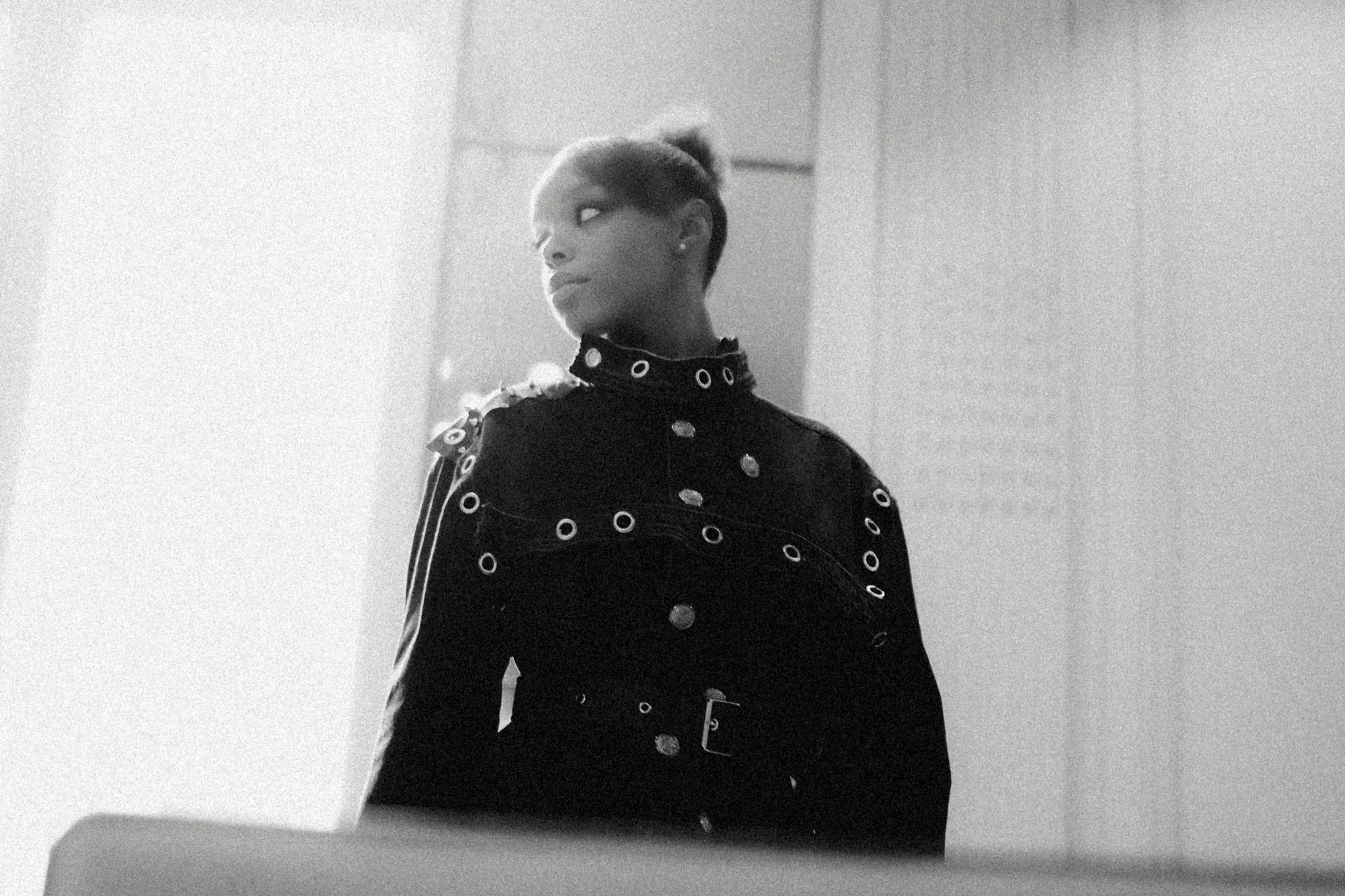
From Gdańsk, Marceli Azra looks in two directions. To the north lies Scandinavia, with its dedication to circular sourcing and pure purpose. Closer to home stand the raw concrete and massive steel cranes of the city’s post-industrial shipyards. NEO-ARMOR, the designer’s Spring/Summer 2027 collection, is what happens when those two worlds meet.
Shown at Revive Fashion Week Paris S/S 2027, the collection shapes heavy distressed denim and repurposed leather into structured carapaces. “NEO-ARMOR is the physical collision of these two realities,” Azra says. “For me, minimalism is not about empty space. It is about stripping away anything without a clear purpose.”
That clarity comes from an unexpected route into fashion. Azra’s background in Scandinavian studies and Swedish philology opened a gateway into the Nordic way of thinking, with its deep respect for sustainability and absolute functionality.
As a designer, Azra is entirely self-taught, learning garment construction and pattern making through independent practice and specialised courses. Wiktoria, Azra’s life partner and muse, graduated from a technical fashion school, and the two share what Azra calls “a fascinating flow of information”. Azra visualises the raw concepts, while Wiktoria’s precise, mathematical eye grounds them with sharp technical advice.


The carapace begins with materials that resist. “Working with heavy distressed denim and thick repurposed leather means dealing with materials that naturally want to fight the body,” Azra explains. “They are stiff and act like a wall. My job is to break that wall without losing its raw, protective energy.”
To do that, Azra sculpts each pattern around the pivot points of the body, such as the shoulders and elbows, using deliberate curved seams and darting. From the outside, a piece can look monumental, even aggressive. Inside, it respects the anatomy, and a well-built internal architecture lets even a heavy leather carapace rest on the load-bearing points of the shoulders. “The armour protects you from the outside world, while the carefully tailored interior embraces you,” Azra says.


Brutalism gives the collection its visual language, though Azra treats it as a question of honesty rather than style. Against a culture of applied motifs and forced narratives, the raw material and the architecture of the garment become the only message. “It is about grounding the wearer in a quiet, monumental strength rather than screaming for attention,” Azra says.
The references come from the heavy post-communist buildings of the region and the history they hold. Azra’s parents and grandparents lived at the fracture between two sociopolitical systems and witnessed the end of an old regime. “The ghost of that era remains deeply embedded in the structures around us,” Azra says. Rejecting the link between brutalism and cold mass manufacturing, Azra keeps full physical control over construction, turning an industrial idea into a deeply human armour.


Heritage appears in the same unsentimental way. Azra never looks to folklore or historical costume, but to posture: a regional toughness and self-reliance shaped by life among heavy concrete. The shield in NEO-ARMOR is practical. Its rigid silhouettes give the wearer control over personal space in a reality that constantly demands attention and exposure. “The armour does not hide who you are,” Azra says. “It protects your energy and allows you to navigate the outside world on your own terms.”


Every piece starts with dismantling. Working within a circular system, Azra does not begin with a blank roll of fabric, but sources existing garments and breaks them down into flat sheets, treating the denim and leather like building materials. High structured collars and monumental proportions need more than fabric alone, so each piece has a hidden internal skeleton that stops the heavy materials collapsing on the body.
Hardware locks it all together. Heavy-duty zips and massive engraved buttons sit alongside metal rings, robust carabiners and tactical clips, all working as functional joints between thick panels. “The result is a garment built with the logic of heavy machinery,” Azra says.


Azra is pragmatic about what one designer can change. The aim is not to force NEO-ARMOR into mass production, or to dismantle fast fashion single-handedly, but to work as part of a wider collective of circular designers acting as an ideological catalyst. “We are here to prototype solutions,” Azra says. The hope is that larger companies will adapt those solutions for their own supply chains.


Digital tools play a careful role in that process. Azra treats 3D modelling as an evolution of the fashion sketch, a way to study volume before touching fabric, while knowing that a render can look flawless and still ignore gravity. Once the work moves into physical tailoring, the repurposed materials set the rules. “The physical process becomes a brutal edit of the digital vision,” Azra says.

For the Paris runway, Azra anchored the show in regional heritage through sound design by the Polish music project Undertheskin, whose cold, pulsing industrial sound mirrored the heavy architecture of the clothes. With the styling, it turned the runway into an immersive brutalist experience.


The next step takes the second skin idea further. Azra is integrating authentic tattooing techniques directly onto heavy repurposed leather panels, scarring and inking the material so that each garment becomes what the designer calls “a walking palimpsest”. The leather keeps the wear of its previous life while taking on a new structural language.
Azra does not pretend that fashion can solve global conflicts, preferring to enforce ethical and structural order within a personal sphere of influence. The garments are meant to “force a moment of absolute pause”. Beyond the wearer, Azra hopes the collection becomes an open blueprint that the next generation can take apart and push further.
In that sense, NEO-ARMOR is made to be dismantled again, much like the garments it was built from.
Designer: Marceli Azra
Photography: Antoine Maokhampio (@flouuu.raw)
Photography: Alessandra Atria (@alessandraatria_photography)
Hair & Makeup: Gerardo Contreras
Hair & Makeup: Constance Ramanamamonjy
Showcase: Revive Fashion Week Paris S/S 2027
Sound Design: Undertheskin
Digital & 3D Concepts: Marceli Azra


