
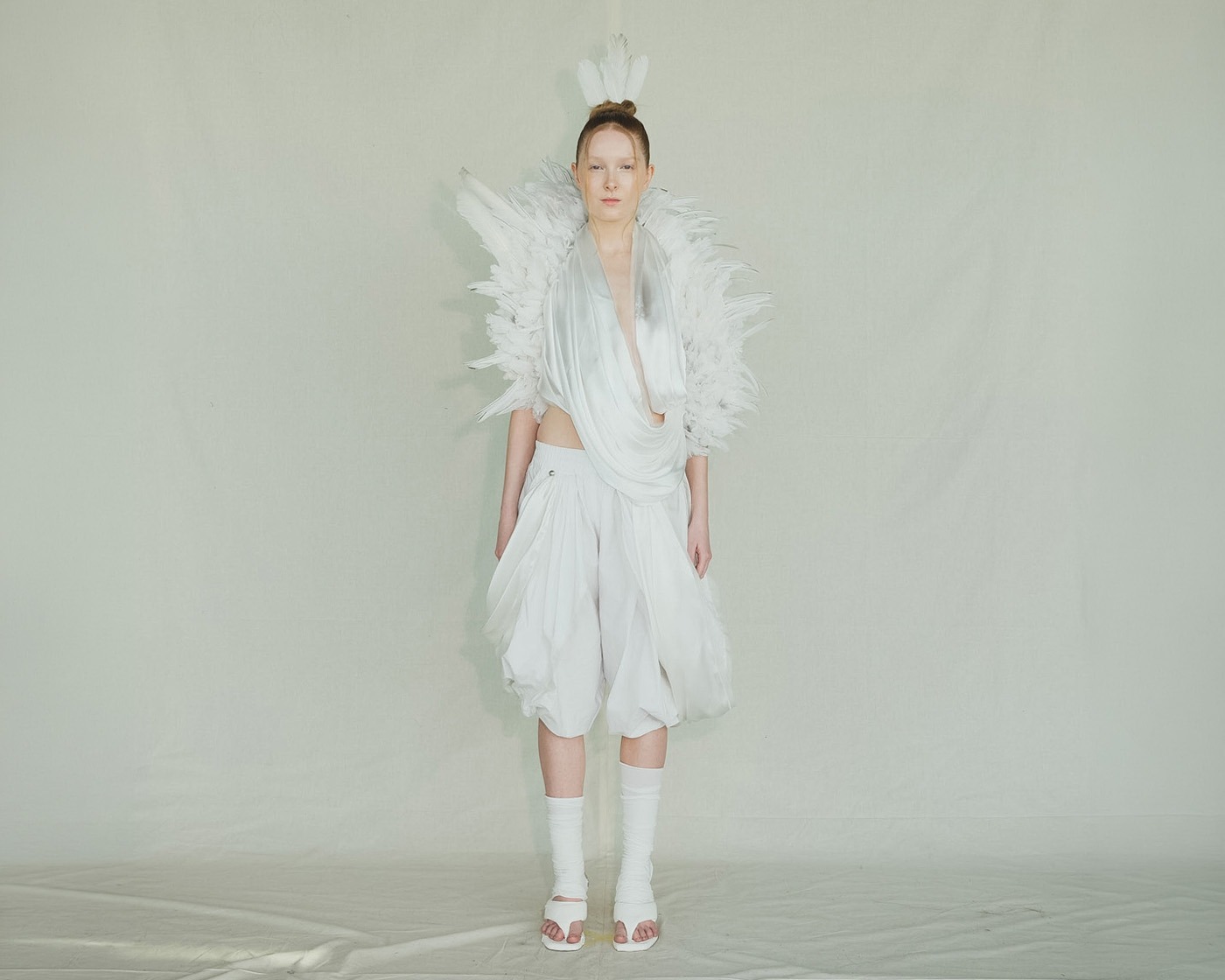
For Stella Michiko, the relationship between fragility and strength is not about two opposing qualities. Instead, her BA collection explores how the two can exist within the same object, material and person. Based in Paris and completing her BA in Fashion Design at the Iceland University of the Arts, Stella found her starting point in Saint Jeanne d’Arc, whose transformation from war hero to saint became the narrative foundation for a six-look collection. Through historical references, unconventional materials and an intensely hands-on process, she developed a collection that gradually moves from the physical world of the warrior towards something more abstract and symbolic.


Stella was drawn to Jeanne d’Arc because of the contradictions within her story. “Her life as a war hero turned saint is a perfect example of strength and fragility coexisting in the same story,” she explains. Rather than approaching Jeanne simply through historical costume, Stella began to think about how her identity could be translated into material and form. She identified three elements that became important to her research: Jeanne as a virgin, as a soldier, and the final chapter of her life, when she was burned at the stake. These ideas led her towards research into peasant clothing, fashion and military garments from Jeanne’s period, as well as historical construction techniques.


The six looks follow this research as a gradual transformation. Stella initially looked at Jeanne’s origins as the daughter of a peasant family, exploring working-class clothing and medieval pleating techniques. As the collection develops, the silhouettes begin to reflect her identity as a warrior, with references to armour and military clothing appearing alongside silk, poplin, metal structures and different construction techniques. Towards the final looks, these historical references become less literal and the body begins to feel increasingly removed from the ground.
One of the clearest examples of this shift is a vest constructed from fine metal wires and ptarmigan feathers. The wire creates an abstract wing structure around the body, while the feathers gradually accumulate across it. Rather than simply recreating the appearance of a bird, Stella became interested in the underlying structure of wings and how those forms could be translated into clothing. “For me, this suggests the transition from a physical warrior into a symbolic and almost otherworldly figure,” she says.
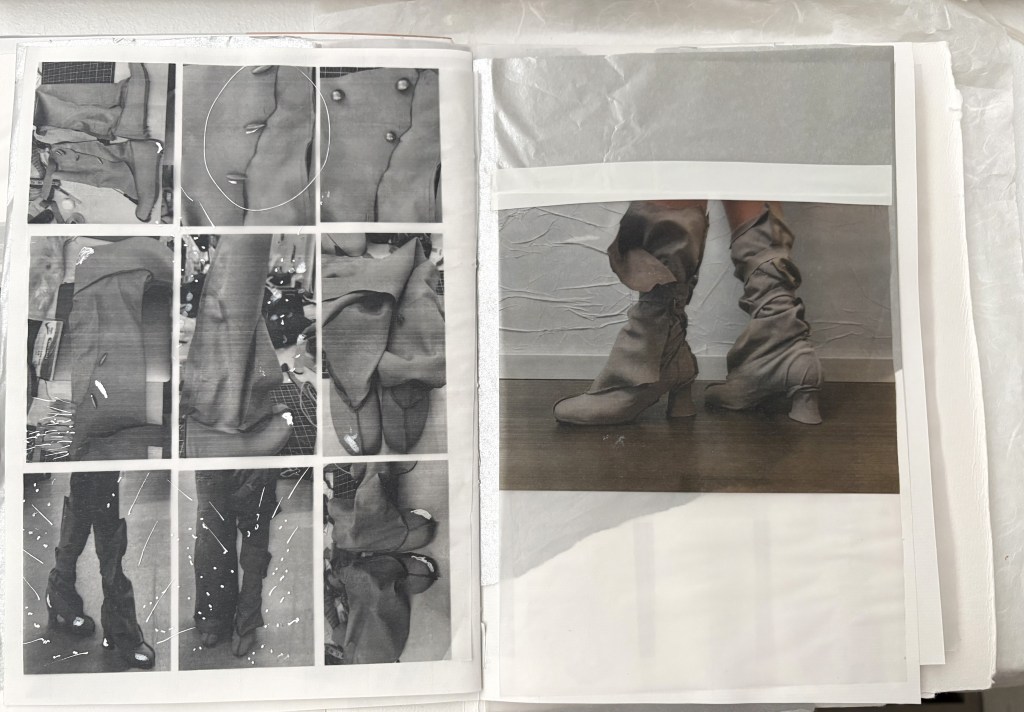
The bird became a central motif throughout the collection because of its connection to both purity and transformation. Stella studied wing bone formations and experimented with structures inspired by umbrellas, using them as frameworks for draping materials such as leather, paper and jersey. Through this process, she developed silhouettes that moved between literal and abstract interpretations. She found that the more abstract forms gave her greater freedom to create depth and allow the garments to be interpreted in different ways.
This interest in structure eventually brought her to one of the most distinctive materials in the collection: Icelandic duck and ptarmigan feathers. Rather than sourcing new feathers, Stella wanted to work with material that already existed and would otherwise have been discarded. She contacted chefs working with Icelandic ducks and collected feathers that would have been thrown away after the birds were prepared. For the ptarmigan feathers, she reached out to friends and family around Christmas, when ptarmigan is traditionally eaten in Iceland.

The process of collecting the feathers became an important part of the work itself. Stella hand-plucked them one by one before incorporating them into the garments, allowing her to develop a much closer relationship with the material. The experience also changed her perception of feathers. “Although feathers are often portrayed as something very delicate and fragile, they are actually much stronger than their appearance suggests,” she explains. “They are essentially the coat of these wild animals — their natural armour.”

That contradiction became central to the collection. Feathers are commonly associated with softness, lightness and delicacy, but Stella became interested in their original function as part of an animal’s protective coat. By salvaging the feathers and building them into garments, she transforms something that might traditionally be perceived as fragile into a form of protection. The feathers begin to operate almost like a second skin, occupying a space between the physical armour of the warrior and the symbolic transformation of Jeanne into sainthood.


This material experimentation extends throughout the collection. Silk, velvet, leather, metal wire and embroidery are combined with hand-sewing, shoemaking and other techniques, allowing Stella to explore protection, structure and vulnerability from different perspectives. Working across both garments and footwear also allowed her to consider how these ideas could change depending on where they were placed on the body.
The importance of making by hand is particularly clear in the way Stella describes her design process. Rather than seeing the finished garment as the execution of an idea that already exists, she allows the process of making to influence the direction of the work. “I discovered that my mind and my hand are very connected,” she says. “A lot develops through the process of making and that’s very important for my work.” The physical act of working with feathers, wire, fabric and other materials becomes part of the thinking itself.


This material-driven approach gives the collection a sense of transformation that extends beyond its reference to Jeanne d’Arc. The garments move between softness and structure, historical clothing and abstraction, protection and vulnerability. What begins with the image of a warrior gradually becomes something lighter and less grounded, with feathers and wire creating forms that suggest wings rather than conventional armour.
Now, as Stella moves beyond her BA at the Iceland University of the Arts, she is continuing to explore unconventional materials and develop what she describes as her own material language. She hopes to build on her hands-on approach through internships and experience in different creative environments, while developing a clearer understanding of where her practice can go next. If her BA collection is any indication, that future will remain closely connected to experimentation, craftsmanship and the possibilities that emerge when an idea is allowed to develop through the material itself.


