
If you sell clothes online into the European Union from outside it, two new charges now sit on top of the VAT you were already collecting. From 1 July 2026, a temporary customs duty of €3 applies to each item in a low-value consignment. From 1 November 2026, a separate Union handling fee of €2 also applies per item. Neither figure is a typo, and neither is charged per parcel.
That last point is the one that catches people out. Five identical T-shirts in one box are not five duties. A dress and a bag in the same box are two. The official rules are specific, and the worked examples later in this piece are clearly labelled as illustrative, so you can see how the maths behaves before you change a price list.
The two charges, clearly separated
The European Commission treats these as two different measures, and it is worth keeping them apart.
The €3 customs duty is a temporary flat fee on low-value consignments, meaning shipments with an intrinsic value of up to €150, sold as distance sales from outside the EU. It replaced the old duty-free exemption (often called the de minimis rule) that applied until 30 June 2026. According to the Commission’s guidance of 8 June 2026, the flat duty applies until 1 July 2028. After that, those goods are meant to be charged at the normal customs tariff, once the EU Customs Data Hub for e-commerce is operating.
The €2 Union handling fee is not a customs duty. It is a fee to cover the cost of processing distance-sale imports. The amount was set at €2 per item by Commission Delegated Regulation (EU) 2026/2152, and the Commission’s Customs Reform page states that it applies from 1 November 2026. Unlike the €3 duty, the handling fee is not limited to consignments of €150 or less. Official guidance says it also applies to distance-sale goods above that threshold, which already pay ordinary customs duties rather than the flat €3.
VAT is separate again. Low-value imports into the EU were already subject to VAT. These two charges come in addition, and VAT rates still vary by member state. This article does not attempt to calculate VAT for you.
What “per item” actually means
In everyday speech, an item is one garment. In the customs rules, an “item” is a group of goods in a consignment that share the same tariff classification and description, and, where the declaration requires it, the same origin. The Commission’s guidance for member states and trade (version of 5 October 2026) puts it plainly: the €3 duty and the handling fee “will automatically apply per declaration line irrespective of the quantity (number of the articles) in that declaration line.”
The Commission has also published a short official illustration. Five T-shirts in one consignment count as one item, so the duty is €3. One T-shirt and one watch count as two items, so the duty is €6. Add the handling fee on the same basis and those examples become €5 and €10, before VAT.
Illustrative examples for a small label
The figures below follow that official method. They are illustrative. They assume a distance sale from outside the EU, an intrinsic value of €150 or less, and no preferential origin claim. They do not include shipping, insurance, carrier brokerage or VAT.
Example A. A customer in France orders five identical T-shirts from your webshop. One product, one tariff line. Customs duty: €3. Handling fee: €2. Total of these two charges: €5, plus VAT.
Example B. A customer in Germany orders one dress and one bag in the same shipment. Two different products, two tariff lines. Customs duty: €6. Handling fee: €4. Total of these two charges: €10, plus VAT.
Example C. A customer in Italy orders two jackets in different fabrics that fall under different tariff codes. Even if they look like a pair, they are two items. Customs duty: €6. Handling fee: €4. Total of these two charges: €10, plus VAT.
Example D. You split what could have been one order into two separate parcels, each under €150, because the customer added a second piece later. Each parcel is its own consignment. If each parcel contains one item type, you are looking at €3 plus €2 on each shipment, so €10 across the two, plus VAT. Sending separately does not avoid the charges, and can multiply them.
For a young label, the practical lesson is simple. A one-style order is cheap to clear under this system. A mixed order, which is how many customers actually shop, adds €5 for every extra item type in the box. If your average basket holds three different products, these two charges alone are €15 before VAT and postage. That is no longer a rounding error on a €90 order.
Who has to pay, and who it applies to
The Commission is clear that both measures are imposed on business, not designed as a tax on the consumer at the door. The person responsible is the declarant: typically the seller, the importer, or their representative. In a residual number of cases a consumer may have to declare the goods themselves, but that is not the usual route for a brand selling through a webshop.
In practice, most small labels will either show the charges at checkout or fold them into the price, in the same way many already handle VAT through the Import One Stop Shop (IOSS) scheme. What you should not do is let the customer discover the bill when the parcel is held. That is the same problem independent boutiques are already having with unexpected duty invoices, which we look at in Independent Boutiques Are Walking Away From Imported Labels Over Surprise Duty Bills.
The rules apply to distance sales into the EU from third countries, regardless of where the brand is based. A label in London, New York or Seoul selling a €40 top to a customer in Spain is in scope in the same way as a large platform. Goods that genuinely benefit from a preferential trade or customs union agreement, and are declared as such, can fall outside the flat €3 duty. That is a documentation question, not a slogan on a product page, and it is one to take with a customs broker or adviser rather than guess.
What this changes in the price of a collection
The Commission’s own reason for ending the exemption is scale. It says almost 5.9 billion low-value items were shipped from third countries to EU consumers in 2025 without paying customs duties, and that the old threshold had become a competitive advantage for certain business models. The new charges are meant to narrow that gap.
For an independent label, the effect is narrower and more practical. If you already make and ship in small runs, you were never competing with platform pricing on volume. You now have a clear per-item cost to put in your export calculator, especially if you sell ready-to-ship pieces one order at a time. Mixed baskets cost more to clear than single-style orders. Returns do not automatically unwind every charge. Official guidance states that the handling fee itself is not refundable once the customs declaration has been accepted, though VAT charged on that fee may be refunded when goods are returned. Read the current rules before you promise a customer a full reversal.
If the EU is a real market for you, build the €3 and €2 into the landed price you show at checkout, keep a record of how each style is classified, and do not assume that a parcel under €150 is “duty free” any longer. It is not. For a wider view of starting prices and channels, see How to Start a Fashion Brand in 2027 and our guide to getting stocked in boutiques. Other EU rules that already affect how you describe your clothes, including green claims, are covered in What Is Greenwashing in Fashion?.
Sources: European Commission, Taxation and Customs Union, EU Customs Reform, Guidance on the €3 customs duty and Union handling fee (5 October 2026), Delegated Regulation (EU) 2026/2152, Council of the EU.
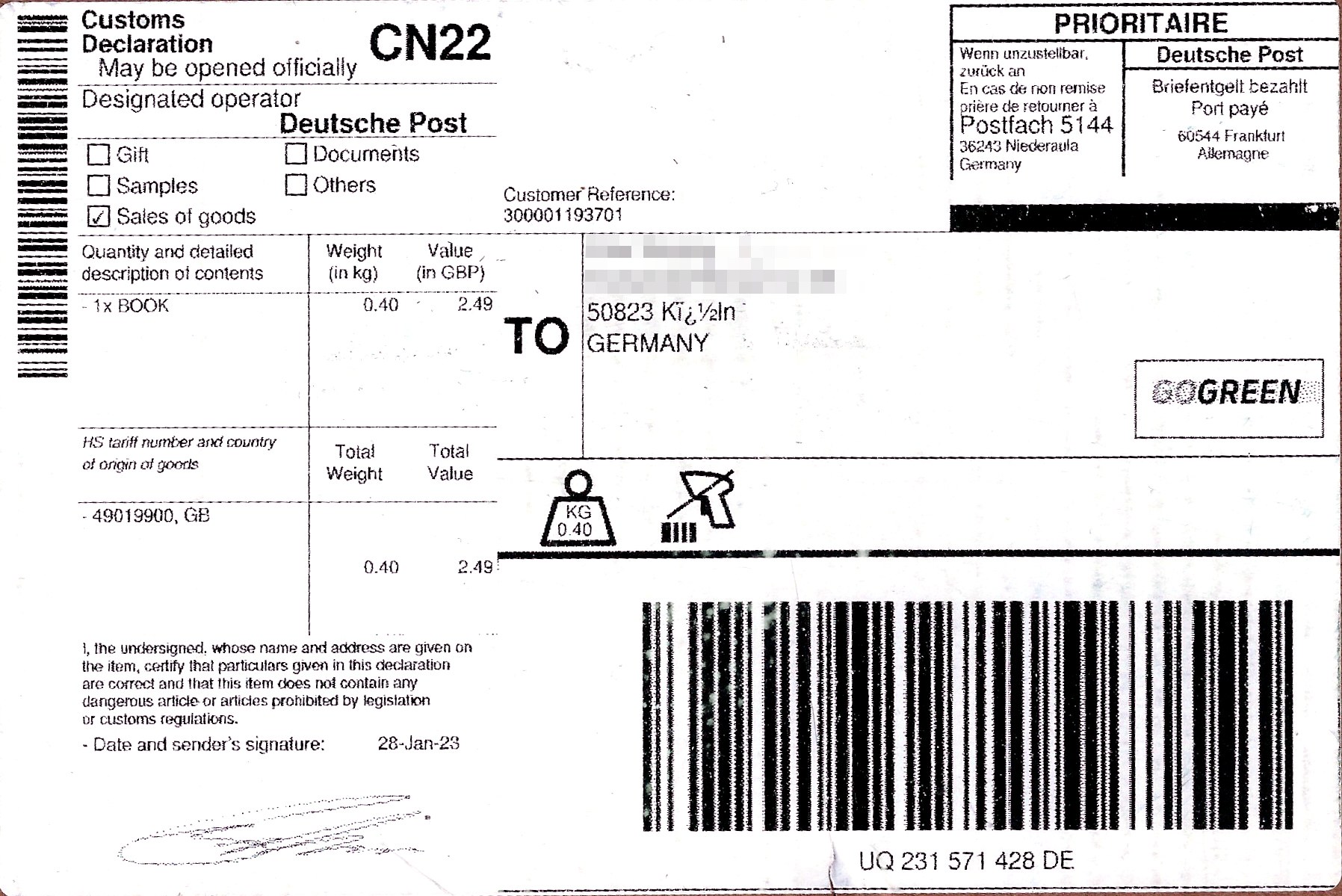
Cover: A 2023 CN22 customs declaration on a packet sent to Germany. Scan: Raimond Spekking, via Wikimedia Commons, public domain.


